

Guatemala elections: LGBT+ candidates with a sexual diversity agenda
In 2015, Sandra Morán became the first openly lesbian candidate in an election campaign in Guatemala. In the 2019 election, at least four LGBT+ candidates were running.

Share

By Pilar Salazar
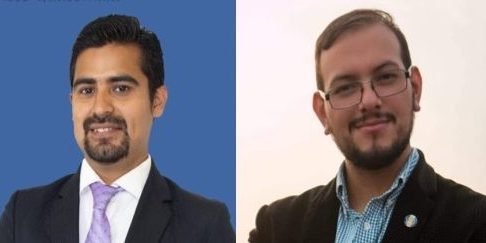
On June 16, Guatemala holds general elections—presidential, legislative, municipal, and for the Central American Parliament—with a new record number of gay men running for elected office. There are at least four visible candidates from the LGBT community: Aldo Dávila, Henry Cortez, José Carlos Hernández, and Otto René Félix.
It is worth remembering that Sandra Morán, a member of the current legislature, was a candidate for the Convergencia party and was elected as the first openly lesbian woman in the 2015 general elections for the department of Guatemala, opening the door for the involvement of LGBTIQ+ people in politics.

[READ MORE: #Guatemala The congresswoman fighting alone for LGBT rights ]
Aldo Dávila

Photo: Pilar Salazar
Aldo Dávila of the Winaq Movement heads the list of candidates for the central district. A human rights defender for 22 years, in 2016 he represented the LGBTQ+ community at the UN High-Level Panel on HIV/AIDS.
Dávila believes it's important that political parties approach her with a candidacy for elected office. She decided to accept the offer from the Winaq party because, she says, it's the movement she most identifies with. The one that "gave her dignity by offering her the top spot on the metropolitan ballot," she stated.
Political agenda
“I have my own agenda, which the party has decided to respect, because before being a congressman or a candidate, I am a citizen. Something that has guided me is the fight against corruption and impunity, but also the defense of the human rights of my peers: trans women, gay people, lesbian women, queer people, intersex people, and bringing the voice of sexual diversity to Congress, a voice that hasn't existed (apart from the voice of Congresswoman Sandra Morán).”
-How do you plan to include LGBT+ rights in the Congress of the Republic and from your party?
Among the key areas I propose to work on is the promotion and defense of the human rights of sexual diversity. We understand that there is a Presidential Commission Against Discrimination and Racism against Indigenous Peoples in Guatemala (CODISRA), but we want a National Secretariat where everyone is included. I am aiming for that, and the promotion of human rights as such. Article 202 bis of the Penal Code does not include figures representing sexual diversity, such as trans women or gay men. Because of this, there is a legal void. The intention is to promote the defense of our rights, to make us visible, and to have our identities and needs clearly defined in writing. We don't want it to simply say, "Any person who may be discriminated against or who suffers racism." We don't want this to be enshrined in the Penal Code in general terms, but rather for the specific forms of discrimination to be defined.
-How has your transition been from activist to candidate for deputy?
This is the million-dollar question, the one I ask myself every night, the one that keeps me awake at night: does being a candidate mean I stop being an activist? When I was executive director of Gente Positiva, which I led for 10 years, I did request a three-month leave of absence without pay. I'm not going to stop being an activist, I'm not going to stop being a citizen for three months while I'm campaigning; I'm going to continue demanding that the Guatemalan state and those responsible for public entities respect my human rights and the rights of my fellow activists. I'm going to continue being an activist.
Henry Cortez

Photo: Metroconvergencia
Henry Cortez approached the Convergence party through the People's Movement, which was his platform to become a candidate for deputy to the Central American Parliament.
He has been a human rights defender for the LGBTIQ+ community, children and youth for 10 years.
Political agenda
"One of the first proposals is the recognition and fulfillment of the rights of the LGBTIQ+ community. We aim to achieve a resolution where the Central American Parliament recognizes and guarantees the fulfillment of the rights of the LGBT community in Guatemala, and that this resolution is binding on our colleagues in the legislature," he told Presentes.
Cortez promises to promote the “differentiated health strategy for trans people” and the “gender identity law” initiative.
According to Cortez, his colleague Víctor Gudiel, who heads the metropolitan list for the same party, will be a key ally from the Congress of the Republic in the fight to achieve laws that favor the human rights of the LGBTIQ+ community.
José Carlos Hernández Ruano

Photo: Jorge López
José Carlos Hernández Ruano , from the founding team of the Semilla political movement, is a candidate for alternate deputy, position one, for the Central American Parliament.
An English teacher and clinical psychology student at Mariano Gálvez University, he has been interested in politics since the age of 12. At the university, he was president of the Psychology Students' Association.
He is a promoter and defender of human rights for youth, children, and women, and also prioritizes the communities that make up the LGBTIQ+ population.
Political agenda
José Carlos describes the Semilla movement as pluralistic, inclusive, democratic, and non-discriminatory. He says that they openly support the decision of transgender people to embrace their gender identity. He promises to support this initiative from the Central American Parliament and Congress, through the ISCA platform (Central American Integration System), which aims to establish a legal framework to address violence and hate crimes that the Guatemalan state fails to address.
-What challenges have you faced as an openly gay candidate?
One of the biggest challenges is the stigma and discrimination we face. There's a certain perception that we're not serious people. Our sexual orientation is judged before our abilities, in a sexist and discriminatory country. The challenge for the future is demonstrating the work we're going to do for this community.
Otto René Félix

Photo: Xun Ceto
Otto René Félix, of the Guatemalan National Revolutionary Unity Movement URNG-MAÍZ, openly gay, is proposed on the national list in box four.
Political agenda
A communications student and son of current congressman Walter Félix, he says that if elected he will promote the bill to punish hate crimes (2017). The initiative was introduced by congresswoman Sandra Morán, of the Convergence party, in the current legislation. He also promises to promote the gender identity bill (Otrans 2017).
-What will be your main areas of focus for the LGBTIQ+ population and are they included in the URNG work plan?
"From the party I represent, we formed a commission on sexual diversity where we addressed all these issues. We met with various organizations, and on every point, we concluded that it is necessary to define hate crimes and penalize them appropriately. That is why, from our current caucus, we are signatories to the initiative on hate crimes, proposed by Representative Sandra Morán. If we reach Congress, this will be one of our main tasks: to put it on the agenda and get it approved."
We are present
We are committed to journalism that delves into the territories and conducts thorough investigations, combined with new technologies and narrative formats. We want the protagonists, their stories, and their struggles to be present.
SUPPORT US

FOLLOW US
Related notes
We are present
This and other stories are not usually on the media agenda. Together we can bring them to light.