

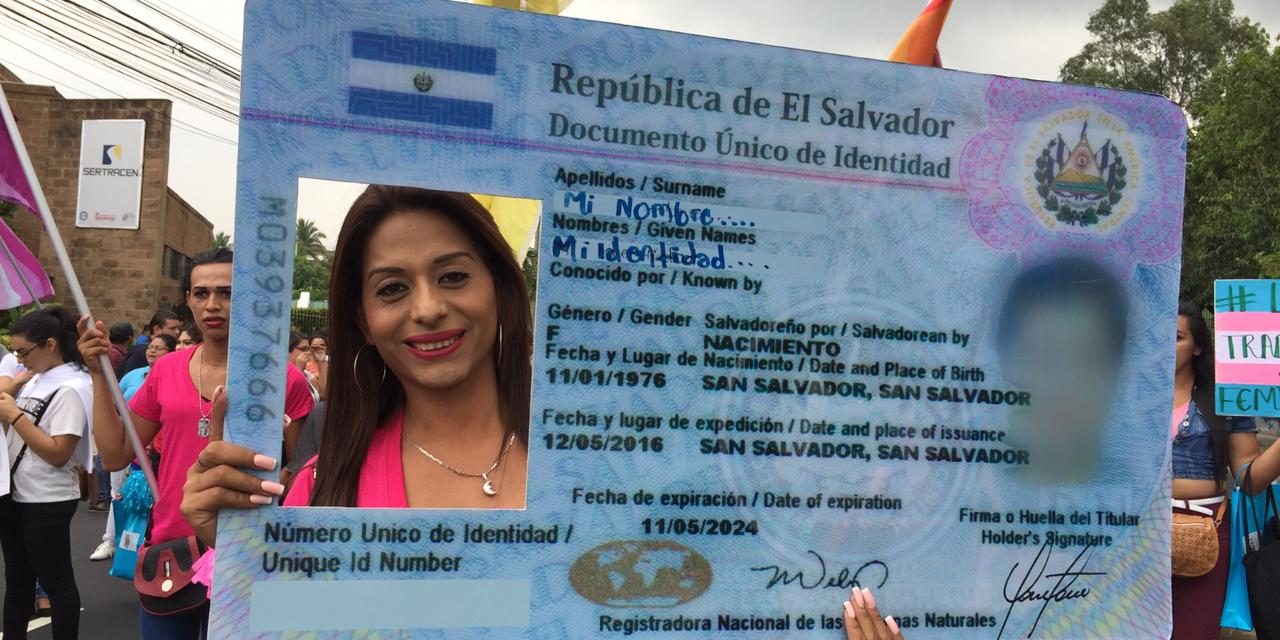
Trans people in El Salvador denounce hate and demand a Gender Identity Law
“We are being discriminated against for being transgender. We are part of El Salvador and as such we demand our fundamental rights.”

Share

By Paula Rosales, from San Salvador
Thalía Rodríguez left her home in eastern El Salvador very early in the morning. She traveled about 200 kilometers to the capital to participate in the tenth march organized by the LGBTI community against homophobia, transphobia, and biphobia on May 17, 2019.
Thalía is a 27-year-old trans woman without gender expression who has participated in every march since they began in 2009. Although she has not suffered discrimination or threats herself, she says that every year she supports her fellow trans women who have not had the same luck in the Central American country.
“For me, it represents the fight for the rights of the LGBTI community, both for those of us who are already here and for the new generations that are coming out,” she told Presentes.

Rodríguez says that although she sees progress in non-discrimination policies from the government, it is not enough. Trans women continue to be murdered.
Statistics from trans women's organizations estimate that 68 trans women were murdered between 2016 and 2019. And in very few cases have investigations progressed or gone to court .
For Carlos Rodríguez, Deputy Attorney for Civil and Individual Rights at the Human Rights Ombudsman's Office (PDDH), non-discrimination policies have also been important steps, but they are not enough.
Rodríguez indicated that her institution has documented the murders of 27 transgender women. They determined that all of these cases had characteristics of hate crimes .
“Of these 27 cases, only one involved the aggravating circumstance contained in the Penal Code. Across the entire universe, there are cases where the characteristics of a hate crime are quite obvious; that is, the homicide occurred in circumstances that give the impression that hatred was the motive for committing the crime,” Rodríguez told Presentes.
The remaining 26 cases investigated by the PDDH have been provisionally shelved by the Attorney General's Office, with very little chance of achieving justice. Of these, 21 are still under investigation and two have been brought before the courts.
“We still see an uphill battle. We see great discrimination among justice system operators,” Rodríguez stressed.
Taking to the streets

For Ámbar Alfaro, a member of the Solidarity Association to Promote Human Development (ASPIDH), going out into the streets has become an act of rebellion against a system that excludes them from all areas.
“Violence and discrimination don’t end with the murder of a sister. Violence and discrimination continue to be experienced by our families and passed on to future generations. We march for an end to violence against our trans bodies. We march against discrimination, exclusion, and being forced underground,” Ámbar reflected over the loudspeakers during the march.

The march proceeded through several streets of the Salvadoran capital until reaching the Legislative Assembly building. There, they hoped to meet with members of parliament to deliver a list of demands, including a call for the prompt approval of the Identity Law, which was introduced in March 2018.
“We are being discriminated against for being transgender. Trans women and men are part of El Salvador, and as such, we demand our fundamental rights. Without an identity law, we do not exist; without an identity law, we cannot access our rights,” said Aldo Peña, a member of Generation Trans Men, during the march.
Ámbar Alfaro explained to the alternate deputies of the party formed by the former guerrilla group Farabundo Martí National Liberation Front (FMLN), the importance of the approval of the Identity Law, which they consider to be one of the debts that the Salvadoran State has with trans people.
“The FMLN offers them its support and tells them that if we are going to champion this struggle and recognize them as a fundamental part of the country's development, this type of law will allow people to be who they are and fully show themselves as human beings, as they are, without a mask,” said Alexandra Ramírez, alternate deputy.
Share
We are present
We are committed to journalism that delves into the territories and conducts thorough investigations, combined with new technologies and narrative formats. We want the protagonists, their stories, and their struggles to be present.
SUPPORT US

FOLLOW US
Related notes

We are present
This and other stories are not usually on the media agenda. Together we can bring them to light.