

Cuba: How a historic Pride march ended in repression
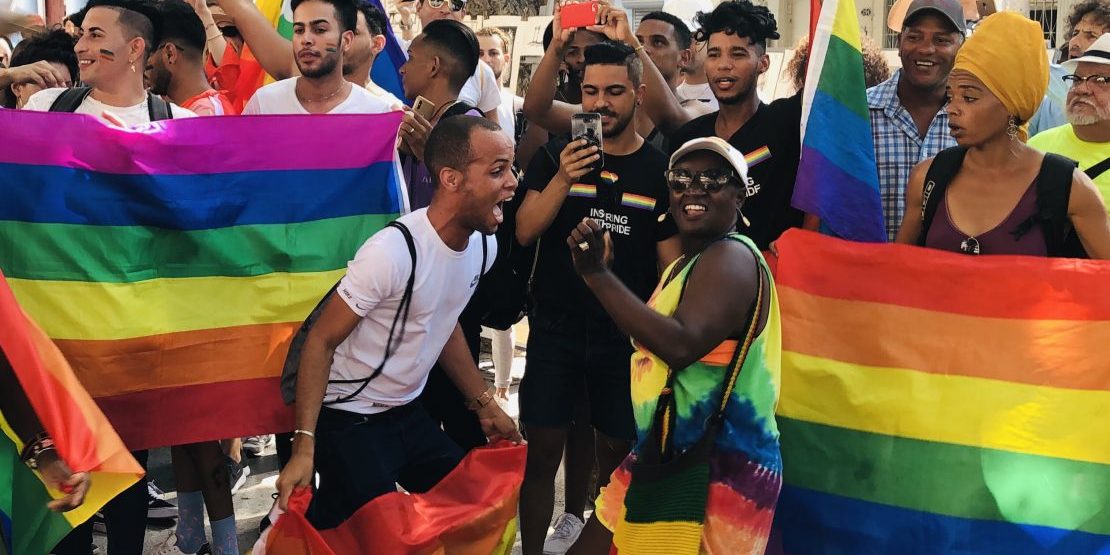
Following the impact of the march, several posts began circulating on Facebook declaring May 11 as the Day of the Cuban LGBTIQ Movement, as a "historic day", as "the Stonewall of Cuba".

Share

By Cynthia de la Cantera Toranzo for Yucabyte
For twelve years, the National Center for Sex Education (CENESEX) has organized the Cuban Day Against Homophobia and Transphobia, including the Conga. An event that, moreover, has always struck me as farcical. The Conga is the “institutional” space and time to express ourselves, to show ourselves, to, why not, to exhibit ourselves. In a way, that moment is respected. But the rest of the year, we have to adapt to the rules, to “good public behavior,” and to “good manners.”
This year, the Conga march deserved to be boycotted, as a sign of disagreement with the failed proposal to include the right to same-sex marriage in the Constitution of the Republic. On December 21, 2018, CENESEX claimed on its Facebook page that there were no setbacks, stating, among the five reasons for voting Yes , that the new Article 82 changes "persons" to "spouses," and that under this legal concept, any type of relationship can be included (two men, two women, a woman and a man). As if "persons" were a term that couldn't encompass two men, two women, a woman and a man. It's unacceptable that the very institution that supported the elimination of Article 68 now tries to defend supposed rights with the same rights that were denied to them.
Fortunately, the protest that the Conga deserved wasn't necessary. The Ministry of Public Health didn't allow enough time. On Monday, May 6, CENESEX announced the cancellation of the event on its Facebook page, using as an excuse that "The new tensions in the international context directly and indirectly affect our country and have tangible and intangible impacts on the normal course of our daily lives and on the implementation of Cuban state policies."
They didn't learn from what happened five months ago . Different situation, different context, same response. People needed nothing more than their cell phones to organize themselves.
Just hours after the cancellation of the Conga, activist Jimmy Roque, a member of Observatorio Crítico , posted on his Facebook account: “Let’s have our own march with the slogan Rights are not subject to plebiscite.”
The next day, I received a Messenger invitation for a gathering on Saturday the 11th at 4 p.m. in Central Park, Old Havana. One of the invitations was shared from Adiel González Maimó's profile, which had been posted that morning.
Organization through networks
At the same time, WhatsApp groups were created to give the event greater reach. Yasmanny Sánchez created one of them without belonging to any organization or association. "Just so people would understand why we're here today. And I'm glad because there are also people here I didn't invite," he told me at the beginning of the march.
Thanks to social media, the organization was spontaneous and immediate. Therefore, it cannot be said that the movement had a leader.
In Santiago de Cuba, similar organizing began through Facebook and private messaging, calling for a march that same Saturday at 9:00 a.m. in Plaza de Marte. CENESEX activist Manuel Lescay Céspedes posted on his wall on Wednesday the 8th: “LGBTQ+ social activists from Santiago de Cuba, we will gather for a march in favor of equality and social justice!!!!!! Against the decision not to hold marches against homophobia in 2019!!!!!”
Hours later, Lescay published the post with the event details. This post, however, does not appear on his profile at the time of writing.
The next day Lescay announced that the march would not take place, and wrote: “We will continue working to make our 12th Day Against Homophobia a complete success.”
And a few hours later, without knowing exactly what happened, he posted: “We are not willing to offer any interviews or exchanges with anyone following the cancellation of the March.”
Two hours before the march organized by citizens in Havana began, the event Marchamos created on Facebook by Yadiel Cepero had 401 people who “will attend or are interested”.
Some activists were already posting about the disappearance of Jimmy Roque and his partner Isbel Díaz, who were detained hours before the march in a failed attempt to eliminate influence. Jimmy and Isbel were released Sunday morning. “We want to congratulate everyone who demonstrated the capacity for self-organization, without the need for strong leadership,” Isbel posted.
At the time of this report, Yadiel Cepero was not answering phone calls. His Facebook profile had been deleted, as well as the "Marchamos" event.
When the march reached the end of the Paseo del Prado, when we thought everything was alright, when we felt not only freedom, but also the certainty that after that day it wouldn't matter much anymore what they thought, how they thought it, what they said, or how they said it, we decided to go all the way to the Malecón seawall to end up with a spectacular photo against the backdrop of Havana. Others would continue on to the Echevarría, the social club where CENESEX organized the big party.
Up until that point, I'd only seen police officers. But just as we crossed Prado and San Lázaro, a colonel and a lieutenant colonel appeared. The militarization of a conflict that wasn't really a conflict until they arrived.
#Cuba | This is how State Security forces repressed more than a hundred activists who dared to defy Mariela Castro's Cenesex and organized an #LGBTI in Havana https://t.co/Eumdgr0pI3 pic.twitter.com/L0e29P97Bv
— Mario J. Pentón 🇨🇺 (@mariojose_cuba) May 11, 2019
Once again, the Cuban state demonstrated virtually no concern for the methods employed. In front of accredited and unaccredited international and national press, they arrested activists Iliana Hernández, Boris González, Ariel Ruiz Urquiola, Oscar Casanella, and Yasmanny Sánchez Pérez without apparent reason or charges.
They showed they aren't worried because they believe it doesn't affect them. Yet.
Following the impact of the march, several posts declaring May 11 as the Day of the Cuban LGBTIQ Movement, as a "historic day", as "the Stonewall of Cuba".
This is one of the first demonstrations organized in Cuba by citizens through social media, and the second mobilization—remember the tornado in January—to originate in cyberspace. We've only had 3G .
And yes, it was a historic day. A day of irreverence, of love as a response to that which limits it, according to—I don't know, I don't understand, we don't understand—what definitions, what moral values, what supposed and correct behaviors.
The day of a calming kiss.
We are present
We are committed to journalism that delves into the territories and conducts thorough investigations, combined with new technologies and narrative formats. We want the protagonists, their stories, and their struggles to be present.
SUPPORT US

FOLLOW US
Related notes


We are present
This and other stories are not usually on the media agenda. Together we can bring them to light.