

An evangelical NGO is indoctrinating against LGBT people in Paraguayan schools.
An investigation conducted by the Paraguayan media outlet El Surtidor revealed that over the past 7 years, the NGO linked to the “pro-life” movement used state funds to spread false information to thousands of students in Paraguayan schools.

Share

By Juliana Quintana
Photos: El Surtidor and NGO Somos Pytyvohára
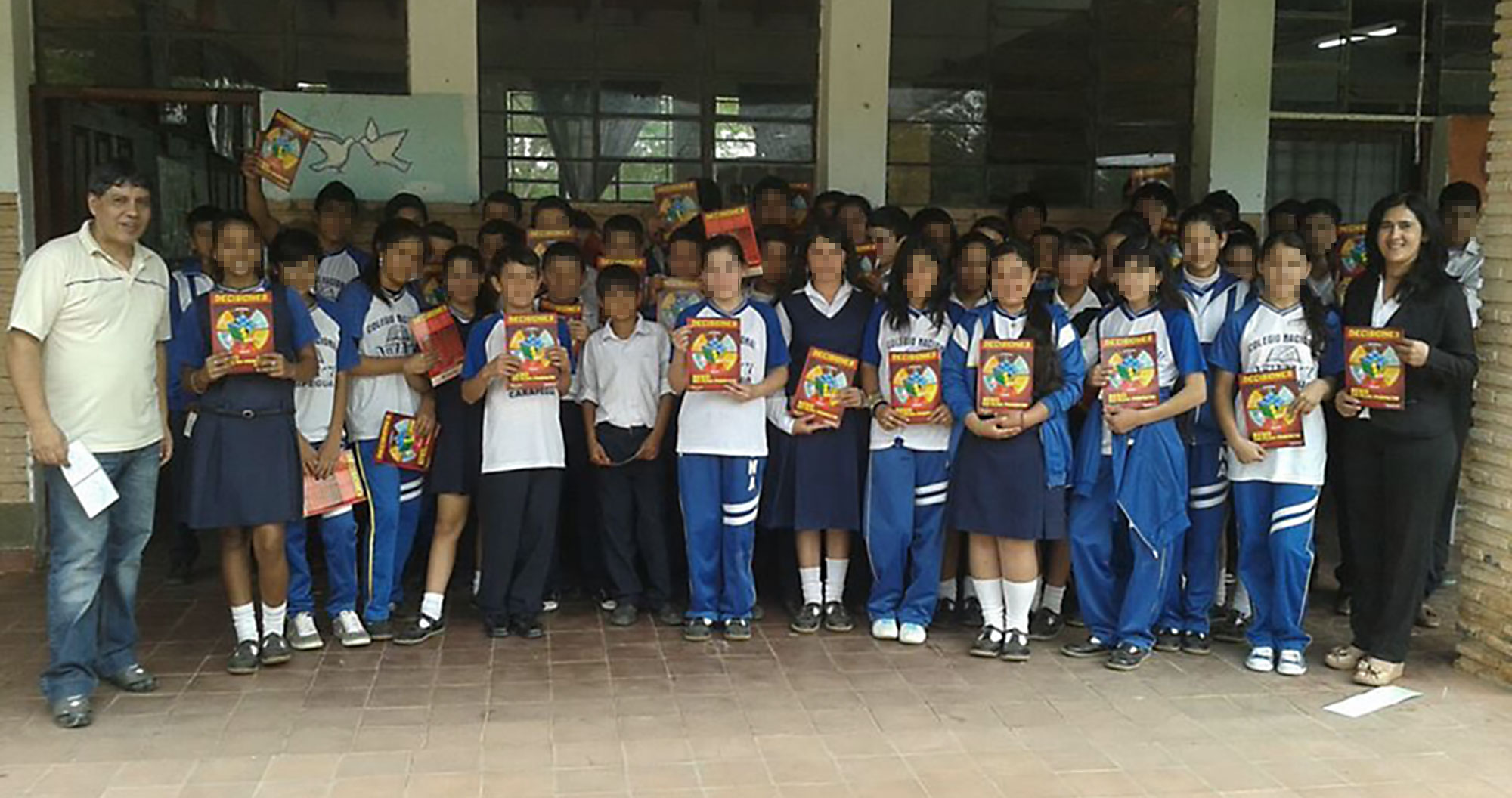
“Homosexuality is not normal. Approximately 2% of the population is homosexual. Therefore, statistically it is not normal, in the sense that it is not widespread. Furthermore, it is not normal in terms of natural function either.” This is the assertion made in the October 2017 issue of the evangelical NGO Decisiones' magazine, titled “ Sex, a Perfect Plan, ” which travels to public and private schools across the country every year, providing talks on sexuality with public funds.
An investigation conducted by the Paraguayan media outlet El Surtidor revealed that over the past seven years, an NGO linked to the "pro-life" movement used state funds to spread misinformation to thousands of high school students in Paraguay. Through talks given in schools across the country, Decisiones maintains that condoms are ineffective as a contraceptive method and as protection against sexually transmitted infections, that women are responsible for their rapes, that pornography is a degradation of sexuality, and that homosexuality is abnormal.
 Bible and childhood sexuality
 Bible and childhood sexuality
The NGO Decisiones was founded by Anton and Lolita Harder in 2002 with the purpose of “instilling biblical principles in youth sexuality.” In the 2010 magazine of the Mennonite Evangelical Center for Theology of Asunción (CEMTA), the founders stated that they had spoken to more than 250,000 students through 3,000 talks such as “Sex, Lies, and Truth.” Their official website states that they have 11 speakers distributed throughout the different departments of the country. Each speaker aims to give between 120 and 250 talks per year. The assigned salary for each talk is 220,000 guaraníes (US$36).
“When I received the first talk, the speaker said that homosexual people have a disorder or a lack of affection—in men, from their fathers, and in women, from their mothers. And that, supposedly, because I'm gay, I didn't receive affection from my father, and that's why I seek the affection he didn't give me in other men,” Jonathan Páez, 18, told Presentes. At the time, he was a student at the Andrés Delmás school in the city of Lambaré. Among the recommendations offered by Decisiones are the “rehabilitation center for homosexual people” and “conversion therapies.”
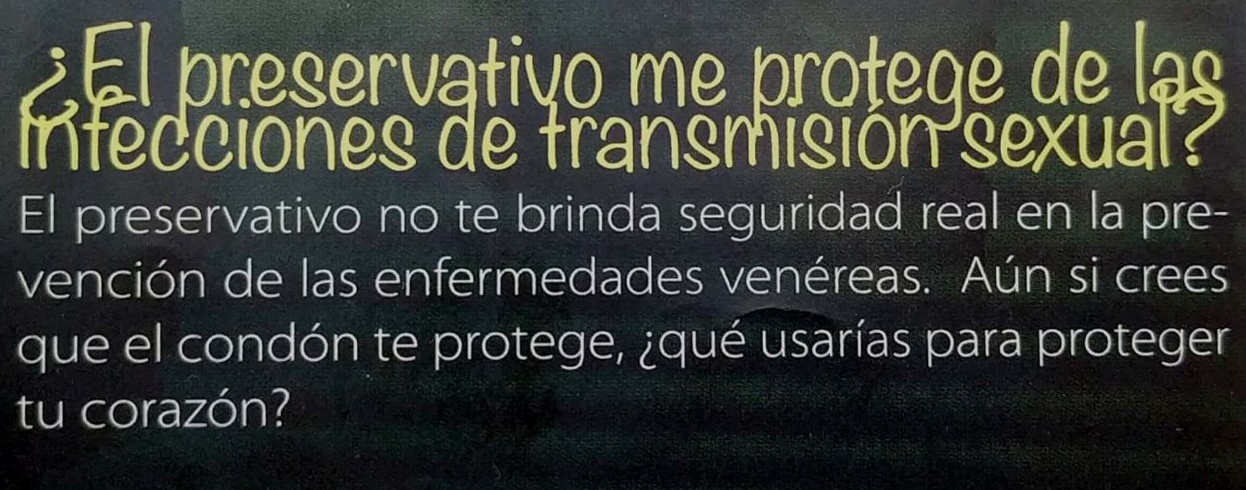 The 2018 magazine states that “homosexuality is a symptom of an emotional problem and represents unmet emotional needs.” They cite Richard Cohen as a source, an American evangelical lecturer and former psychotherapist who promoted “sexual reorientation therapies,” for which he was expelled from the American Counseling Association in 2002. According to the magazine, “the need for love from a same-sex parent,” “sexual abuse,” “a highly sensitive temperament,” and “an overprotective mother” are some of the factors that predispose individuals to “the development of homosexuality.”
In 2017, the Paraguayan Society of Psychology issued a statement regarding “sexual reorientation therapies”, where they recalled that homosexuality was removed from the list of mental disorders by the American Psychiatric Association in 1972 and from the list of mental illnesses by the World Health Organization (WHO) in 1990.
Sins and Hell
FC is 17 years old and an activist with Somos Pytyvohára . When she lived in Ciudad del Este, she received the talk at the Teniente Primero Manuel Cabello school. “I remember that the first time there were three boys and two girls; they weren't professionals. What caught my attention was that they said that people who are attracted to people of the same sex go to hell, that masturbation is a sin, and that you have to be a virgin when you get married,” she said.
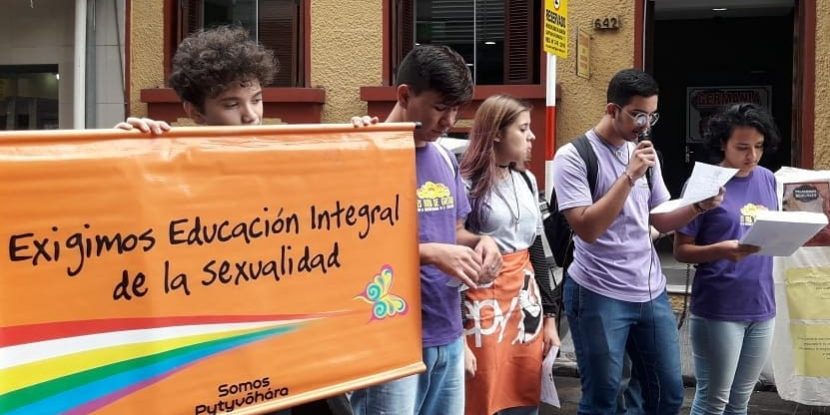
Since 2015, Somos Pytyvohara has denounced the content of the sexuality classes in the Decisiones program, but they have received no response from any of the four ministers who have held the position during this period, including Eduardo Petta, the current Minister of Education. On April 4, they protested in front of the Ministry of Education and Science (MEC) building and demanded comprehensive sexuality education. “The information provided in the magazines they give to students is unscientific,” Jonathan stated.
María Belén González received the lecture from seventh grade through ninth grade at the Saturio Ríos Regional Education Center, which has 6,000 students in total. It is one of the largest schools in Paraguay. “Once they showed images of supposed abortions, of babies seven, nine months old, and it was horrible. That was their method of scaring us. You felt like there was no way out,” she concluded.
Before entering the lectures, students were asked to leave their backpacks and cell phones outside the auditorium. The lectures were held as part of various subjects related to Health and Ethics and took place during class time. “The speaker who talked to us at my school said that same-sex relationships are an illness, that they are wrong, and that people with homosexuality should seek treatment at the nearest church or in a rehabilitation center,” Jonathan said.
Conversion therapies
 Conversion therapies
Conversion therapies for LGBT people were considered by the Inter-American Commission on Human Rights (IACHR) in 2015 as “a possible form of torture.” In Paraguay, “conversion therapies” are not legally prohibited, unlike in countries such as Brazil and Argentina.
For Ana Portillo, a researcher and member of the education team at the Paraguayan Peace and Justice Service (Serpaj), there is a relationship between the repression of sexuality, rigid gender roles, and a militaristic culture. “When young people express themselves in different ways and question established societal norms, the response is to send them to mandatory military service and promote more authoritarian forms of education. What lies behind this fear is the need to control the population.”
The Ministry vetoes a guide for teachers on Comprehensive Sexuality Education (CSE).
According to the latest data from the Ministry of Health, in Paraguay, two births occur daily to girls between the ages of 10 and 14. There are also 53 births daily to adolescents aged 15 to 19, and six reports of child abuse are filed daily. According to the Gender Directorate of the Ministry of Health, this percentage jeopardizes the health and life prospects of girls and adolescents. In this context, last December, Serpaj launched a sexuality education guide for teachers.
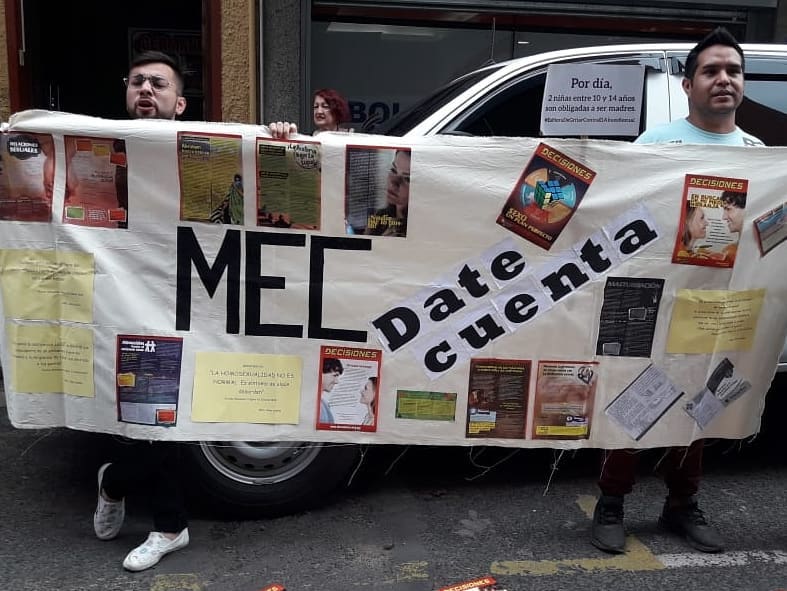 In March of this year, the Ministry of Education and Culture (MEC) rejected the guidelines, arguing that they established "libertine concepts that even contradict the provisions of the National Constitution." Serpaj had an agreement with the MEC that began last year, and since then, negotiations had been conducted through letters and requests for meetings to renew the agreement. This coincided with the change of government, and from that point on, Serpaj was not received by Minister Eduardo Petta or the deputy ministers, nor did they receive an official response regarding the renewal of the agreement.
There are two important precedents regarding the rejection of Serpaj's materials. The first dates back to the period between 2010 and 2011, when the Ministry of Education and Science (MEC) was finalizing the pedagogical framework for sex education in schools. However, the process was interrupted by the first wave of anti-rights protests, which culminated in the repeal of the framework.
The second precedent was the resolution issued by the previous Minister of Education, Enrique Riera, which prohibited the distribution of materials on “gender theory and/or ideology” in schools. At the hearing, the Minister asserted that the Paraguayan Constitution defines marriage as being between a man and a woman, and upholds traditional family values. And in response to pressure from anti-rights groups demonstrating that day, he declared: “I can burn the books with you in the plaza.”
The Ministry of Education and Science (MEC) vetoed the guide but, at the same time, allowed the distribution of the magazine Decisiones, which did not undergo the same institutional process. Yesterday, El Surtidor reported that Decisiones renounced public funding this year. But until the Ministry of Education issues a statement on the matter, in Paraguay, the evangelical group will continue giving talks to teenagers in which they maintain that "homosexuality is a symptom of some disorder" and that "anyone who has sex can be exposed to an STI."
We are Present
We are committed to a type of journalism that delves deeply into the realm of the world and offers in-depth research, combined with new technologies and narrative formats. We want the protagonists, their stories, and their struggles to be present.
SUPPORT US

FOLLOW US
Related Notes
We Are Present
This and other stories don't usually make the media's attention. Together, we can make them known.