

The trial for the transfemicide of Marcela Chocobar begins
More than three years after the hate crime, the accused will be tried for the transfemicide of Marcela Chocobar in Río Gallegos.


Share

Report by Belén Manquepi Gómez, from Río Gallegos (Santa Cruz)
Photos: Presentes Archive/Luli Leiras and BMG
More than three years after Marcela Chocobar was last seen alive, the two men accused of murdering the 26-year-old trans woman will stand trial in Río Gallegos starting May 21. They are Ángel Azzolini and Oscar Biott.
“We hope that the judges, the prosecutors, and society will stand with us. That the truth will come out and that we can learn what happened. Depending on the verdict, we will be able to find some peace and finally bury the part of my sister's body that we have,” said Judith Chocobar. To this day, all that has been found of Marcela is her skull. Also, a white boot, her jacket, and a blonde wig. But her body has still not been found.

That's how they last saw her
When someone asks what Río Gallegos is like, one of the main answers is precisely its tranquility. In the capital of Santa Cruz province, robberies are not characterized by violence, and homicides are not as frequent or regular as in other cities. Some residents of Río Gallegos still leave their doors unlocked. When a violent incident occurs, it has a profound impact.
In Río Gallegos, nightclubs are only open on weekends and holidays. There are only four clubs in the city center. The others are located further out, and by municipal ordinance, all must close at 6:00 AM on weekends. Just one block from the riverfront is the Russia Bar pub, the last place Marcela was seen alive.
On September 6, 2015, at 6:30 a.m., security cameras recorded her getting into a red Renault 9. When Marcela didn't return, her sisters filed a missing person report, but it took 48 hours for them to file a formal complaint. Eight days later, on the morning of Monday, September 14, 2015, skeletal remains and other evidence indicating that Marcela was dead were found. Fifteen days passed before the forensic laboratory confirmed on September 29 that the remains belonged to the young woman. That same day, three men were arrested while driving a car matching the description of the one recorded by the cameras.
The search
“We thought she might be trapped in trafficking networks. Because of the marginalization inherent in sexual exploitation, it’s easier to capture women who are already marginalized. We thought she might still be alive. Then, when the skull was found, more leads started to fall into place,” Paula Nauto, a member of the Las Rojas group, which supports this case, tells Presentes.
On October 5, 2015, following an operation in which more than 80 kilos of drugs were seized, then-Governor Daniel Peralta, accompanied by the top police brass, held a press conference. When asked about Chocobar's murder, Peralta stood up and left, leaving the Chief of Police, Commissioner General Salomón Aleuy, to give a brief response.
In this scenario, where neither the family nor the press had any information about the progress of the investigation, the Chocobar sisters threw themselves into the fight. “The family had been following the trail of trafficking networks, of prostitution. They were outside some brothels, watching who went in, who came out; the family itself acted as investigators,” Paula recalls. It was the same path that Susana Trimarco, Marita Verón's mother, followed for years when she investigated her daughter's disappearance in Tucumán.

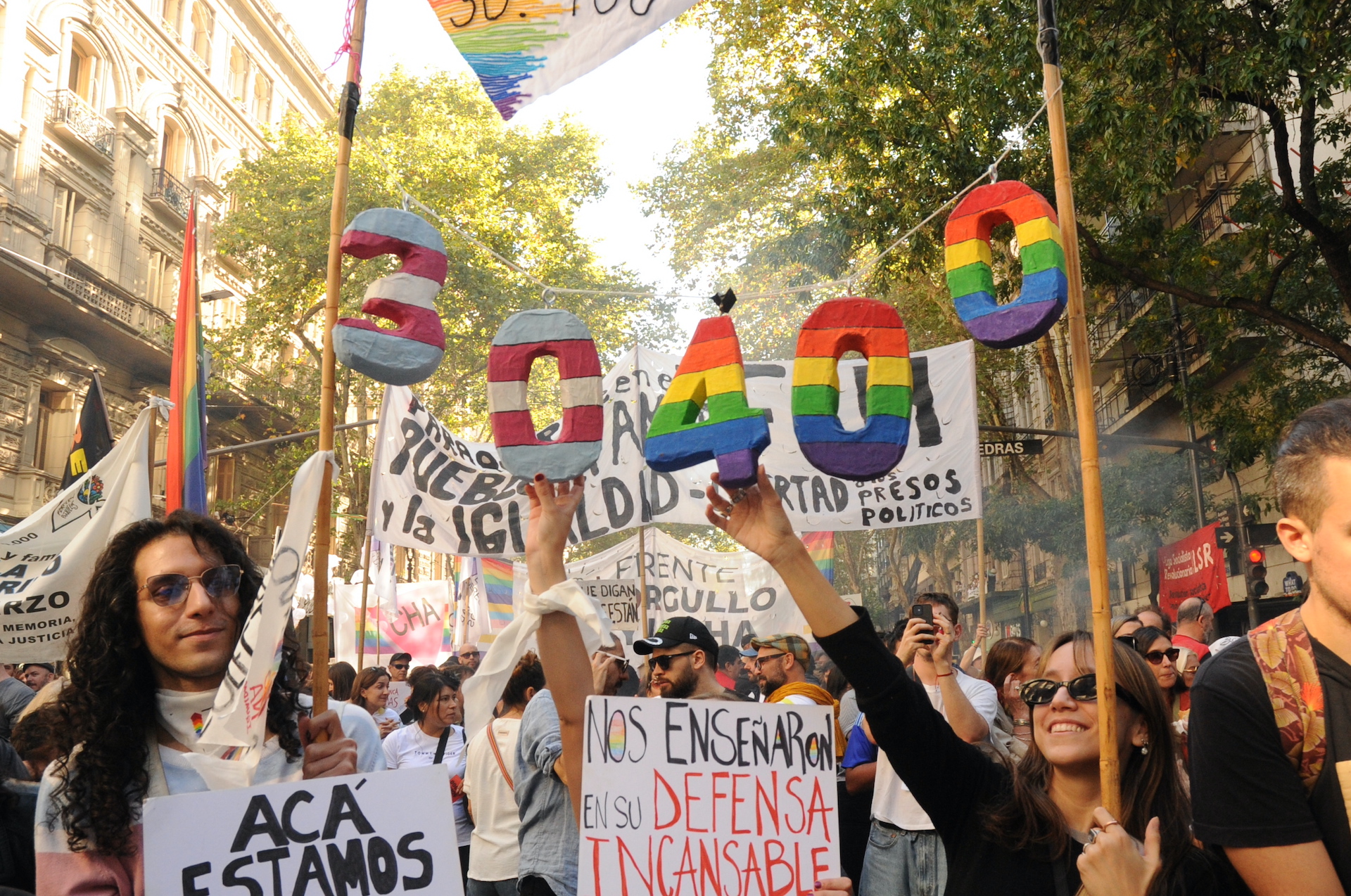
Demand for Justice for Marcela Chocobar at the Ni Una Menos march in Río Gallegos.
She also recalls a family search in the San Benito neighborhood. “I estimate two months had passed. They knew she was dead, but they hadn’t found her body. They went out with sticks and rakes to search; it was terrible, because it meant they had no support from the State or the Justice system. They were alone, facing the search for their sister’s body,” Paula remembers.
Alba Rueda of the Trans Women's Network, who accompanied Marcela's sisters from Buenos Aires, says: "I was deeply moved by the cruelty; it seemed like a terrorist message to the entire trans community, both because of how they had treated her and also because of how they had tried to cover up the traces of those responsible."
What will the trial be like?
On March 8th, Marcela's sisters announced that the court had confirmed the trial was scheduled for May. The official notification finally arrived a few days ago.

Detained since April 18, 2016, Ángel Azzolini, held in pretrial detention in Puerto San Julián, and Oscar Biott, in Río Gallegos, will appear in court starting May 21. They are accused of aggravated homicide or cover-up and simple homicide, respectively. Adrián Fioramonti was also detained at that time, but was released on bail and acquitted due to "lack of evidence." Although not among the accused, on August 23 of last year, he threatened one of Marcela's sisters . A criminal complaint was filed against him in Court No. 2.
- Still without a new building after it burned down in 2015, the oral proceedings will take place in a small room of the Criminal Court.
- According to Presentes, there are more than 50 witnesses. They anticipate that the hearings will last for at least a week.
- The trial will begin on Tuesday, May 21st at 09:00 at the headquarters of the Criminal Chamber of the First Judicial District .
- The court is composed of Jorge Yance (president) and Joaquín Cabral. The third member has not yet been confirmed.
Regarding the long wait for a trial date, Judith Chocobar, Marcela's sister, said: “The process has been endless; it's very agonizing. It's overwhelming to keep thinking about what happened to her. Why don't they put themselves in the shoes of the family members who are demanding justice? Knowing the date has brought us some relief, but it also means continuing to wait for that day. All my sisters and I are anxiously awaiting what will happen that day when we see them for the first time. It's a pain that has already taken root in the family; no one can heal it. Depending on the verdict, we will be able to feel that peace and also finally bury the part of her body we have and move on from that grief. We hope to have the peace we need. We hope that the judges, the prosecutors, and society will stand with us. That the truth will come out and what really happened.”
"There is an unequal administration of justice."
For activist Alba Rueda, “justice isn't a fraction; it translates into a judicial system where there are different standards depending on the publicity surrounding the events. Despite the family's significant mobilization and visibility, they couldn't transcend the provincial level. This is evident in the apathy and the lack of effort made by the courts to address the issue. I believe there is a very unequal administration of justice and transphobia within the judicial system. This involves not only issues of expert testimony but also the visibility of these types of crimes. Demanding justice today for Marcela Chocobar means facing a trial where only the presence and demands of social organizations will be able to sway the judicial system.”

Alba Rueda, at the march against transvesticide, October 2018, Trelew, Argentina.
A hatred that persists
Social transvesticide—the killing of trans people due to lack of access to basic rights such as health, education, and work—is not foreign to Santa Cruz. Regarding the exclusion of trans people, Paula recounts that “when a mural was painted, there were comments on social media denigrating it for being trans and a sex worker. But this is a recurring situation when someone is a victim; a reactionary response emerges, with all the negative connotations some people attach to being a woman and being trans.”
To advise that the debate be conducted with a gender perspective, the National Institute for Women will present an Amicus Curiae.
Regarding expectations, the member of Las Rosas stated: “ We hope the trial will bring visibility to the marginalization experienced by trans people, who are dying because of marginalization, prostitution, and stigma . Regarding Marcela's case in particular, I also hope that political responsibility will be addressed in this trial. If it isn't, we women will organize and start bringing it to the forefront. Political responsibility is fundamental, not only for the perpetrators, but also for those responsible who must be held accountable.”
We are present
We are committed to journalism that delves into the territories and conducts thorough investigations, combined with new technologies and narrative formats. We want the protagonists, their stories, and their struggles to be present.
SUPPORT US

FOLLOW US
Related notes


We are present
This and other stories are not usually on the media agenda. Together we can bring them to light.