

Colombia: First collective reparation for LGBT+ victims of the conflict
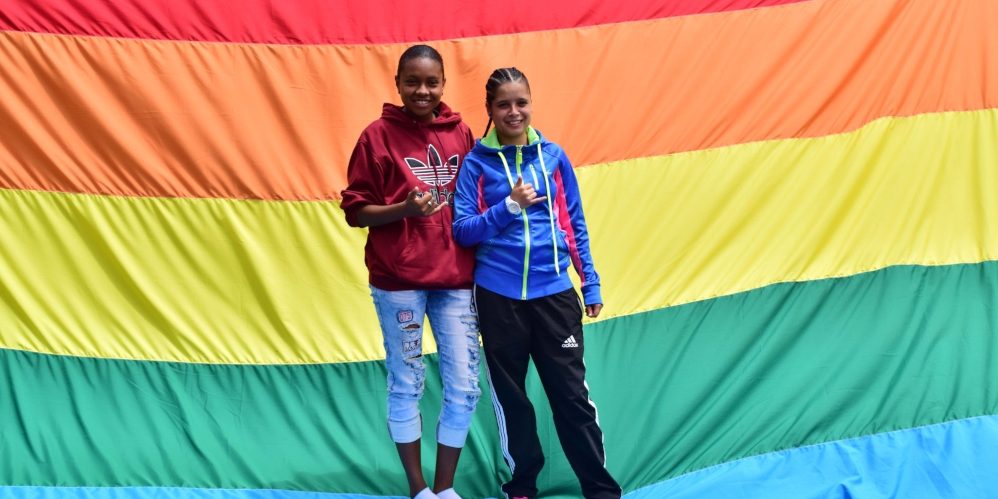
The LGBT Roundtable of Commune 8 in Medellín is the first sexual diversity organization recognized as a Subject of Collective Reparation in the Colombian armed conflict.

Share

The LGBT Roundtable of Commune 8 in Medellín was the first organization from the LGBTQ+ community to be recognized as a Collective Reparation Subject within the framework of the Colombian armed conflict. Just one step away from signing the country's first reparations plan for LGBTQ+ communities, the ongoing dispute with the State continues.
By Julio C. Londoño A. for Hacemos Memoria *, from Medellín (Colombia)
Photos: Julio C. Londoño A. and the LGBT Committee of Commune 8 of Medellín
In January 2016, the LGBT Roundtable of Commune 8 in Medellín became the first LGBT organization to be recognized as a Collective Reparation Subject (SRC) within the framework of the Colombian armed conflict. Although the law stipulates a six-month period to begin implementing a Comprehensive Collective Reparation Plan (PIRC) following this declaration, the organization has faced a series of institutional obstacles that have delayed the process.
For Jhon Restrepo, one of the founders of the Roundtable, reparations have been a constant struggle with the State to find common ground. “The State is not prepared to provide reparations for the LGBT community because it seeks to maintain a system, a model, and not transform it. Reparations policies have a restorative approach that seeks to return to victims their place, their material possessions, their symbolic value, their dignity. But in our case, what are they going to return to us? We are seeking the right to inhabit, move about, live, be, and act in any setting,” Restrepo asks.
That has been the struggle since the LGBT Roundtable was formed in the Esfuerzos de Paz neighborhood in 2007: to transform a territory historically marked by war and forgotten by the state. Since then, community work has begun to unite and give visibility not only to LGBT people in the district, but also to other excluded populations, such as Afro-Colombian people who have arrived displaced to this territory from other regions of Colombia.
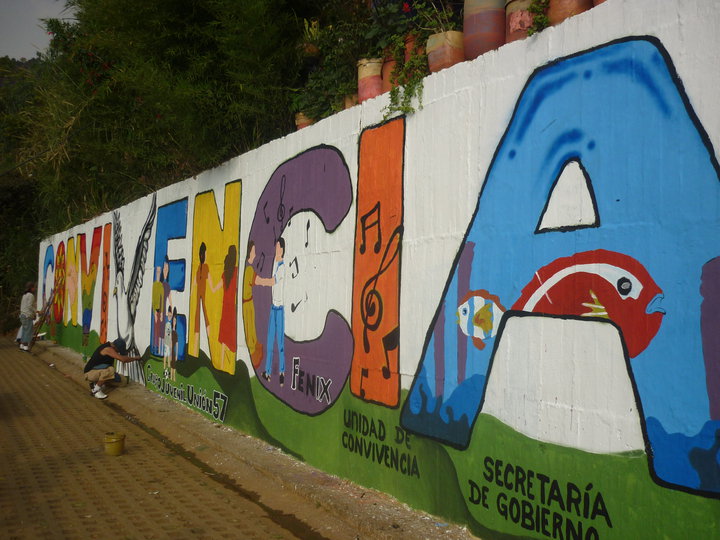 However, the movement, which once boasted 33 young people, was halted by the paramilitary groups vying for control of Medellín's eastern hillside. As July Gutiérrez, a member of the Mesa, recalls, in 2010 nearly 150 families were displaced from the commune. Around that time, the Mesa members had been called upon to repaint a mural that read "Adolfo Paz, thank you for pacifying the comuna," in honor of the paramilitary leader Don Berna. "CONVIVENCIA" (coexistence), painted in the colors of the rainbow flag, was the word that replaced the armed groups' message. The mural didn't last a day. Only a small message survives: "Insist, Persist, and Resist because the only option is not war," from which the armed actors crossed out the "NO" to symbolically reaffirm their power.
Harassment, physical attacks, and threats became a constant for the members of the Mesa and a warning to the LGBT population of the commune. That same year, a group of men identified as being under the command of Julio Perdomo, former leader of the 'Caicedo' criminal group, beat several members of the Mesa who were preparing the first Carnival for Life and Sexual Diversity in the commune. The message was that blood and feathers would flow if the march took place. And although the event went ahead as an act of resistance with police support, the Mesa would disintegrate due to the displacement its members subsequently faced.
In total, there are 51 collective damages that the Roundtable identified in its process and that were recorded in the damage diagnosis document that the UARIV closed in July 2018. A process that took longer than budgeted because, as Colombia Diversa stated in a 2018 report , the Roundtable initially faced a lack of diligence and transparency in the processes carried out by the Unit for Comprehensive Attention and Reparation to Victims (UARIV).
On the one hand, there were logistical problems and a lack of communication regarding certain adjustments the Unit made to the Plan. On the other hand, the limited experience and sensitivity of public officials on issues related to gender and sexual diversity led the members of the Roundtable to repeatedly recount their experiences of victimization and explain how these events were related to their sexual orientations and gender identities.
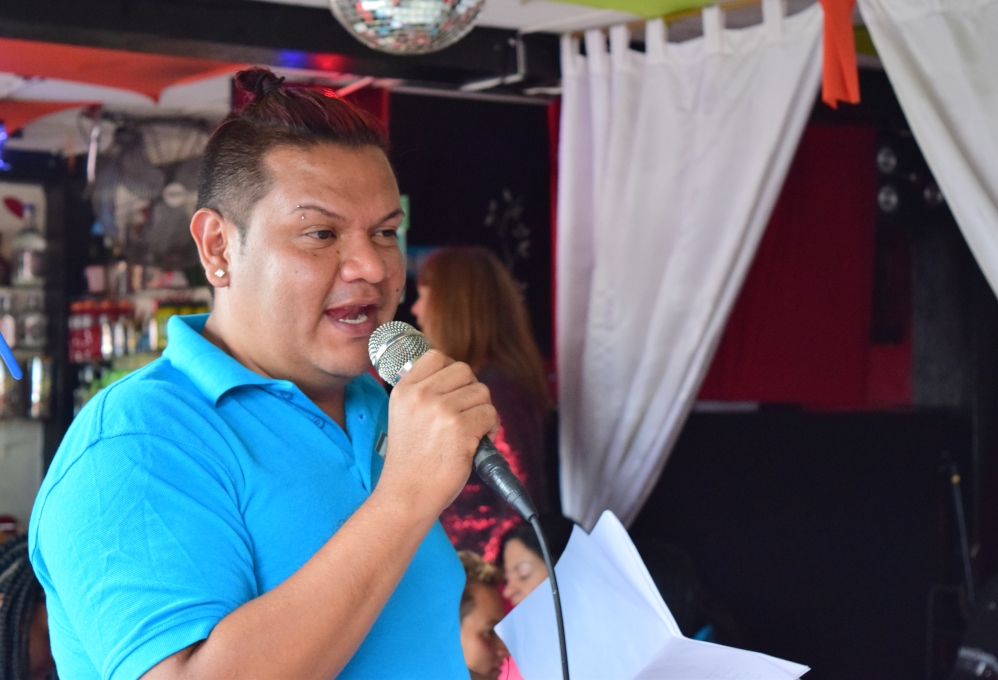
Jhon Restrepo, co-founder of the LGBT Roundtable of Commune 8 of Medellín
As Colombia Diversa explains in its report, unlike ethnic or racial communities, whose collective practices are rooted in traditions, “lesbian, gay, bisexual, and trans people do not in any way constitute […] a community of subjects with uniform characteristics or life experiences or with a shared worldview. On the contrary, people with diverse sexual orientations and gender identities have used the acronym LGBT as a form of political enunciation, as an umbrella category, in order to make visible a shared root of exclusion and discrimination—the heteronormative system—but not an identical way of inhabiting or understanding the world.”
Therefore, providing reparations to the LGBT community requires commitments from the State to transform the discriminatory conditions that enable violence against them. As the report by the National Center for Historical Memory (CNMH), " Annihilating Difference ," explains, the war did not invent violence against sexually diverse people, but it did exacerbate it, and armed actors imposed their moral orders in the territories they occupied.
In this sense, despite the expectation surrounding the plan's implementation, Jhon Restrepo considers it a defeat that the UARIV, as coordinator of the National System for Comprehensive Attention and Reparation to Victims (SNARIV), has assumed full responsibility for the reparation process, leaving out other institutions such as the Ministries of the Interior, Justice, Health, and Education. These institutions would be forced to create real public policies to address the historical problems of the LGBT population, whether or not they are victims of the conflict, with the aim of guaranteeing that what happened with the Roundtable will not be repeated.
“There is a possibility that the plan will not be finalized or that it will not be feasible in budgetary terms, because it depends on the fiscal situation of the Victims Unit, and this unit is being dismantled. This is especially true now that it is being proposed that there is no conflict,” Restrepo explains. “Currently, the resources come exclusively from the Unit. This prevents us from addressing structural and fundamental issues because other agencies, such as ministries and secretariats, have been left without any responsibility. This affects a fundamental issue, which is the guarantee of non-repetition, and in that sense, it undermines the law itself,” he adds.
One of the institutions that most supported the Collective Reparations Roundtable was the National Center for Historical Memory (CNMH), which had promised to accompany and fund part of the implementation process of the Comprehensive Reparations Plan (PIRC). However, according to Restrepo, the change in leadership of this organization, now headed by historian Darío Acevedo, led to a breakdown in the relationship. “The gender team within the CNMH was dismantled. For LGBT communities, it is now risky to be there and entrust our memories and our processes to an institution that no longer represents the victims. On the contrary, today there is an attempt to deny the conflict and, even more so, what has happened to us. Today, it is not an institution that we, the victims, recognize as a legitimate body and a safe space.”
In this sense, Restrepo's opinion is that ultimately it is social movements that have taken on and built what the State has failed to guarantee them. Therefore, the PIRC (Integrated Plan for Rehabilitation and Integration) includes a rehabilitation strategy for the LGBT community that can be implemented by the Mesa (Table). Even though a public policy exists for the LGBT population of Medellín, it rarely materializes in the city's outlying districts. "The Voice of Bodies" will be the program through which the Mesa hopes to create safe spaces and forums for dialogue for LGBT people.
“These gatherings and collectives are spaces for transition, understood not from a transgender perspective but in terms of constructing diverse identities,” Restrepo explains. “The absence or destruction of these spaces leaves the population without any protective environment or guarantees, leading to countless problems. That's why we want to create spaces for encounters through body art , radio exercises, physical expression, dance, body mapping, and more. We will also have resources for aesthetic activations in public spaces and audiovisual components for these gatherings.”
Another component they hope to develop is a training program certified by a local university to train LGBT-focused psychosocial support workers, both members of the Roundtable and other interested individuals. “Who hasn’t had a friend come to them with a problem with their family because they came out ? Or a relationship issue, sexual abuse, in a park, in a nightclub? Who has the tools to address that? That’s why we want to create these support networks and safe environments for the LGBT community,” Restrepo explains.
Part of the plan also includes a line item for the adaptation and expansion of Casa Diversa (headquarters of the LGBT Roundtable of Commune 8) and the preparation of a human rights report on the LGBT population of Medellín.
Only the signing of the final PIRC document is needed, which is expected to be ready within the next two months and would cost approximately 900 million pesos to be implemented over three years. However, given that the Victims' Law is set to expire in 2021, there is a high risk that the Plan will not be fully implemented if the law is not extended.
*We Make Memory is a project based on the agreement between the University of Antioquia and DW Akademie for the promotion of historical memory.
Share
We are present
We are committed to journalism that delves into the territories and conducts thorough investigations, combined with new technologies and narrative formats. We want the protagonists, their stories, and their struggles to be present.
SUPPORT US

FOLLOW US
Related notes
We are present
This and other stories are not usually on the media agenda. Together we can bring them to light.