

Salta: Police attacked a trans woman in the middle of the street
A police officer assaulted a 23-year-old trans woman in Salta. A march is being organized to demand an end to institutional violence.

Share

By Elena Corvalán
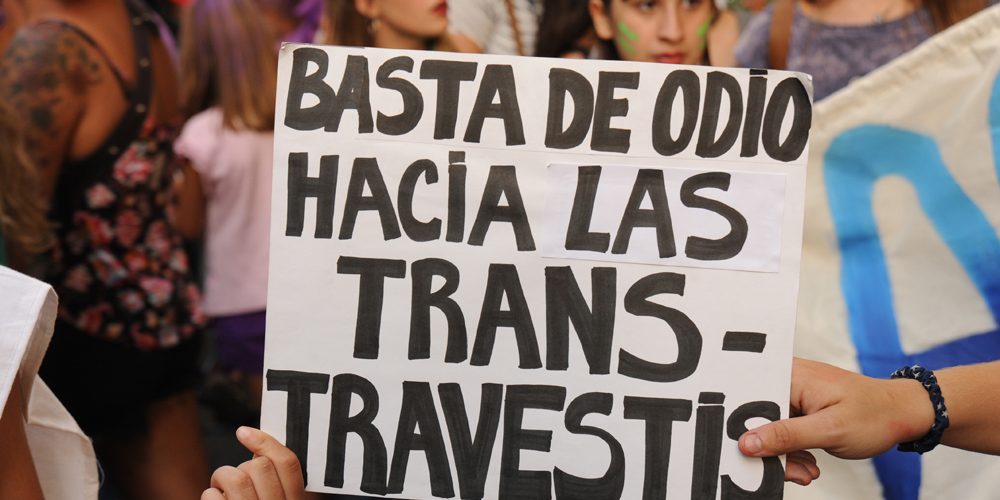
A police officer assaulted a 23-year-old transgender woman in the city of Salta, leaving her with bruises and a laceration on her head. The attack occurred on Wednesday, April 17, around 1:30 p.m., on San Martín Avenue at number 2800, in the Islas Malvinas neighborhood, near the tourist-friendly Artisan Market. The victim and a friend were walking to the friend's home. LGBT+ organizations in Salta announced they will hold a demonstration to demand an end to institutional violence.
According to V. (the victim), in the complaint she filed at the Villa Asunción police station, three or four police officers in a patrol car intercepted them on the street. Amid insults, they ordered them to "move on." Later, after they had left the busiest part of San Martín Avenue—as stated in the complaint—one of the officers got out, insulted them again, and attacked V. with a baton.
“Why are you doing this to me? I’m going to report you,” the young woman tried to defend herself. The aggressor got into the patrol car and drove off. None of the other officers called for help for the victim, even though she was covered in blood.
As best they could, V and her partner, J, walked to the home of trans activist Renata Gabriela Soto, who lives in the area, and asked for her help. She accompanied them to file a police report, called an ambulance from the provincial emergency service (SAMEC), and publicized the incident on social media.
The police officer who assaulted them has not yet been identified. V and J described him as a tall man (approximately 1.80 meters), with a muscular build, wearing a dark blue police uniform with a vest, but without a badge. They also failed to see the number on his cell phone.
Soto noted that while they initially received good treatment at the Villa Asunción police station, after waiting a reasonable amount of time for the ambulance to arrive, she contacted the 911 emergency service herself. They then told her they had not received any request from the police station. Finally, the ambulance arrived and took the young woman to San Bernardo Hospital, where she received treatment.
“The worst injury was to his head, but his head and his whole body hurt; he had bruises all over. I experienced it firsthand; those blows hurt a lot,” he said.
Transphobic attack in broad daylight
V. lives with her mother and siblings in the humble Santa Rita neighborhood. She doesn't have a cell phone, so Soto planned to pick her up today so she could be examined by a forensic doctor. Soto recounted that V. and J. were very frightened by the police officer's actions. He emphasized that it's not common for a transphobic attack to occur in broad daylight.
“It surprises me that this is happening during the day now. Because at night we see these massive operations, and we're kind of used to seeing girls running, falling, and being mistreated,” Soto said. The activist stated that the police often take trans women to the Judicial City (located in the far north of the city, far from the center).
“They release you there as a minor offender and you have to walk back (…), sometimes having to wait for a bus, or hitchhike, or find a way to get back downtown. It makes me feel so helpless because we should be looking for other ways for our fellow LGBTQ+ people to find work in other fields; the government needs to be more present ,” she added. She said there are no initiatives in this regard from the provincial or municipal governments, only the national government with the Ellas Hacen program, which is enabling LGBTQ+ people to complete their primary and secondary education.
Soto, 33, earns a living as a caregiver for the elderly and supplements her income with sex work. “I’ve been on the run since I was 16,” she says. She recently managed to buy a small car, which she uses to avoid police violence and to help trans women who also suffer such treatment. The activist said there are “many girls from the provinces; I’ve noticed there are more girls, and young women.”
The Salta Transparency Group (GTS) and the Association of Transvestites, Transsexuals and Transgender People of Argentina (ATTTA) of Salta issued a statement of condemnation yesterday: “ Why so much violence and persecution towards our group, which only wants a space in society and respect for what is a human right and to live with dignity? ” they asked.
They march to demand their rights
Trans activist Mary Robles announced to Presentes that they will hold a march next week to demand respect for their rights. There are “employment problems, health problems,” and also “a problem of police persecution.” “The girls can’t find work, they don’t have a dignified life, and no matter the time of day, they’re being arrested. The institutional violence against us cannot be allowed ,” she emphasized.
“Who are you going to complain to when you have a high demand and the police don’t act? If even the judge doesn’t act, then that ’s the problem we’re having, and it’s even more serious this year, which is political , where truly terrible things are happening because, in the end, between not having work and the situation getting more intense every day, what are we supposed to do if we don’t really achieve full citizenship?” she added.
Robles emphasized that the current economic and social crisis is felt most acutely by the LGBT+ community. The trans women (referring to the victims of the attack) don't even have phones. “We are on the verge of destitution, just beyond the point where we can have any hope of being human, of having a better life, or perhaps we simply can't,” she lamented.
Police abuses every night
Pía Ceballos, from ATTTA Salta and one of the directors of the Observatory of Violence Against Women, also told Presentes that they are organizing a mobilization to protest institutional violence. “ Police abuses against trans and travesti women happen every night. Isolated cases have occurred in different neighborhoods where they can't walk during the day because they are either harassed or detained, and it's the neighbors themselves who come out to defend the trans women,” she described.
“We have a police force that not only uses rhetoric against trans identities and doesn’t respect the names of our trans sisters, but is also extremely violent. Trans people in Salta are not living in a democracy today . With the events that happened today, we can’t feel safe, sleep peacefully, or move around freely in this province,” she asserted.
The assault was reported to the Sexual Diversity Unit of the Provincial Undersecretariat of Gender Policies, headed by Victoria Liendro, and to the Provincial Secretary of Human Rights, Federico Uldry. This was done so that progress could be made in identifying the assailant and the other police officers who failed to act, and so that sanctions could be imposed.
Salta, the most violent province for LGBT people
According to the latest report from the National Observatory of LGBT Hate Crimes of the Ombudsman's Office of the City of Buenos Aires, in conjunction with the Argentine LGBT Federation, the province of Buenos Aires, the Autonomous City of Buenos Aires (CABA), and Salta register the highest number of attacks against LGBTI people. "It is no coincidence that large urban centers concentrate the highest number of hate crime cases in the country, given the notable migration of LGBT people to these areas due to the significant stigma and exclusion associated with belonging to the LGBTQ+ community in smaller cities," the report states. The report highlights the correlation between population and hate crimes in the province of Salta, as this jurisdiction has a considerably lower population density than Buenos Aires and CABA, yet it ranks third in the number of cases, with almost half the number of hate crimes as CABA. "We can infer from these results that Salta is the most hostile province to the LGBT community and where the most hate crimes occur in all of Argentina, in proportion to the number of inhabitants."
We are present
We are committed to journalism that delves into the territories and conducts thorough investigations, combined with new technologies and narrative formats. We want the protagonists, their stories, and their struggles to be present.
SUPPORT US

FOLLOW US
Related notes
We are present
This and other stories are not usually on the media agenda. Together we can bring them to light.