

State violence against trans people: the health system leads the complaints
According to a report based on complaints, 46% were assaulted in hospitals, and the second largest group, with 36%, was the police.

Share

By Paula Rosales from San Salvador
Photo: ASPIDH Trans Rainbow
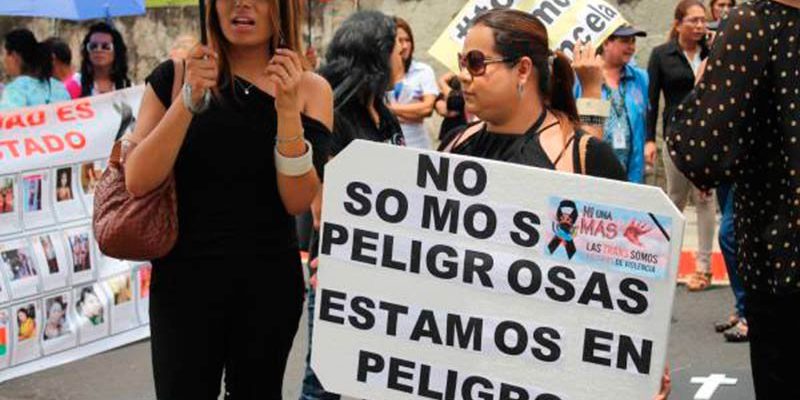
According to the report “Stop trans genocide”, prepared by the Solidarity Association to Promote Human Development (ASPIDH Arcoiris Trans) and the Latin American and Caribbean Network of Trans People (REDLACTRANS), in El Salvador trans women continue to be subjected to violence by state institutions.
This is confirmed by the results of a study conducted in 2018 based on complaints from trans women who reported that they suffered some type of discrimination and harassment from state institutions: 46% in hospitals, 36% in the Police, 6% in the Armed Forces and mayoral offices, and 3% in universities.
“The doctor and nurses didn’t want to call me by my name.”
Sandra N., 26, went to a public hospital in San Salvador for a consultation due to severe abdominal pain, possibly caused by a liver tumor. Instead of professional care, she was met with mockery and mistreatment from staff, nurses, and doctors. She is one of many trans women who have reported aggression and discrimination, but for fear of reprisals, she prefers not to reveal her identity or further details.
“When I arrived at the emergency room, the cleaning staff mocked me, and I was writhing on the floor in pain. After they treated me, the doctor and nurses refused to call me by my female name. The next day, they admitted me to the women's ward, but the cleaning staff started shouting that I was a man, and a nurse told me I didn't belong there and kicked me out. I was still dizzy,” Sandra told Presentes.
According to her account, when they took her to the men's ward, she suffered harassment and intimidation for a night. “They started attacking me: they said they had brought in a faggot and that they were going to sleep soundly that night. They made me cry with how they treated me,” Sandra said. “I got up and went to tell the doctors to take me out of there. I felt very harassed, and one doctor, treating me like a man, told me that if I wanted to leave, I should just sign and go. They didn't care about the discrimination,” she said.
 READ MORE Hate crimes in El Salvador: two trans women murdered in one week
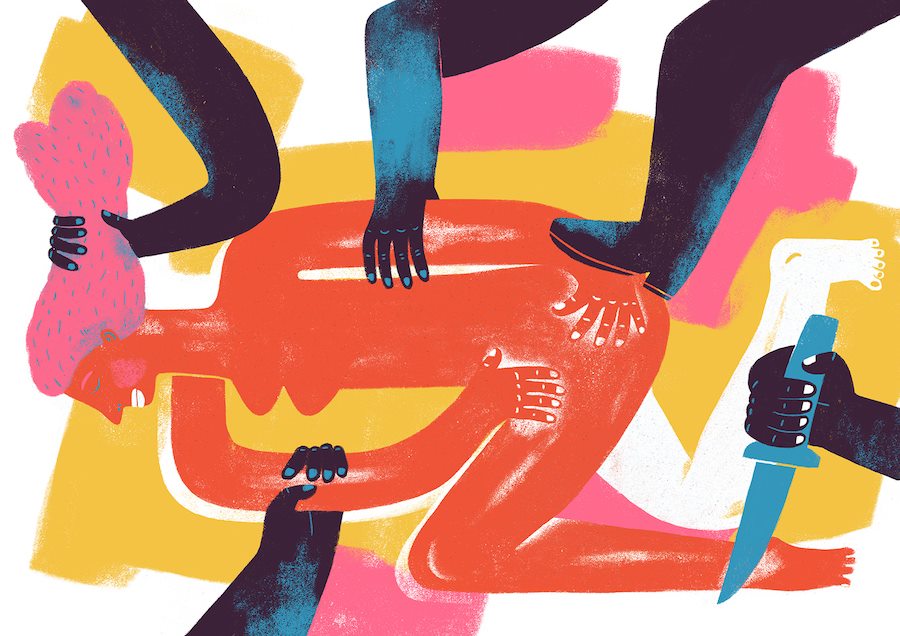 READ MORE Hate crimes in El Salvador: two trans women murdered in one week
Interference from religious groups
Although the current government of leftist Salvador Sánchez Cerén adopted measures to reduce and eradicate discrimination in public institutions towards people of the LGBTI community, the changes are insufficient according to ASPIDH.
For the trans women who participated in the preparation of the report, discriminatory acts in state institutions are due to "moral fundamentalisms caused by the interference of religious groups and the inability of public officials to carry out their work with a human rights approach."
Dr. Ana Isabel Nieto, head of the national STI and HIV program at the Ministry of Health, says that the Government created a tool for reporting violations of the right to health and that units have been created in all hospitals to handle and resolve complaints.
Nieto points out that the first healthcare guidelines for LGBTI people were created in 2010 with the participation of trans women's organizations: the guidelines were disseminated, and the women themselves acted as facilitators. “Eventually, these cases of discrimination occur. The problem we have is the high turnover of healthcare personnel, and the university doesn't prepare them to understand these guidelines. There is still work to be done in providing comprehensive care for trans women because there aren't enough specialists to address their diverse needs,” Nieto told Presentes.
Security, another challenge
Another public institution with a high number of complaints is the National Civil Police, with 36%. One of the complainants said she was abused, arrested, and paraded naked while a group of police officers filmed her with their phones.
“I was intercepted by a patrol car with three police officers, they proceeded to beat me and steal my belongings. When I defended myself, I was seriously hit on the eyebrow with the butt of a pistol and threatened that if I reported it they would kill me in my own home,” said the complainant.
The police force of the Central American country was formed after the signing of the peace agreement that ended 12 years of civil war (1980-1992), which left 75,000 dead and 8,000 missing.
“I would like to tell the associations that attention will be given to the reported cases, and those that may occur will be given more specific, faster, and less bureaucratic treatment in the territory,” the deputy police commissioner, Ever Manzano, told Presentes.
LGBT migrants flee gangs
A previous study by ASPIDH, titled “Waiting for Death,” indicated that between 2016 and 2017, gangs were the primary perpetrators of human rights violations, accounting for 60% of reported cases. Among the crimes committed against transgender women, threats represent 35%, physical assaults and beatings 19%, and murders 28%. Since 1993, an estimated 603 transgender women have been murdered.
However, there are no disaggregated statistics for the LGBTI population nor official figures on transfemicides: authorities justify this deficiency by arguing that there is no gender identity law that would allow for the identification of trans victims. The report also points to the need for Congress to approve a bill introduced in 2018 that would recognize gender identity as an essential element for trans women and men.
READ MORE Karla Avelar: “In El Salvador there is a genocide of LGBTI people”
José M. is an 18-year-old trans man who fled in one of the caravans seeking to reach the United States. He says he decided to emigrate because he received death threats in the municipality where he lived, and three trans women had already been murdered in 2017: “I have suffered many threats and discrimination. Where I live, trans women and transvestites have been killed. They said they were going to wipe them all out, and they did. We don't know who killed them. Some say it was gangs, the police, or the military; we don't know who it is,” he explains to Presentes.
We are present
We are committed to journalism that delves into the territories and conducts thorough investigations, combined with new technologies and narrative formats. We want the protagonists, their stories, and their struggles to be present.
SUPPORT US

FOLLOW US
Related notes
We are present
This and other stories are not usually on the media agenda. Together we can bring them to light.