

First Congress on Inclusive Language: words for everyone
The First Congress on Inclusive Language of the province of Buenos Aires will be held in La Plata on April 11 and 12.

Share

By LC
The First Congress on Inclusive Language of the Province of Buenos Aires will be held in La Plata on April 11 and 12. With the motto “From the @ intervening in writing to 'todes' as a way of organizing ourselves,” the event is an initiative of the Buenos Aires Ombudsman's Office, sponsored by the Faculty of Humanities and Education Sciences of the National University of La Plata (UNLP).
“We are seeking to reach some conclusions about what is happening with the deconstruction of language and the attempt to make it more inclusive. It is happening in the streets, in schools, in art, in the media, which have begun to communicate in an inclusive way,” says Karina Nazábal, Secretary of Gender, Childhood and Adolescence Policies of the Ombudsman's Office of the province of Buenos Aires and one of the organizers of the meeting.
The activities, which are open and free, will take place between 10:00 AM and 6:00 PM at the Karakachoff Building of the UNLP (National University of La Plata), located at 48th Street, No. 566. The Congress will be conducted through workshops and thematic discussions (see the full program below). "The congress will be a space to denounce the invisibility of women, transvestites, and sexual dissidents in language, for centuries," says Nazábal.
From Presentes , we will be participating in the discussion “ The Power to Name, the Named Power,” on Thursday the 11th at 2pm . The panelists will be María Eugenia Ludueña, co-director of this agency, Gabriela Barcaglioni (Red PAR), Liliana Viola (Soy Supplement, Página/12), Cynthia Ottaviano (UNDAV. Postgraduate Program in Inclusive Communication and Non-Sexist Language), and Nadia Portillo (Todes Program, UNLP).
 A language with bodies
 A language with bodies
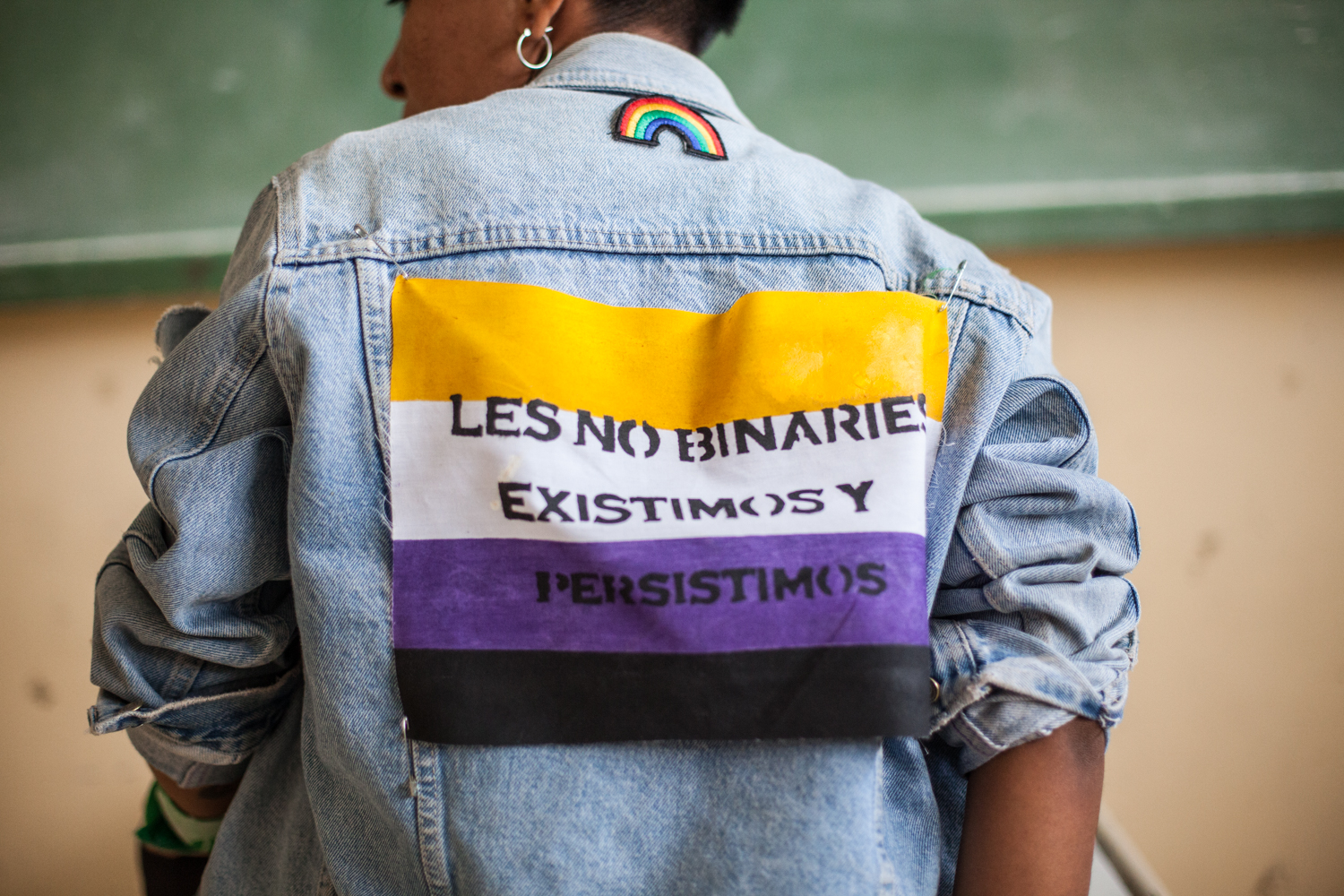
Among the panelists is Gabriela Mansilla, mother of a trans girl and founder of the organization Infancias Libres (Free Childhoods). “ We want a new language that also incorporates the body. Because bodies speak, and it's necessary to include them. In addition to questioning language, we also question education. We have to talk about the trans body in education, name it. The Comprehensive Sex Education Law (ESI) was necessary and revolutionary, but it doesn't address this,” she denounces.
Mansilla exemplifies: “Instead of saying ‘male reproductive system ,’ we want to talk about the fertilizing genital system and not assign a gender to an organ and its natural function—that is, to name it without gender. When we talk about menstruating bodies, we seek to avoid assigning a feminine character to menstruation, so that our trans masculinities who menstruate—and it is natural and healthy for them to do so—do not feel rejected. Inclusive language is not just about using the ‘e’; bodies speak, and they are not respected.”
From kings to commoners
Drawing a parallel with the last Congress of the Spanish Language, held in Córdoba in March and attended by the King and Queen of Spain, Nazábal says: the Congress of Inclusive Language is 'from the kings to the commoners'. He explains that monarchies “came to impose a language with bloodshed upon us commoners, attempting to construct another language, because words permeate us from before we are born.”
Nazábal points out: there are identities, such as transvestites, that were not mentioned for years. “Transvestites and trans people had to wait a long time to vote, many years after women, because they were registered on the electoral roll without their identity being recognized.”
The transvesticide of Diana: language, visibility and justice
On this point, Say Sacayán, an activist with the Anti-Discrimination Liberation Movement (MAL) and brother of trans activist Diana Sacayán (murdered in 2015), says that the landmark ruling that convicted one of his sister's killers was the first to use the term "transvesticide." This word, which didn't exist in the courts before, "we brought it into the fold, and from then on we were able to talk about the vulnerability and violence suffered by the trans community, because, as Lohana said, what isn't named doesn't exist. And that non-existence makes all the community's problems invisible," said Say, who will be at the Congress on Thursday the 11th at 11 a.m., at the panel: Condemning Hate, Naming Transvesticide.
Also present will be Luciana Sánchez, the prosecuting attorney in that trial; Mariela Labozzeta, from the Specialized Prosecutor's Office for Violence against Women and LGBT+ (UFEM, who was also a prosecutor in the trial) and Juan Kassargian, who represented the INADI (National Institute against Discrimination and Xenophobia) prosecution.
“The power that seized control of language and sovereignty”
“Why a congress on inclusive language in a context of inflation and families who don’t know how to feed their children?” says Nazábal. “Because we understand that the power that has seized control of language is the same power that has seized control of sovereignty, land, and resources that belong to everyone. So, on Thursday and Friday, we’re also going to discuss that same power. When we say that patriarchy is going to fall, we want that individualistic, capitalist, inhumane power to fall, along with all the other characteristics of the power that has manipulated language.”
We are present
We are committed to journalism that delves into the territories and conducts thorough investigations, combined with new technologies and narrative formats. We want the protagonists, their stories, and their struggles to be present.
SUPPORT US

FOLLOW US
Related notes


We are present
This and other stories are not usually on the media agenda. Together we can bring them to light.