

Buenos Aires: Hate attack at Pride March goes to trial
For the second time in Argentina's history, the crime of aggravated assault motivated by hatred of sexual orientation will be tried.

Share

By Cecilia González
The investigation into the attacks on four activists at the end of the 2017 Pride march in Buenos Aires has been sent to trial by Judge Paula Petazzi of Criminal and Correctional Court No. 11. This marks the second time in Argentina's history that the crime of aggravated assault motivated by hatred of sexual orientation will be prosecuted.
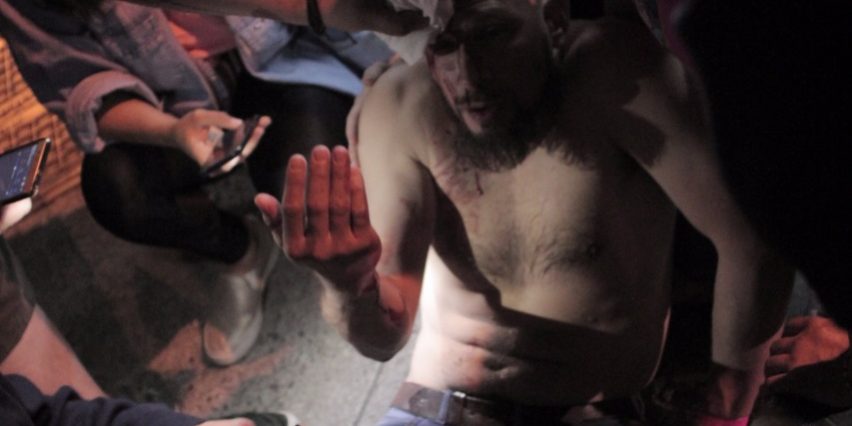
On November 19, 2017, as a massive Pride march was dispersing in Buenos Aires, on Montevideo Street, between Rivadavia Avenue and Bartolomé Mitre Street, a group of homophobic men emerged from a house. Shouting “degenerate faggots,” they threatened three gay men who were leaving the march, including González, who was attacked from behind with a stick.
Background: the attack on Jonathan
The only precedent for this type of crime is the case of Jonathan Castellari, a 26-year-old man who was attacked by seven men in a McDonald's on December 1, 2017. In a plea bargain, Gastón and Alejandro Trotta, Rodrigo Cardozo, Juan Ignacio Olivieri, Facundo Curto, Juan Bautista Antolini, and Jonathan Romero admitted to assaulting Castellari because he is gay. Last November, the prosecution agreed to a three-year suspended sentence for the crime of "aggravated assault motivated by hatred of sexual orientation" and imposed community service on the defendants.
[READ MORE: Castellari attackers sentenced for “hateful behavior based on sexual orientation”]
Greta Pena, a lawyer with 100% Diversity and Rights, who, along with the Argentine Homosexual Community (CHA), is supporting the victims of the attack at the Pride march, explained that the two cases are different. Castellari's case was resolved with a plea bargain and probation. The upcoming trial, however, will include hearings and witnesses.
Why it can set a legal precedent
“It’s a momentous event. A trial like this sets a precedent, clarifying the legal definition of 'hate based on sexual orientation .' Throughout the hearings, numerous arguments can be presented and incorporated into the verdict. That’s the most important thing: that the gravity of these crimes is understood and brought to light,” he said.
One of the three victims, Juan Víctor González, lamented in an interview with Presentes that the prosecution acted "very slowly" because it took 15 months to reach a trial.
“We started with a judge who wouldn’t budge, he simply didn’t want to investigate the case. Then they replaced him with Judge Petazzi, and she actually started doing something. Initially, I would say I feel a bit powerless knowing that someone decided not to investigate, and that this was going to just fizzle out,” he said.
However, he acknowledged that the decision to take the case to trial represents progress. “A sentence is already something important; it gives us something in our favor. It's like we can start to have a little bit of justice. It's a drop in the ocean; there's still a long way to go.”
The investigation progressed until, in December of last year, Judge Petazzi prosecuted two men accused of the homophobic attack and charged them as co-perpetrators of the crime of repeated minor injuries aggravated by having been committed out of hatred for sexual orientation, a crime that carries a sentence of between six months and two years in prison.
Pena recalled that, initially, the case was classified as "assault." Thanks to the activism of 100% Diversity and Rights, the CHA (Argentine Homosexual Community), and the work of lawyer Luciana Sánchez, the classification was changed to include hate based on sexual orientation as an aggravating factor. It was clear that the victims had not been attacked by chance, nor with the intention of robbing them, but rather in the context of a march celebrating sexual diversity.
“The attack occurred during a mass demonstration. It’s an attack with a symbolism that transcends the victim herself because it spreads a message of hate against the LGBT community. It’s a disciplinary violence against bodies and non-hegemonic desires. It’s structural violence, not an isolated incident. It’s not about one or a few people who went berserk and attacked; these are attacks with a purpose. We had to provide the prosecutor with the record of attacks in recent years against lesbian and gay couples, not to mention the trans community,” she stated.
González, for his part, explained that after the attack he felt dazed and afraid, and it was difficult for him to walk in the street. “I work doing house maintenance; I’m a plumber and an electrician. I didn’t feel safe until I was home, and at night I felt unsafe thinking that the people I reported might come looking for me,” he said.
The positive aspect, she added, is the intense work carried out by the lawyer for the three victims, Luciana Sánchez. And that both 100% Diversity and Rights and CHA supported them at all times.
“They contacted me the day after the attack, and that's largely why this case has progressed. They showed us that we're not alone. Their support is what made me feel better right away; they really helped me a lot with many things, so I can say they were always there for me,” she said.
We are present
We are committed to journalism that delves into the territories and conducts thorough investigations, combined with new technologies and narrative formats. We want the protagonists, their stories, and their struggles to be present.
SUPPORT US

FOLLOW US
Related notes


We are present
This and other stories are not usually on the media agenda. Together we can bring them to light.