

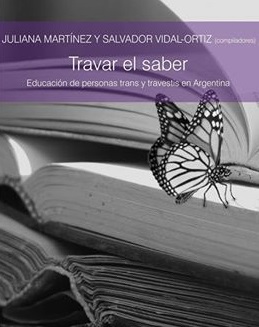
“Travar el saber”: a transvestite-trans educational experience told in the first person
The book contains 33 accounts of individual and collective educational journeys in Argentina, written by the people who lived them. Published in 2018 by the National University of La Plata (UNLP), it is being presented in Mexico.


Share

From being objects of study in academia to becoming producers of knowledge and understanding. That's what "Travar el saber" (Transvestite Knowledge) is about, a book that collects the experiences of transvestites and trans people in educational spaces through first-person narratives: 33 stories from transvestites and trans people who recount their journeys and how that education impacted their lives.
The book focuses on the work of three pioneering organizations in these efforts: the Mocha Celis Trans Popular High School, OTRANS Argentina, and the University of Avellaneda.
Published by the National University of La Plata, the initiative arose from compilers Juliana Martínez and Salvador Vidal-Ortiz and was published and presented in Argentina in 2018 and in Mexico City in 2019.
“Travar el saber” is a phrase that comes from the memory of the words and actions of Lohana Berkins, who reflected on the impact of a transvestite accessing the University: “When a trans woman goes to the University, her life changes; when many trans women go to the University, the institution changes.”
“This book crystallizes the importance of this structural change, highlighting the impact of factors such as family acceptance, access to employment, and immigration status, among others.
Travar el saber evokes the historical struggle and revolutionary yearning of this group, not for inclusion within an exclusionary system, but for the radical transformation of the categories and institutions that sustain and reproduce it; among them, primarily, education,” the compilers explain.
“Our words will not die”
Alma Fernández, a trans activist and graduate of Mocha Celis—the world's first trans high school—is one of the book's authors: “For us, education is a very powerful process. It's returning to a place from which we were expelled. And being able to tell our story, to be able to say in the first person what it produced in each of us, is a double victory,” she tells Presentes from Mexico. “For many of us, most of us, this is the first time we've been included in a book as authors. That's an action, a strategic move in a project that is both educational and political: because it seeks precisely for us to stop being objects of research and become researchers ourselves. It's about stopping the machinery that is the chain that produces knowledge, so we can appropriate it and begin to produce trans theory and literature in our country,” says Fernández. And she adds: “It is dignified to be subjects who produce knowledge. This gives us hope and encourages us. Because it is a way to overcome this average and this life expectancy that we have, because our words will not die. Transvestite fury!”
 She traveled with Claudia Vázquez Haro, president of OTRANS, who is also an author on the book, sharing her personal experiences as well as those of the organization, which includes many trans women and, like her, migrants. Invited by the National Autonomous University of Mexico (UNAM), they traveled with the editors and UNLP researcher Facundo Ábalo. “'Travar el saber' (Disrupting Knowledge) challenges the hegemonic ways in which knowledge is produced and circulated. It also addresses the practices and knowledge of trans and travesti people not only individually, but also collectively. And it explores how their entry into formal education spaces challenges traditional knowledge and the banking model of education.” "Travar el saber is at the same time a profoundly political tool, written from a trans, travesti, trava, and sudaca epistemology. Now it arrives in Mexico to share the Argentine experience and continue spreading the word about modes of organization, resistance, and struggle of our collective, one of the most combative in the Latin American and Caribbean region," said the trans leader.
Share
We are present
We are committed to journalism that delves into the territories and conducts thorough investigations, combined with new technologies and narrative formats. We want the protagonists, their stories, and their struggles to be present.
SUPPORT US

FOLLOW US
Related notes
We are present
This and other stories are not usually on the media agenda. Together we can bring them to light.