

#8M What did the transfeminist marches in Latin America demand?
Regional journalistic coverage of the marches of women, lesbians, bisexuals, transvestites, trans people and non-binary identities.

Share

Airam Fernández (Santiago/Chile), Juliana Quintana and Jessie Insfran Pérez (Asunción/Paraguay), Esteban Marchand (Lima, Peru), Pilar Salazar (Guatemala City/Guatemala), Paula Rosales (San Salvador, El Salvador), Ana Fornaro, Luciana Caminos, Ariel Gutraich and María Eugenia Ludueña (Buenos Aires, Argentina).
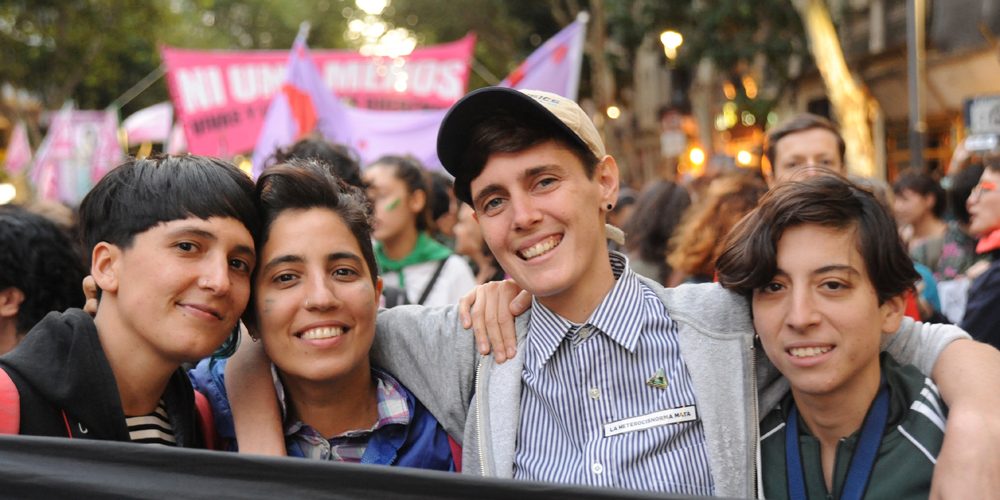
March 8th (#8M) shook the world with the power of feminism unfolding in the streets. At Agencia Presentes, we provided journalistic coverage focusing on the participation of lesbians, bisexuals, transvestites, trans people, and non-binary individuals in the International Women's March and Strike.
The regional coverage included six Latin American countries: Argentina , Chile, Paraguay, Peru , Guatemala, and El Salvador.
 Beyond the differences between legislative frameworks and the situations faced by LGBTQ+ groups in each country, this #8M feminisms demanded an end to violence, and to violence perpetrated against transvestites and trans people due to hatred of gender identity.
San Salvador
In San Salvador, a march began at 8 a.m. toward Congress to demand the passage of dignified and equal laws. Diversity was a prominent feature of the march, and its voices were heard throughout the Central American country.
#ElSalvador #8MPreentes #8M ⚧ Marches are taking place in the streets of San Salvador to demand an end to violence against women, trans people, and gender non-conforming individuals. They are calling for the passage of equal rights laws that guarantee rights for all. #SeVaACaer coverage: @rosalespaula pic.twitter.com/btTGyIGK4n
— Agencia Presentes (@PresentesLGBT) March 8, 2019
, 383 women were murdered, 14 of whom were trans. The #LGBTI marched in force to demand justice for femicides and transfemicides.
"We, the diverse women, are striking for many reasons. One is to demand that the legislative assembly pass the gender identity law and recognize the fundamental rights of the trans population," said Bianka Rodríguez of the organization Comcavis.
#NOW "For universities free of harassment and sexual violence against women." "Never again will we be silent against impunity." The march and the #InternationalWomensStrike in the streets of San Salvador. #8MPresent #8MLatam #FeministStrike pic.twitter.com/2L4WvI3IWM
— Agencia Presentes (@PresentesLGBT) March 8, 2019
#NOW #ElSalvador "Together we strike, together we march." Lesbian feminist groups demand legal abortion and rights for all on this #InternationalWomensDay #ItWillFall #8MPresent #FeministStrike #InternationalWomensStrike pic.twitter.com/IbZ66eznyP
— Agencia Presentes (@PresentesLGBT) March 8, 2019
🇸🇻 #8MLatam “We are from the Trans Men of #ElSalvador and we are here supporting women, demanding their rights. We are also victims of gender violence,” says Aldo Peña, a trans man. From San Salvador, @rosalespaula #8MPreentes pic.twitter.com/6jU25fFppC
— Agencia Presentes (@PresentesLGBT) March 8, 2019
Guatemala City
In Guatemala City, the #8M march began at 11 a.m. from the Plaza de los DDHH (Human Rights Plaza), in front of the Court of Justice. #AltoGenocidioTrans (Stop Trans Genocide) was the slogan of the trans groups: "Let's remember, our rights are also human rights."
Ilse Janeth Contreras, from the transgender sex workers' collective, denounced that her colleagues in the Trébol area of Zone 11 are in constant danger. She said they are called "the red collective," a name they have adopted as a form of resistance.
The march ended at the headquarters of the Women's Sector, an organization that brings together several groups. In the early hours of March 8th, activists reported that their facilities had been ransacked and documents stolen.
#Guatemala “Joy as an act of rebellion”: María José Rosales explains that this is one of the slogans of lesbian women in this march commemorating March 8th #InternationalWomensStrike #FeministStrike #8MPresent #8MLatam From Guatemala City: Pilar Salazar pic.twitter.com/qbP472lfCf
— Agencia Presentes (@PresentesLGBT) March 8, 2019
#8M ⚧ #Guatemala #8MPresent Young women organized an afternoon march with the slogan #GirlsAreNotTouchedNotRaped #BecauseWeAreAllOneAndOneIsAll ofUs, where the trans women's group participated. pic.twitter.com/vp9BKSxleL
— Agencia Presentes (@PresentesLGBT) March 8, 2019
Lime


 About 5,000 women, trans people and lesbians marched along Avenida de la Peruanidad in Lima towards Plaza San Martín to say "We want to live."
March 8th in Peru: “We are not hysterical, we are historic!” shouted some 5,000 women, trans people, lesbians, and bisexuals in Lima. Photo coverage. https://t.co/5DhJoHcVeK pic.twitter.com/TTUOnlv3a9
— Agencia Presentes (@PresentesLGBT) March 9, 2019
This March 8th, people took to the streets to protest the 31 femicides and at least two hate crimes (there are no official figures); a lawsuit that has been ongoing for almost two years against the gender approach in education to remove it from the national curriculum; and the advance of fundamentalisms that deny the humanity of women and LGBTI+ people, also denying everyday violence.
#Peru 🇵🇪
“I’m marking my name because without LGBTQ+ women there is no feminism or equality”
Gabriela Zavaleta, activist with @masigualdadpe #8MPreentes #8M ⚧ pic.twitter.com/WHF8qo3evD— Agencia Presentes (@PresentesLGBT) March 8, 2019
Santiago, Chile
 The march held in Santiago, Chile, to commemorate International Women's Day was a historic and inclusive demonstration. The feminist tide of green and purple scarves stretched for more than 4 km, and this time, unlike previous occasions, it was a truly diverse demonstration.
In #Chile 🇨🇱, trans activist @ShaneCienfuegos joined the #InternationalWomensStrike . "Without trans, lesbian, and bisexual women, there is no feminism," she declared. #8M 🦄 #8MPresent pic.twitter.com/MvlIrHoRYk
— Agencia Presentes (@PresentesLGBT) March 9, 2019
[NOW] 🇨🇱 The lesbian feminist bloc has a significant presence at the Santiago march. In front of La Moneda, the presidential palace, they stop to shout: "We are lesbians because we want to be!" #8M 🦄 #8MPresent pic.twitter.com/J0bEYtZSus
— Agencia Presentes (@PresentesLGBT) March 8, 2019
The most repeated: those who demanded justice for Nicole Saavedra, the young lesbian murdered in June 2016 in a town near Santiago, a case that to this day remains in total impunity.
🇨🇱 [NOW] This is how the massive feminist march in Santiago, #Chile, organized by @Coordinadora8m . Together we made history! #8M 🦄 #NoMeansNo pic.twitter.com/wzXLKmxxWU
— Agencia Presentes (@PresentesLGBT) March 9, 2019
[NOW] 🇨🇱 Nicole Saavedra was found dead on June 25, 2016. There are no culprits or suspects. Lesbians in #Chile raise their voices for her and for those who are no longer with us in the #InternationalWomensStrike #8M 🦄 #8MPresent pic.twitter.com/dUwBCrpsPL
— Agencia Presentes (@PresentesLGBT) March 8, 2019
🇨🇱 So far this year, at least 10 femicides have been recorded in #Chile . Trans murders also exist, but there are no official figures in the country. This is Felicia's reason for marching: "They keep killing us, we go out into the streets in fear. This has to stop." #8M 🦄 pic.twitter.com/QcadmFPoVJ
— Agencia Presentes (@PresentesLGBT) March 9, 2019
Assumption


 LGBTI women demanded equality and the eradication of the sexist culture entrenched in all work environments.
#PARAGUAY Women and LGBTQ+ groups demand parity in the country's political and social power, under equal conditions. #8MPreentes #8M ⚧ pic.twitter.com/T1P9smWQLS
— Agencia Presentes (@PresentesLGBT) March 8, 2019
#PARAGUAY #8M ⚧ Democracy Square: During the reading of the manifesto, peasant and indigenous women denounced exploitation by agribusiness and soy cultivation. Sex workers denounced their criminalization. pic.twitter.com/qAggFYsudJ
— Agencia Presentes (@PresentesLGBT) March 8, 2019
Buenos Aires
#8M ⚧ #Argentina Here is the trans resistance. pic.twitter.com/cqc8kB3dHo
— Agencia Presentes (@PresentesLGBT) March 9, 2019

 Also, the effective implementation of comprehensive, secular, scientific, and respectful sex education that acknowledges sexual and gender diversity in all educational establishments; the enforcement of the Gender Identity Law in educational institutions. No to homo-lesbian-trans-biphobic hate. Never again will we return to biological determinism! And a quota for transvestite/transgender employment in all educational institutions in Argentina.
🇦🇷 [NOW] “I’m a trans guy and I’m here against biologism because without trans people there is no feminism,” says Samuel. #8M 🦄 pic.twitter.com/HHgKaldsf8
— Agencia Presentes (@PresentesLGBT) March 8, 2019
🇦🇷🌈 “We march to reclaim the identity of our children and to support the trans and travesti struggle. Thanks to them, our children have their ID cards. We march for #ComprehensiveSexualityEducation and new ways of building families outside of patriarchal heteronormativity.” #8M ⚧ #BuenosAires pic.twitter.com/19gJCZ1U7B
— Agencia Presentes (@PresentesLGBT) March 8, 2019

We are present
We are committed to journalism that delves into the territories and conducts thorough investigations, combined with new technologies and narrative formats. We want the protagonists, their stories, and their struggles to be present.
SUPPORT US

FOLLOW US
Related notes



We are present
This and other stories are not usually on the media agenda. Together we can bring them to light.