

#8M This is how women, trans, bi and lesbians marched: "Our work matters"
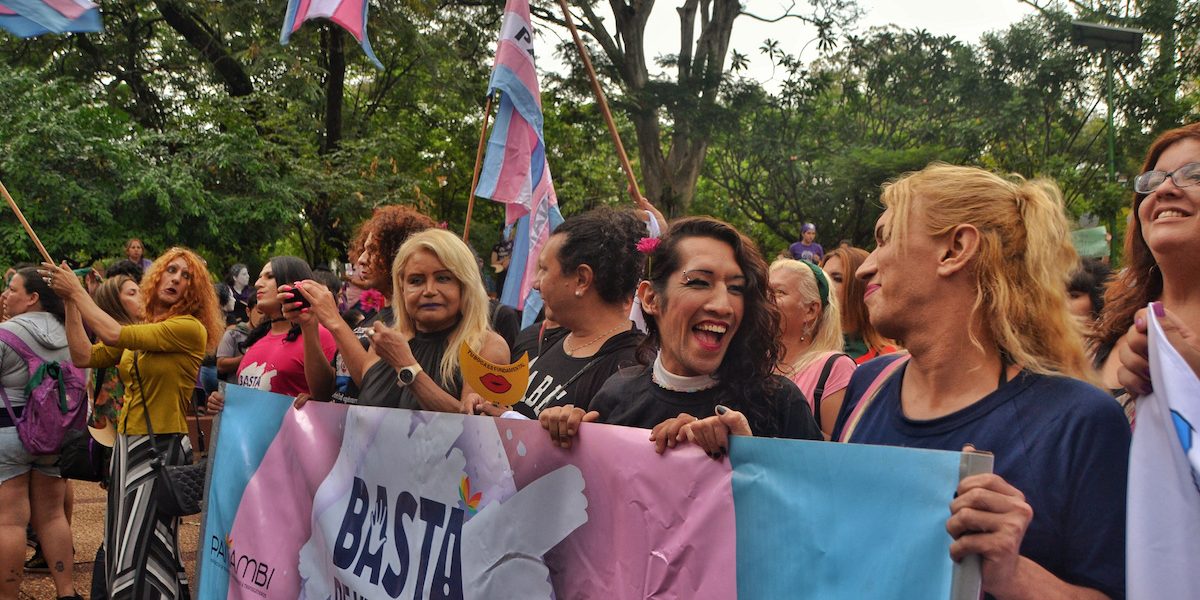
The march began at Plaza de la Mujer (formerly Plaza Italia) and proceeded to Plaza de la Democracia. More than 3,000 people participated.

Share

By Juliana Quintana, from Asunción
Photos: Jess Insfrán
At 5:00 PM, the Paraguayan branch of the International Women's Strike (#8MPy) sent a statement via their WhatsApp group, which has over 245 participants, announcing that the march would not be canceled due to rain. Under the slogans “Ore rembiapo ovale” (our work matters) and “ore kuña ropyta” (we are on strike), more than 3,000 women—domestic workers, farmers, Indigenous women, residents of the Bañado Sur neighborhood, students, and LGBTQ+ women—marched.

The march departed from Plaza de la Mujer (formerly Plaza Italia) on Jejuí Street around 7:30 p.m., heading towards Plaza de la Democracia. International Women's Day in Asunción was celebrated with glitter, handmade t-shirts, poetry, dancing, and songs in Guaraní, one of the favorites being "Che reté, che mba'e" (My body is mine). Among the groups that asserted the value of their work, the LGBTQ+ community stood out.

“Trans people suffer double discrimination at work, and it’s very difficult for us to find jobs in cisgender heterosexual jobs. My first job was at McDonald’s. They told me that customers shouldn’t see my face and made me clean the floor all the time. One day, when they finally let me work the register, 350,000 guaraníes were missing, and that was impossible. They would cause any kind of altercation to get me fired. My coworkers stole, and then they docked my pay,” Emily Marin, a 20-year-old trans woman, told Presentes.

According to the feminist manifesto of the coalition, in Paraguay, women earn 30% less than men for the same work, and, in addition, dedicate twice as much time to unpaid, unrecognized labor. “What they call love is unpaid work,” journalist Noelia Díaz Esquivel read from the stage in Plaza de la Democracia.

Feminist communicator and poet Fátima Aguilar believes that freelance is the most precarious form of employment, particularly for women. “In freelance work, while we don't have to keep to set hours, we have to meet a lot of objectives and manage our time beyond all gender roles. Within this context, we face incredibly difficult pay, lack social security, and our work becomes much more invisible,” she stated.
 This week, 200 employees were dismissed without prior notice from the Superior Electoral Court (TSJE). In an interview with Presentes, Liz Insfrán, from the TSJE's human resources department, explained that, as a lesbian woman, her current situation is difficult because, if she is not reinstated, she will have to start a new job search in a country where discrimination against lesbians and bisexuals in the workplace translates into unjustified dismissals and aggravated harassment with a lack of reporting mechanisms.

“When I started at the TSJE, I had a partner who was also my coworker. The truth is, the harassment and the veiled comments were terrible. At the time, I let it go, but today I realize how awful it was. Once, an area manager suggested we make a pornographic video; luckily, it didn't escalate and it stayed there,” Liz recalled.

But even LGBTQ+ people with job security suffer harassment. More than being seen as a blonde, an Argentinian-Guatemalan, or a lesbian, Natalia Pintus prefers to be seen as a person. In the 10 years she has worked as general manager of a technology magazine called Paraguay TI, she has never been judged for her appearance, unlike in other jobs. “I understand that I am part of a privileged sector within the LGBTQ+ community, and I know I am very fortunate for the work experiences I have had,” she said.

Daniela and María José Ramos live and work together at a hydraulic engineering consortium. They were forced to take jobs in their field for family reasons, unrelated to their sexuality. Even while hiding their relationship at work, they experience workplace harassment. “Several times, our boss, without overstepping boundaries, told us he liked having us there. We think the way we're treated is because we're attractive. It's a shitty privilege,” Daniela said.

The day concluded with music from all-female bands, another demonstration of local feminism. But this day wasn't only celebrated in the capital; it was also observed in several departmental capitals, including Ciudad del Este, Coronel Oviedo, Encarnación, Pilar, and, for the first time, Concepción. LGBTQ+ women demanded equality and the eradication of the patriarchal culture prevalent in all workplaces.
We are present
We are committed to journalism that delves into the territories and conducts thorough investigations, combined with new technologies and narrative formats. We want the protagonists, their stories, and their struggles to be present.
SUPPORT US

FOLLOW US
Related notes

We are present
This and other stories are not usually on the media agenda. Together we can bring them to light.