

A lesbian couple fights for recognition of their co-parenting status
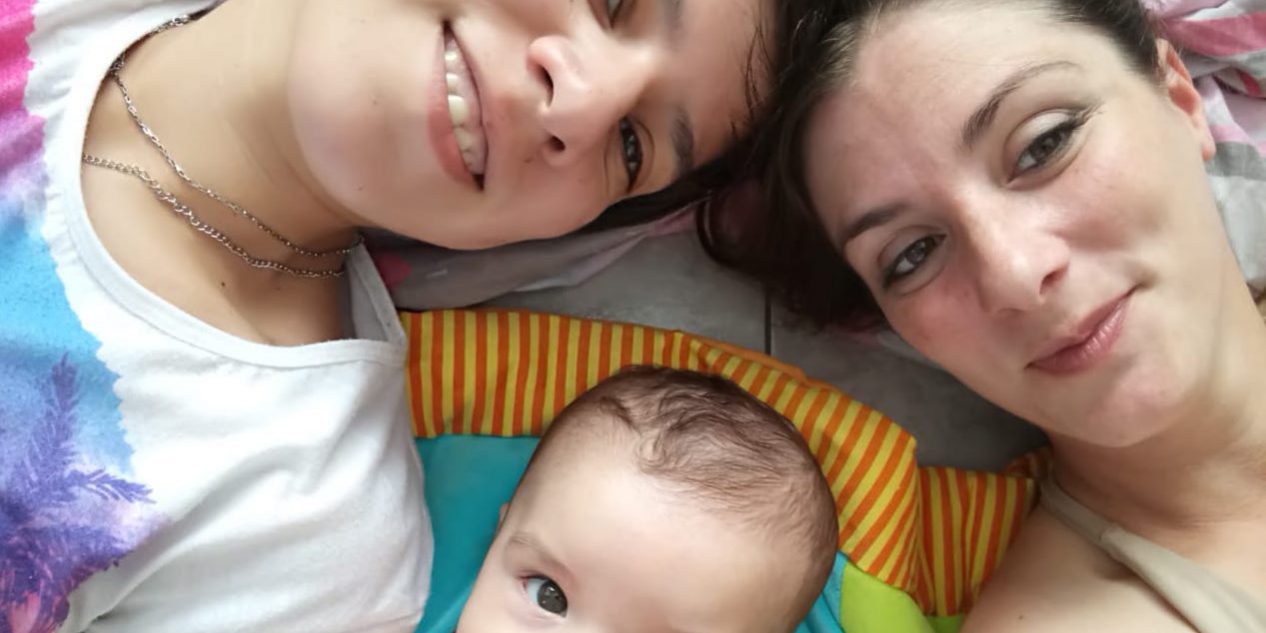
Adriana Lemos and Patricia de Jesús Otazo, married since 2012, had a child through home artificial insemination, and the Civil Registry does not accept registering him as their child.

Share

Adriana Lemos and Patricia de Jesús Otazo, married since 2012, had a child through home artificial insemination, and the Civil Registry does not accept registering him as their child.
By Paula Bistagnino
Two and a half years ago, Adriana and Patricia decided to become mothers. They had married in 2012 thanks to the Equal Marriage Law and had longed to start a family ever since. After a failed attempt at a private fertility clinic, and without the money to pay for another, they decided to try a home approach: a friend donated his sperm and they became pregnant. Thomas was born in August 2018, but when they went to register him at the Civil Registry in the Buenos Aires town of San Miguel, they were told it wasn't possible.
“From that moment until today, six months later, our son still doesn't have an ID. We can't take him to a hospital or enroll him in daycare. We couldn't even go to the beach for a weekend because we can't afford to take the bus,” says Adriana Lemos, Thomas's surrogate mother. His wife, Patricia Jesús de Otazo, adds: “After five months of starting the process in La Plata, they told us our request was denied, and only because we sent a letter to the governor (María Eugenia Vidal), telling her our story. It wasn't until the next day that they informed us the decision had been made.”
"The boy has a father, let him come and acknowledge him."
The women say the head of the Civil Registry in San Miguel never saw them. Even though they asked to speak with her on the first of the four days they went there because they didn't understand what they needed to complete the process. "Imagine, one employee took pity on us and told us it was a disgrace how we were being treated and recommended we go directly to La Plata because we weren't going to get anywhere there," says Adriana.
[READ ALSO: The struggle of a lesbian couple who managed to register their baby as the child of two mothers]
They first recounted all of this back and forth in a presentation they were only able to make on their fourth visit, accompanied by a lawyer. "They wouldn't accept it from us." Later, they recounted it again in an even longer and more detailed document sent to Vidal, detailing the various responses they received: "The boy has a father, let him come and acknowledge him," "Your wife is denying his identity, register him as a single mother or call any man who will acknowledge him," "Register him as a single mother and later, if she wants, she can adopt him," "If you bring any man off the street, we'll register him in two seconds."
“They were very disrespectful the whole time, and it was clear that the problem is that we are two mothers,” she adds. Ana Hilbert, the lawyer for Abosex—the organization supporting them in their complaint—explains it similarly: “We filed two complaints regarding the mistreatment, which clearly involved discrimination: one at the Civil Registry in San Miguel and another in La Plata.”
Five months passed between the time the request was submitted to La Plata and the response: “The day after sending the letter to Vidal, the General Counsel of the Government, Sergio Aliandri, issued a regrettable unfavorable opinion in record time, limiting himself to a restrictive interpretation of the Civil and Commercial Code, without options or solutions, in a truly inhumane manner. They clearly rushed to close the matter with a negative response,” the women explain in a new statement.
 “This is a case of discrimination.”
According to the Civil Code, there are three forms of parentage: biological, by adoption, and by Assisted Reproductive Technology (ART) under medical supervision. “The legislation does not prohibit home insemination. It only regulates ART performed in clinics, but it does not prohibit those performed at home,” the lawyer explains.
“Furthermore, this cannot be interpreted restrictively regarding the rights of both mothers. We are facing a case of discrimination because if it were a heterosexual couple, the father would not be required to provide this documentation to prove paternity or consent to home insemination, as this is understood by virtue of being married. Therefore, we also consider the decision of the PBA Registry to be discriminatory,” she adds.
In an interview with Presentes, the director of the Provincial Registry of Persons, José Etchart, explained that the five months that elapsed between the start of the process and the issuance of the resolution are within the expected timeframe for cases of this complexity: “A resolution from the registry requires the intervention of the General Counsel of the Government. This is a difficult case, and it is also the first one we have encountered in the province of Buenos Aires. It was resolved according to the provisions of the Civil Code, which does not regulate home-based assisted reproductive technology; that is to say, it is not provided for that it can be resolved administratively. Therefore, it is beyond our jurisdiction: it must be resolved by the courts,” the official said, adding that they will facilitate a meeting with the couple.
Regarding the complaints of mistreatment received at the San Miguel office, he added: “We have taken note of the mistreatment complaint and understand that the complexity of the issue requires training for the people who work in the registries to provide appropriate care.”
“A heterosexual couple is not required to provide DNA to register their children.”
Valeria and Patricia recount that, in the middle of the argument at the Civil Registry, the employee asked them, “And how am I supposed to know it’s artificial insemination?” Adriana says that at that moment she asked, “Do you say the same thing to heterosexual couples? Do you ask them for a DNA test?” Then Patricia added, “What if I go out on the street and bring any man I find?” The employee was blunt: “I’ll register him in two seconds.”
The legal department of the Provincial Registry of Persons acknowledges that this is the case: when a heterosexual couple presents a baby, the birth is registered without requiring any proof of paternity from the man. However, in cases involving two women, it is necessary to have the sperm donor waive his paternity rights.
Adriana and Patricia say they have the necessary documentation, but they were never able to present it because it was never requested. In the letter they sent to Vidal, they explained their relationship with the sperm donor: “While talking with a friend—after the medical treatment failed, they couldn't afford another attempt—he offered to be a donor. He is someone we know who helped us with this insemination without medical intervention. He is someone who does not wish to claim any paternity and can state this in writing, also providing his contact information in case our child needs it for health reasons, as required by the Civil and Commercial Code.”
Finally, they closed the letter with a desperate plea: “We don’t know what to do anymore. Our son is being denied his identity, and they’re practically trying to force one of us to register him as a single mother. Or worse, to adopt. We want to make this very clear: you don’t adopt your own child, and you don’t register as single when you’ve been married for eight years. They have no shame.”
We are present
We are committed to journalism that delves into the territories and conducts thorough investigations, combined with new technologies and narrative formats. We want the protagonists, their stories, and their struggles to be present.
SUPPORT US

FOLLOW US
Related notes



We are present
This and other stories are not usually on the media agenda. Together we can bring them to light.