

The film about the world's first transgender high school
“Mocha: our struggle, her life, my right”: the documentary about the world’s first trans high school.

Share

By Luciana Caminos
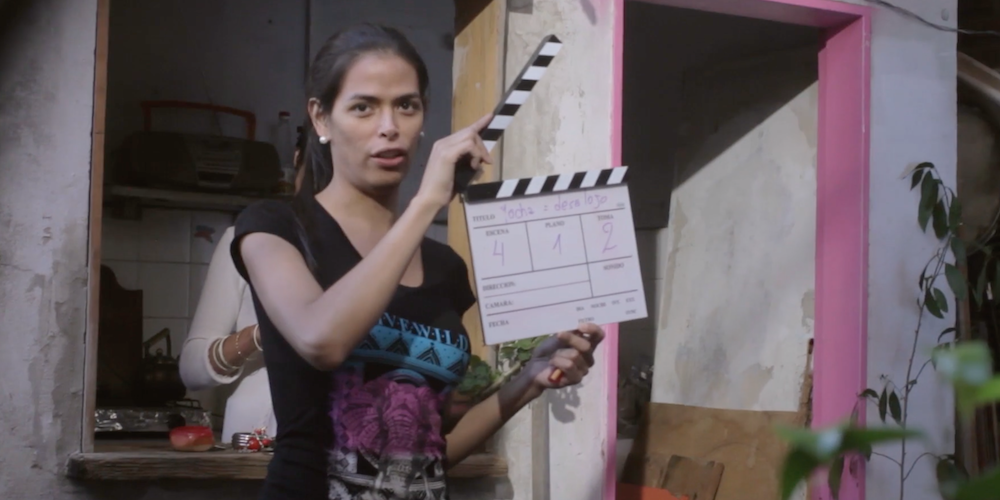
It begins like this: 2014. On the fifth floor of an old building in the Chacarita neighborhood of Buenos Aires, next to the Lacroze station on the Urquiza Railway line, a group of students prepares to begin filming a docudrama. It will tell the story of their lives. They divide the roles: production, script, makeup, wardrobe, and casting. They will be both protagonists and filmmakers. This behind-the-scenes scene opens “Mocha: Our Struggle, Their Life, My Right,” the documentary about the world’s first transgender high school.
The Mocha Celis Trans Popular High School is an inclusive, non-exclusionary, public, and tuition-free secondary school with a focus on Gender, Sexual, and Cultural Diversity. It was conceived from its inception to address the historical exclusion experienced by trans, transvestite, and transsexual people. It has been operating since 2012, the year the Gender Identity Law in Argentina.
“When we started, the media would come to the high school to document how the trans women studied. There was a kind of objectification of them, and the students began to raise concerns about it. This took shape in the research methodology course. They wanted to move from being objects to being subjects who produced knowledge and meaning, with a collective first-person narrative. That's how the documentary came about,” says Francisco Quiñones, director of the high school and of the film. He shares the latter role with Rayan Hindi.

Who was Mocha Celis?
The documentary weaves together first-person accounts from students with various situations involving Mocha Celis. She was a trans woman from Tucumán who worked in the Flores neighborhood and was murdered by a police officer. In one part of the documentary, Lohana Berkins recalls: “Mocha couldn't read or write. When we arrived at the police stations as detainees, she always asked me to read to her. I remember that when we were in the cells, there was another trans woman, a very well-educated girl. And I told her: ‘Let's take advantage of being in here and teach Mocha. But do it in a way that doesn't make her feel bad, that makes her feel less than.’”
Story in trans code
The representations of Mocha Celis's life "served as a theater of the oppressed to talk about themselves and recognize that there is a matrix that is imprinted on their bodies," says Quiñones.
“We wanted to reflect the system that applies a necropolitics that discards what is not functional, in order to understand why trans people have an average life expectancy of 35 years. This film was the excuse for them to be able to talk about themselves without sensationalism, showing what happens to them, the evictions, the police repression, the discrimination, in trans code,” adds the director.
This concept is set in a scene where a birthday party is taking place. There's music, drinks, and merriment, when suddenly two women arrive saying that another woman was taken away by the police. The immediate response is: "Let's call the lawyer and all go to the police station to get her out."
This nod—a tribute to Ángela Vanni, the historic lawyer for trans women—is spoken by the character played by Alma Fernández. Just a few weeks ago, Alma experienced a similar situation when she was arbitrarily detained by the Buenos Aires City Police. “La Mocha provided that symbolic embrace, that holding of hands that we as a collective have been seeking for years,” says the activist.
 "Bachi made me see life in a different way."
 "Bachi made me see life in a different way."
“La Mocha is a family,” says Virginia Silveira, a trans woman, law student, and employee of the Public Prosecutor's Office. She arrived in Buenos Aires from Salta at age 13. She learned about the high school through a post by trans activist Marlene Wayar. She was part of the first graduating class. “I was the first to enroll. There were five of us, including a friend I brought along. The school made me see life differently. It showed me where I wanted to go. It taught me to set small goals so I could achieve them. And above all, it made me realize that without the right to housing, work, and education, you can't develop. I was being held back, and that's when I started to react, to grow, to see life in a different way.”

Flavia Flores graduated last year. She is the vice president of the student union. "La Mocha is not just a place to study, it's a place of support. It opened the door for me to become an activist and to be able to help other younger girls."
Sebastián Remolgado was a student at Mocha, also from the first graduating class, and worked as a production assistant on the film. “I was the only straight guy there, and I came to Mocha because I hadn't finished high school. For me, it was an incredible experience; it helped me overcome many prejudices.”

No education for transvestites and trans people
“The matrix is only just beginning to change, but police repression continues and is increasing. The Vanni of before is Luciana Sánchez now,” says Quiñones, referring to the lesbian and feminist lawyer who, among other things, represented the plaintiffs in the trial for the transvesticide of Diana Sacayán.
“Our trans sisters here in Buenos Aires have the option of Mocha, but in the interior of the country there are no access points to education. It's not a public policy to educate trans women in the provinces. There are no laws promoting it. Only Santa Fe implemented the 'Recognize is Repair' program. So Mocha ends up being a volunteer-based institution, because it depends on our willingness to ensure the well-being of our trans sisters,” says Quiñones.
 She gives the example of a student who lives in Pilar. Getting to Mocha means taking five buses and paying 17 pesos, without a formal job. “So it all depends on the help of teachers and volunteers. We have parties, raffles, everything we can to help them. We don't have comprehensive funding, and the upkeep of the space remains unresolved, even though it's a model school.”
“Mocha: Our struggle, her life, my right” becomes a necessary pedagogical tool to replicate the experience of the Mocha Celis High School and also to learn about the reality of trans people through their own voices.
In Buenos Aires, it can be seen on Sundays in February at 6 pm at the Malba. There will be a screening on February 28 at the Gaumont Cinema.
Preview of the MOCHA DOCUMENTARY video – TRAILER from YouTube
We are present
We are committed to journalism that delves into the territories and conducts thorough investigations, combined with new technologies and narrative formats. We want the protagonists, their stories, and their struggles to be present.
SUPPORT US

FOLLOW US
Related notes
We are present
This and other stories are not usually on the media agenda. Together we can bring them to light.