

Alessia Injoque: a trans and migrant executive challenges the corporate world
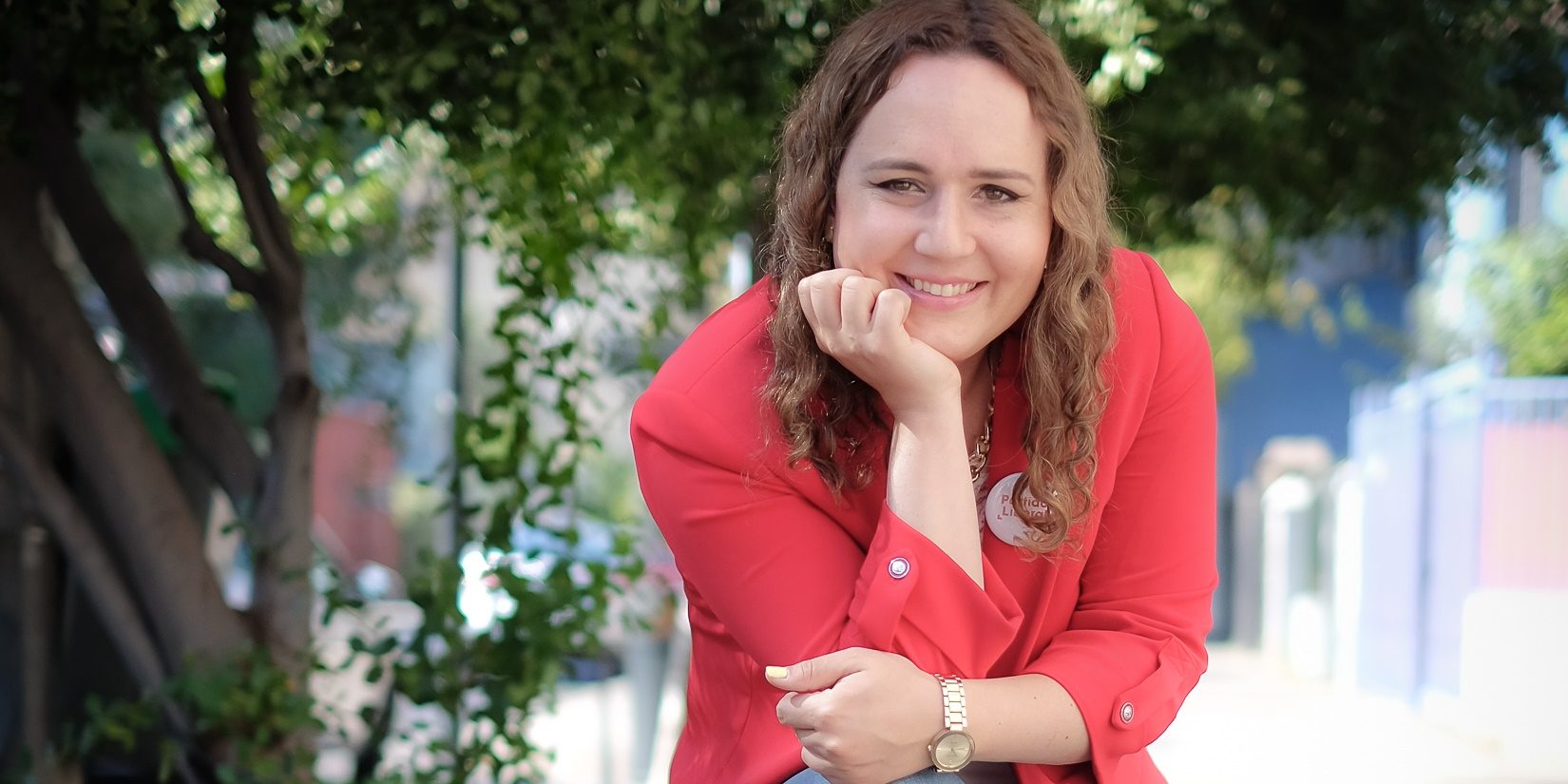
She is 37 years old and holds a leadership position in one of the most important companies in Chile; her public transition made her an activist and LGBT role model in Chile.

Share

By Airam Fernández, from Santiago, Chile
Photos: Josean Rivera.
Two years ago, Alessia Injoque faced all of Chile from the cover of QuéPasa to tell her story: that of an immigrant industrial engineer, Peruvian, daughter of evangelicals, responsible for a large part of the systems of a private company, who at 35 years old became the first person to transition into a leadership position at Cencosud, one of the most important and powerful consortiums in the country.
Without seeking it, she became an important voice within the local LGBTQ+ community. Now she combines her engineering career with activism, politics, and writing. She has given talks on diversity at other companies, serves on the board of the Iguales Foundation, and recently joined the Liberal Party because she wants to influence the diversity agenda. Last year she wrote and published Chronicles of an Infiltrator , a sort of autobiography where she recounts the paths that led her to where she is today. “I am transgender, lesbian, and proud. I reserve the shame for those who cannot accept it,” Alessia writes in her book.
READ MORE The challenges of the gender identity law in Chile
-What was it like to transition publicly and in a leadership position at a large company?
When I made the decision, I had no idea how to do this or where to begin. So I did the basics: I checked and researched if there were any previous cases. I didn't find anything similar or equivalent, and since I was terrified, I spent a year living a double life. In all my personal spaces, I started living as Alessia, except at work, for fear that someone would see me on the street or somewhere and recognize me. It was very stressful. While I continued living that way and working up the courage to talk about it at the office, I decided to treat myself: I took dance classes, makeup classes, and started seeing a speech therapist to train my voice and somehow fit in a little with what society expects of a female role, especially in such a formal work environment.
When I told my boss, I expected her to say she didn't know the policies for handling my case or that she would consult with HR first. But, to my surprise, she offered support from the very first minute. That was a turning point and fundamental, because I went from thinking I could lose my job and my career for no longer wanting to hide my identity, to receiving support and guidance, even though no one knew at that moment how we would approach my transition. After speaking with the managers, we went to HR, and since there wasn't a defined protocol, because this had never happened before, they contacted diversity organizations for advice and to work together on policies and procedures for doing it and communicating it to everyone in the best way. I had to give a speech in front of 60 people, and I decided to give a long presentation on the psychology of resistance to change, which led me to end up talking about my more personal side. The hardest part was when I got to the final point and had to say that I'm trans. There was a huge silence in the room. I cried, people came up to hug me, they applauded. That moment was very powerful. The next day, on my birthday, Alessia arrived at the office. Although I was very nervous because I felt like I was walking on a catwalk with thousands of eyes on me, from that moment on I am a completely free and happy person, because honestly I didn't expect so much support and solidarity.
-What has been the hardest part of your process?
I recently separated from my wife. Cosette was by my side every step of the way and helped me through the first steps in my transition. We did everything we could to make it work because we truly loved each other. But it was very difficult, both for her and for me. We remain very close, we care deeply for each other, and I will always cherish the time I spent with her and all the support she gave me, because when I began to live as a free person and felt like the world was crashing down on me, she was the rock I could lean on. With all that pain, I turned to writing, and it helped me a lot.
 -Let's talk about your identity as a trans woman and lesbian. How did you come to terms with it, and how does your community accept it?
 -Let's talk about your identity as a trans woman and lesbian. How did you come to terms with it, and how does your community accept it?
"I think it's very important to talk about this because now we have information about diversity that we didn't have before. In my childhood, the word 'trans' didn't exist. There were transvestites, who at that time were understood as men who were attracted to men but dressed as women because they liked men so much that they wanted to be women. There was no other definition, and gender identity didn't exist. So I was very confused because I liked women but didn't want to feel like a man. I even sometimes wondered if I was a heterosexual transvestite. When the term 'trans' appeared, I understood everything and accepted that I am a woman who is attracted to women. Since it was difficult for me to understand, I perfectly understand the confusion it generates for many people with a heterosexual worldview. For them, it's a rarity; for me, it's no longer an issue. This is who I am."
-What has your relationship been like with your evangelical mother?
At first, it was incredibly difficult because my mother is not only evangelical but also openly anti-sexual diversity. The conversation with her was via email because I'm in Chile and she's in the United States. When I told her, her world fell apart. The first thing she did was ask if I had been raped, because for many who think like her, being trans means you're a deeply damaged person. Then she asked me to keep it a secret and not to flaunt it, but that was something I wasn't willing to continue doing. She apologized to my entire family because she felt guilty about this "sin" I was committing and thought she had done something wrong with me during my upbringing. Over time, things have improved, and now she has a somewhat more resolute position on this. Now she believes I'm a message from God for her to stop being a discriminatory person. It makes me laugh a little, and I don't share that view or that explanation because I'm also an atheist, but if she wants to believe that, what can we do? One good thing about this is that he just wrote a book about me that will be released in February, and although it's in a very different vein from mine, with a Christian focus, I'm very happy because it will reach people that I'll never be able to reach in my life, since that Christian audience speaks a language that I don't speak.

-Your transition led to activism and now to politics, do you have aspirations to influence the debate from those areas?
"Actually, I didn't plan any of this. My case became public after I appeared on the cover of QuéPasa magazine, and that's when I started giving interviews, talks at companies, I got involved with Fundación Iguales, I wrote a book… Sometimes I can't believe it, because it's all been very spontaneous. The thing is, I realized I had the opportunity to contribute and make the message known. My experience is public because I want people to know that it is possible. And if I can contribute with my story or by sharing things I know now but didn't know during my childhood or adolescence, it makes perfect sense to me. I recently joined the Liberal Party because I understood that if I really want to bring about change in the LGBTI community, I have to start taking a stand and getting involved, so I chose this organization because of its ideological alignment, because they share the political ideas of someone like Justin Trudeau in Canada, or Emmanuel Macron in France. Perhaps in some countries they think that being liberal is the same as being right-wing, but here in Chile it's not like that." So, if you're asking me about any political aspirations, the truth is I don't have anything very structured right now. I'm just trying to put together a plan for the future regarding the diversity agenda. At this moment, the regulations for the Gender Identity Law, which was recently approved, are being finalized. We're beginning the discussion on marriage equality, and I think the road ahead won't be easy, but I'm optimistic that we'll achieve it and that one day we'll be seen as the normal people we are, with all our rights guaranteed and respected.
We are present
We are committed to journalism that delves into the territories and conducts thorough investigations, combined with new technologies and narrative formats. We want the protagonists, their stories, and their struggles to be present.
SUPPORT US

FOLLOW US
Related notes


We are present
This and other stories are not usually on the media agenda. Together we can bring them to light.