

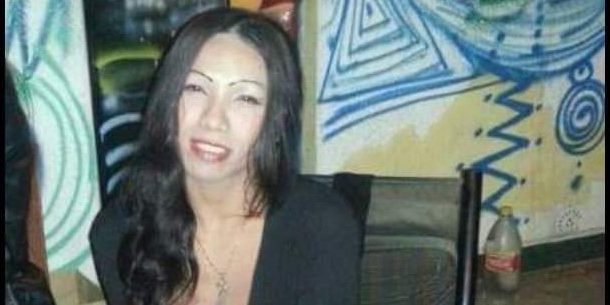
Laly Heredia, a 36-year-old trans woman, was murdered on Camino de Cintura.
Laly Heredia was a 36-year-old trans woman. She was killed by a gunshot to the hip, but she had been shot several times before that.

Share

[News in progress] Published at 00:25 [ Updated: 15:00 4/2/2019]
By ME Ludueña
A neighbor walking down the street raised the alarm: at dawn on Sunday, February 3, the body of a young trans woman lay at the intersection of Monseñor Bufano Avenue and Arribeños Street, Camino de Cintura, near Los Pinos (La Matanza, Buenos Aires Province). She had been shot in the hip, and several 9mm shell casings were found around her. She was taken to the Los Pinos Fourth Police Station. Her fellow trans women were almost certain of her identity. It wasn't until the night of February 3 that her sister and her partner identified her: it was Laly Heredia Escobar.
She was 36 years old and had come to Argentina from Lima, Peru, 10 years ago. She lived in Morón (Buenos Aires province) in a rented apartment with Emanuel Ferraro, a construction worker. "We've been together for nine years. She left home Saturday at midnight, telling me she'd be back by 5, but she never came. I found out what happened through social media," Ferraro told Presentes.
Yesterday, when Lali's photo began circulating on Facebook, Ferraro and one of Lali's sisters who lives in Argentina (the rest of the family lives in Lima), went to the police station and at the fourth station in Los Pinos they recognized the body.
"According to what the police told me, she was killed around 3 a.m. She was working when a man approached her asking for (sexual) services, and they executed her right there, at the door of a hotel on Camino de Cintura. We believe she was in agony from 3 to 7 a.m. Nobody helped her."
"There is still no definitive hypothesis as to who killed her or why," judicial sources told this agency.

The case is classified as "aggravated homicide with the use of a firearm." The Homicide Investigation Unit of the La Matanza Judicial Department is handling the case. So far, the only information available is that she was shot in the hip. However, she was shot several times before being killed. Robbery has been ruled out as a motive: the money she was carrying was not taken.
The bullet casings found next to his body are 9mm, the caliber used by police weapons. "It's the most common caliber. We haven't developed a working hypothesis based on the caliber," judicial sources said.
On Monday afternoon, the family continued trying to raise funds for the wake and planning how to organize a march to demand justice. They want to hold a march, coordinating with trans and travesti organizations. "We are devastated. Lali was incredible. She came to Argentina looking for a better life. She traveled to Peru once a year to see her mother, sent them money, and always dedicated herself to her family, never wanting them to lack anything. She carried a huge burden. She had dreams. She knew about the violence that girls on the streets suffer; she knew things were very bad. She had experienced what all those who work on the streets go through with the police. But she wasn't involved in anything shady," said her partner.
"They continue to violate us even after we are dead"
Shortly after the transphobic murder of Laly became public, the newspaper Crónica reported on the events, violating the gender identity law by referring to her with male pronouns. In response, trans activist Violeta Alegre wrote: “This process is one of the many unique aspects of our identities, where the media continues to violate us even after death, when we are not yet considered light. Reading the comments on our news stories, almost celebrating our deaths, shows us the horrific world we have been forced into, for being who we want to be, as a result of a State that refuses to even guarantee us a peaceful rest. They want us dead, we know it.”
Today they found another comrade dead from a gunshot wound. Today, within feminism, there's a blatant display of fascist messages against us. Today, our identities are suffering much more violence in the streets, from insults and bottles thrown at us, to police brutality and gunfire. Today, they won't share our news or create an uproar like they did with the appalling story in La Nazion. Nor will the mainstream feminist movement, which loves to report on living bodies and selectively highlights the dead, give us any light.
READ MORE: Investigation into the death of a trans woman run over on Camino de Cintura
Along the Camino de Cintura (which crosses several jurisdictions), many transvestite and trans girls survive by engaging in prostitution, exposed to violence of all kinds, including police violence.
While some of them may identify as sex workers, many more resort to prostitution as their only means of subsistence, after having been excluded and expelled from other areas such as education and work.
In order to begin to do something to reverse labor exclusion, in the province of Buenos Aires, the Diana Sacayán Transgender Labor Quota Law (promoted by this human rights activist) was approved by the legislature more than 3 years ago, in September 2015. But to this day it has not been regulated.
Deaths of transvestites and trans people so far in 2019
Laly Heredia's death is the second violent death of a trans woman in Argentina so far in 2019. But trans and travesti organizations that collect data say that in the first 31 days of the year there were at least ten deaths of trans and travesti people.
Jessica Benavidez, 33 years old, Entre Ríos
Of those deaths, two are under investigation. One of them occurred in Entre Ríos province, on January 24, when a neighbor in Paraná found the body of Jésica Benavídez, a 33-year-old trans woman. She eked out a living as a sex worker and lived in extreme poverty. Her colleagues called her “La Nicky.” She was originally from Santa Elena (La Paz province) and had arrived in the capital of Entre Ríos province more than 10 years ago.
Mirta Antonella Eva Di Marzo, 30 years old, Salta
Days later, on January 27, after spending three months in a coma following a brutal hate crime, 30-year-old Mirna Antonella Eva Di Marzo died in Güemes, Salta . She had been unconscious in intensive care since October 21, when she was attacked by a man outside the Caribe nightclub in General Güemes (50 kilometers from the city of Salta). “Hate speech is what killed Mirna and what continues to kill trans women,” her family’s lawyer, José Lazarte, told Presentes last week upon learning the news.
READ MORE Salta: Young trans woman dies after three months in a coma following hate attack
The silenced victims
Given the lack of official data on transvestite and trans deaths, organizations and activists keep a list documenting both violent deaths (transvesticide) and deaths caused by exclusion (social transvesticide: lack of access to basic rights such as education, health, work, housing, employment; most of these deaths are linked to diseases from which other populations do not die prematurely).
They are part of that list, which doesn't appear in the media:
Mariana Quinteros, La Rioja, 48 years old
Jessica Paola Ochoa, CABA, 36 years old
Carolay, CABA
Yamile, CABA, 24 years old
Sandra Cantero, Reconquista, Santa Fe
Gabriela Farias, Lomas de Zamora, Buenos Aires
Yesica Neira, Comodoro Rivadavia, 56 years old
Luciana Anahi, CABA (originally from Güemes, Salta), 28 years old
READ MORE: Salta: “Mirna was killed by hate speech”
Lali barely surpassed the average life expectancy for this group in Latin America by one year: 35 years. The data presented in this article was confirmed to Presentes by various sources.
We are present
We are committed to journalism that delves into the territories and conducts thorough investigations, combined with new technologies and narrative formats. We want the protagonists, their stories, and their struggles to be present.
SUPPORT US

FOLLOW US
Related notes


We are present
This and other stories are not usually on the media agenda. Together we can bring them to light.