

The journey of Julissa, a Salvadoran trans woman who left in the migrant caravan
This is the story of Julissa, a 27-year-old Salvadoran trans woman who decided to risk her life to save it. Fleeing the gangs that persecuted her because of her gender identity, she decided to join the migrant caravan that left San Salvador.

Share

This is the story of Julissa, a 27-year-old Salvadoran trans woman who decided to risk her life to save it. Fleeing the gangs that harassed her because of her gender identity, she decided to join the migrant caravan that left San Salvador heading north on January 16. The Salvadoran LGBTI Federation estimates that of every 100 people from the community who leave the country, about 30 disappear along the way, 50 return, and only 20 manage to reach their destination: Mexico or the United States. Julissa isn't intimidated by the numbers: "I'm not leaving to get ahead, I'm leaving to save my life."
By Paula Rosales, from El Salvador
Julissa left her house quietly. It was early one morning this month. Her steps were stealthy, fearful. She didn't want to alert her neighbors, much less arouse suspicion that she was leaving her home to escape a gang and join the migrant caravan that departed for northern El Salvador on January 16.
She's not exaggerating. This 27-year-old trans woman lives in a dangerous place, a department in the northeast of the country controlled by gangs. The area has a name, but it could really be anywhere in the Central American nation plagued by homicides and violence.
In 2018, El Salvador recorded a total of 3,340 homicides, an average of 9.2 deaths per day, according to official figures from the National Civil Police. By the end of the year, the country had a homicide rate of 50.3 per 100,000 inhabitants.
Julissa lived in an apartment building where 127 people were murdered at the end of 2018. That's why she decided to escape quietly; she feared becoming just another statistic for the authorities. As she walked purposefully through the deserted streets with her few belongings, her goal was clear: she would join a migrant caravan hoping to cross the border into the United States.
Julissa heard about the caravans on the news and then began to wonder over and over what it would be like to go on these massive mobilizations. But her thoughts remained just that, until December 10, 2018, when she decided to do it:
"That day one of the gang members came to ask me for $100, but I told him I didn't have it. On other occasions when they asked me, I hadn't refused, so he told me that I wouldn't get away with the next warning," he tells Presentes.
[READ ALSO: LGBTI+ migrants in the caravans from Honduras to the United States]
Deep down, Julissa is sad because she has no choice but to give up her home, her job as an informal vendor of shampoo, lotions, and beauty products, her customers, her life. The gang members are demanding more money than she can give them.
—They are living off our sweat and I can't stand it anymore, I've been in this situation for about nine years, I can't take it anymore, I have to emigrate.
Bread, circuses and LGBTphobia
Julissa grew up with her mother, grandmother, and aunts in a remote rural town in the northeast of the country, where corn and coffee were grown. When she turned 18, she began her transition, which led to her mother's rejection and constant beatings from an aunt. She defended herself, and was reported to the police for domestic abuse and imprisoned. Upon her release, she was informed that she had a restraining order against her, so with nowhere else to go, she asked a friend for shelter.
To her surprise, her friend told her that the humble Linda Luz de América circus was about to arrive in town and that she could find a job there and have a bed to sleep in. With no prior experience and no other options, she took the advice.
For five months, Julissa danced and imitated Tex-Mex artists Selena and Ana Bárbara, two of her favorites. Her pay ranged from four to six dollars per performance. The amount depended on whether she came down from the stage and walked into the audience to interact with them; otherwise, she only earned four dollars. Despite the audience's jeers and laughter, she always came down from the stage.
"When the circus moved to other towns, they didn't pay us, and that's when we worked the hardest. During that time, I lost weight, going from 180 to 90 pounds. I ate very little, or there were days when I didn't eat anything at all. It was terrible mistreatment," he recalls.
According to estimates from the Salvadoran LGBTI Federation, there are an unofficial figure of 5,000 transgender men and women in a nation of over six million inhabitants. The transgender community lacks legal protections and access to employment, forcing many to work in the informal sector, engage in sex work, or remain unemployed.
[READ ALSO: Karla Avelar: “In El Salvador there is a genocide of LGBTI people”]
One day, after Julissa finished her performance, a spectator approached her and told her he was in love with her. At first she hesitated, but he persisted so much that Julissa quit the circus and began a life with her suitor.
"Those were the best seven years of my life. He taught me what it meant to have a family. We got ahead despite his family's rejection, we managed to build a house, and we were happy until the death threats started," she said, looking down sadly and rubbing her hands together.
The threats from Mara Salvatrucha (MS-13) began in 2016. The gang members came to the couple's house and told them that they didn't want "assholes" in their territory, that it was a disgrace to the gang for that type of person to be near them.
Gangs are hierarchical, patriarchal structures that operate outside the law. In neighborhoods, they control people through threats of death, extort businesses, and sell drugs on a small scale.
The government of the leftist Farabundo Martí National Liberation Front (FMLN) is maintaining an offensive against gangs with thousands of police and military personnel on the streets.
—The gang member who called me said: I'm going to enjoy going to your house and shooting you in the head. I told him why they were going to kill me if I hadn't done anything to them, and he said that having homosexuals in the territory was low for them.
To protect their lives, the couple had to separate. Julissa went back to living alone and for two years dedicated herself entirely to selling beauty products and playing soccer for the Atlético Fénix women's team, where she became captain. Then, the gang members returned to her door to demand the money, which she couldn't pay.
 Migrant caravans: “We don’t want to travel with homosexuals”
 Migrant caravans: “We don’t want to travel with homosexuals”
 The mass exodus of people to the United States, organized through social media and WhatsApp chat groups, came to light in October 2018, when thousands of Hondurans decided to leave their country to escape poverty and violence. Days later, a large group of Salvadorans followed suit. This sizable group, which included dozens of children, raised alarms at the White House, and President Donald Trump himself ordered the militarization of the southern border to prevent their entry. Since then, the president has also been demanding that the U.S. Congress fund a border wall.
Trump's threats have not stopped the flow of caravans, which has also complicated matters for the governments of Mexico and the so-called Northern Triangle of Central America, made up of Guatemala, Honduras and El Salvador.
Official figures from the Salvadoran government estimate that 2,700 people have migrated in five caravans, of whom 600 have returned on their own and three others have died from various causes.
The movements continue, despite warnings and messages from local and US authorities. Julissa is one of them and risked asking in one of the organizing chat groups about the details of the trip.
"I asked a question to find out how many transgender women were in the caravan, because I am one of them, and quite a few people in the group asked that my number be removed because I am trans," she says.
Her question sparked a wave of criticism and insults. Among the responses was that the chat group was serious and that they did not agree with taking the trip with homosexuals.
—After the reactions, I felt discouraged. I didn't understand why they were saying those things. We're all human.
But she was determined to leave the country.
Julissa traveled 130 kilometers on the bus that took her from her hometown to the capital, San Salvador, a place she had never been before. She got off the bus when the sun was at its peak and walked on the hot asphalt of the unfamiliar city.
During the journey, he asked how to get to the Plaza de El Salvador del Mundo, the country's most iconic monument and a meeting point for people who decide to join the caravans heading to the United States.
Her luggage is minimal. A black backpack containing canvas pants, a roll of toilet paper, wet wipes, body powder, underwear, socks, and a pair of shower sandals.
In addition, he carries a rosary and an image of the Virgin of Guadalupe for protection during the more than 4,500-kilometer journey to the border between Mexico and the United States.
“No one is deceiving anyone into joining the caravans in El Salvador. The caravans represent a need for protection, work, and income,” commented César Ríos, director of the non-governmental Salvadoran Institute for Migrants (INSAMI).
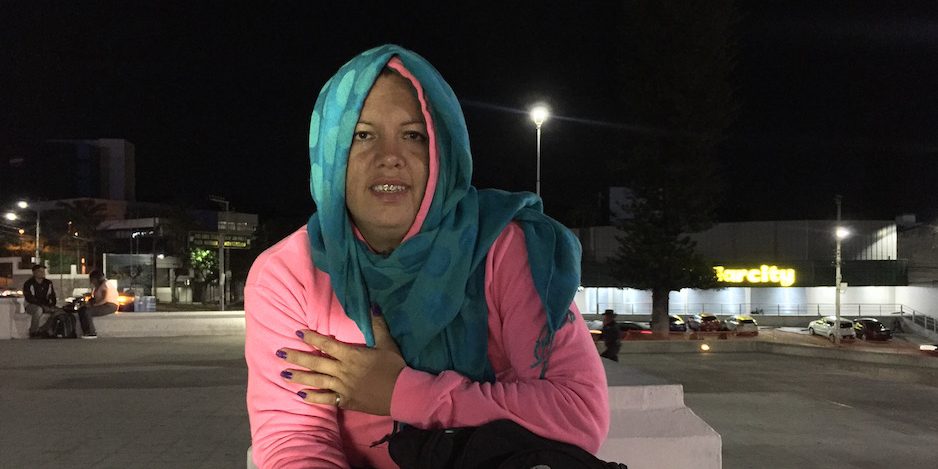
Night has fallen, the stars tremble again in the sky, the cold hits hard and Julissa is sitting at the foot of a monument, the Savior of the World, along with a dozen other migrants, who, exposed to the elements, wait for the time to begin their journey.
"Maybe I won't be able to sleep tonight, it's very cold, I'm afraid someone will come and steal our things," Julissa said as she blinked and hugged her backpack.
***
Julissa and El Salvador have something in common. Paradoxically, they both share the number 27. She is 27 years old, and El Salvador is celebrating the same number of years since the signing of the Peace Accords, which ended an armed conflict (1980-1992) between the Army and the former FMLN guerrillas.
Furthermore, January 16th on the calendar serves as a day for authorities to commemorate the pact between the warring forces, while for Julissa the day will be remembered because she embarked on her journey to the United States.
"I didn't know that was celebrated today. I wish the State would support us more, at least accompany us on the way to the United States," he said.
Very early in the morning, an anonymous organizer of the caravan goes around telling people that they should gather at one of the corners of the square to pray and receive instructions.
Julissa takes the opportunity to approach Liduvina Magarín, the vice minister for Salvadorans abroad, who has come to try to discourage people who are about to leave.
"The risks of migrating this way are great. They are exposed to all kinds of dangers. To begin with, the journey, the sun, hunger, disease, and also encountering people who are dedicated to doing evil; they are people who are traveling in the same caravan," Magarín warned Julissa, who in turn told him that she was determined to leave.
The deputy minister also explained to Julissa the attacks faced by members of the LGBTI community, but when Julissa refused to cooperate, she finally told her to be careful. Magarín gave her her personal phone number and told her she could call her anytime.
The Salvadoran LGBTI Federation estimates that out of every 100 people from the community who leave the country, about 30 disappear along the way, 50 return to the country, and only 20 manage to reach their destination.
Community groups are concerned that many people in the community end up falling victim to human trafficking networks. Some victims are lured by traffickers in bars or pubs, who inform them about false offers of asylum and protection in other countries.
The organizer gives the order for the caravan members to begin walking. Julissa slings on her black backpack, grabs two water jugs, and starts walking the perilous journey toward the United States.
"I'm not leaving to get ahead, I'm leaving to save my life," Julissa says.
We are present
We are committed to journalism that delves into the territories and conducts thorough investigations, combined with new technologies and narrative formats. We want the protagonists, their stories, and their struggles to be present.
SUPPORT US

FOLLOW US
Related notes
We are present
This and other stories are not usually on the media agenda. Together we can bring them to light.