

Brigitte LG Baptiste, trans biologist: "Science needs to be deconstructed"
The renowned Colombian biologist and ecologist Brigitte LG Baptiste was in Chile to talk about climate change. But with Presentes, she spoke about gender and nature.

Share

By Airam Fernández, from Santiago, Chile
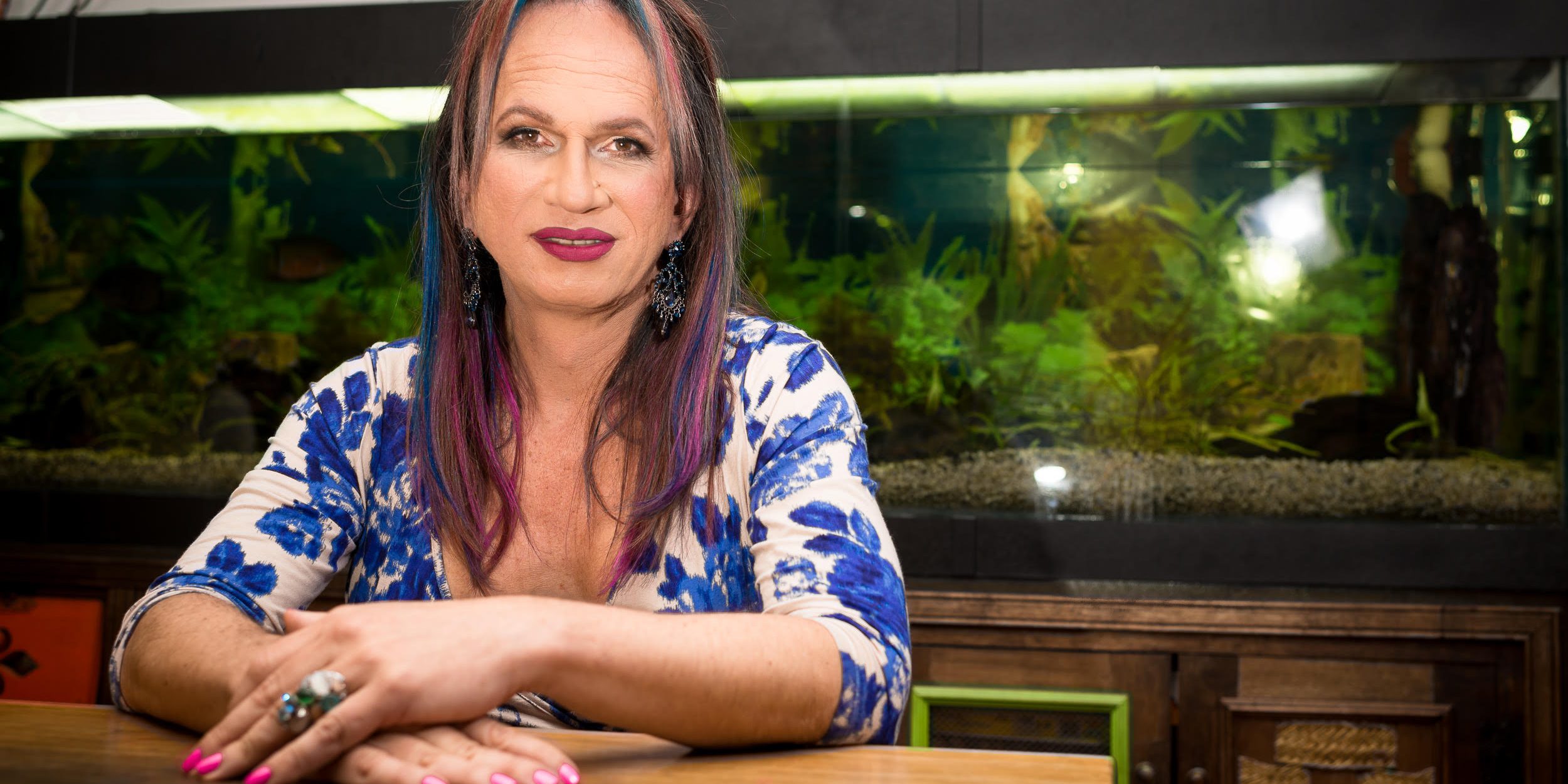
Brigitte LG Baptiste is the director of the Alexander von Humboldt Institute for Biological Resources Research in Colombia. An award-winning biologist and ecologist, she was in Chile to speak about climate change at the Congreso Futuro (Future Congress) and what would happen in the event of the extinction of cacao. But she, a trans woman and expert scientist, would have loved to talk about gender and try to answer the question that Latin America's largest science and thought festival chose for this year: "What species do we want to be?"
“With that question as an invitation, I thought it would be striking and interesting to look for spaces to talk about the construction of sex, because it is also a central theme in evolutionary biology and a central theme in contemporary cultural construction. Unfortunately, it didn't happen. I only dedicated myself to talking about climate change and other topics that are also extremely important,” Brigitte tells Presentes.
When she transitioned 20 years ago, Brigitte had to do so in front of a scientific and academic community where she already had a name and a solid career. She considers herself fortunate to be able to say that at the time, at 35, she had the full support of her colleagues and friends in that conservative world. After her visit to Chile, she was surprised that several people involved in that same world resisted her identity. “I was very surprised by that resistance to addressing me with feminine pronouns,” she said.
READ ALSO [ The challenges of the gender identity law in Chile]
-If you had had any opportunity to talk about how science contributes to explaining trans issues, what would you have said?
That would have been very interesting, but also quite a long conversation. I've spoken about this before, and I've always said that there are several interesting perspectives to consider. The most relevant ones have come from ethology or behavioral sciences, from primatology, and from feminist women who have deconstructed the interpretations of primate behavior that had been drawn from psychiatry or sociology. There has been fascinating work in this area by people like Joan Roughgarden and her book * Evolution's Rainbow* , where she compiles studies on transgenderism, transsexuality, and parenting among wild species and demonstrates the absolute prevalence of heterogeneity and all kinds of arrangements that have existed for millions of years. I would also have mentioned another contribution from the social sciences: how the construction of rights and identity elements are identified as components of personality development, of the evolution of the exercise of individual freedom, as a substantial element of social development.
 -This is where the queer theory you keep talking about comes in…
Exactly. When my wife Adriana told me about queer theory many years ago, I struggled to understand it, since the natural sciences are rigorous, often deterministic. We believe that the role of science is to reveal the truth, and that isn't necessarily true. Queer theory fundamentally states that identity is a contextual construct that develops. This possibility of playing and combining, constructing and deconstructing identities is also fantastic for expanding the notion of what it means to be human and of roles. And when you study ecology extensively, you realize that this is exactly what happens in the world, in ecosystems: the identity of all living beings is defined through their relationships with other living beings; there is no stable identity, nor one determined by their genes. The most obvious example is domestication, which creates identities all the time, even some that never existed before, and which constantly expand the notion of what life is.
-Has this been formally discussed or considered from a scientific perspective?
No. There is literature, there are movements, there are arts, but science hasn't thought about it or written about it, and that's the task I want to undertake: to provide support and arguments for the scientific community itself, which in some way rejects diversity or justifies determinism. What I like about this theory is that it questions the construction of identities and, above all, the erotic charge of identities, which is one of the least analyzed topics by contemporary science, leaving it to medicine and psychiatry.
-So you're in favor of deconstructing that contribution of science to explain trans…
-Absolutely! Deconstructing science to address gender and sex is a crucial task. Ultimately, science is a social construct, so it must constantly correct itself. The construction of nature has many biases, much ideology, much subjectivity, which is neither good nor bad per se, but rather part of the phenomenon or of our position as organic beings who come from the living world.
-If you had to compare yourself to a wild species, plant or animal, which one would it be?
-It would definitely be a snail. They're hermaphrodites and they have epic mating rituals, imagine that!
-Do you think there is a connection between your love for biodiversity and your daily life?
My current reflections are increasingly reconciling me with these issues. Reconciling me in the sense that I was a person full of questions, wanting to understand why human beings find it so difficult to accept diversity as something positive, why we always construct discipline to build people's identities, and how we use that to organize society. It always seemed to me that there were significant contradictions, or that we were being too deterministic, especially because it's so often repeated that homosexuality or adoption by same-sex couples isn't natural. And when I begin to understand that it does happen in nature and in wild spaces, I feel a great sense of relief on the one hand, and a pedagogical obligation on the other. At least so that the arguments of naturalization that have always been used against me, and with which people have sought to limit the rights of LGBTI people, don't continue to gain ground.
-What things do they criticize you for?
-There is a sector that cannot understand how it is possible that the director of the Alexander von Humboldt Institute, which promotes issues such as conservation, protection of nature and sustainable use of biodiversity, intends to change gender or "fake" a sexuality that has not been granted to her.
 -How was your transition received by the scientific community in Colombia?
I was studying in Barcelona, I had gone there to distance myself from my past. I had been there for a year when they came to find me from Bogotá. I remember that moment and I get emotional because someone I appreciate very much, who later became dean of a faculty, came all the way there and said to me, "Look, I want you to come to the university and be a professor." I thanked him for the gesture and told him that he should realize that I was a different person now. But he told me that he saw the same person I had always been and that the change I was pointing out wasn't an impediment. It was wonderful because when I returned to the Pontifical Javeriana University in Bogotá, a Catholic university, nobody cared anymore. Or at least nobody said so. Those years I spent teaching, where my feminization became public, were very special and very positive, and I know I'm privileged for that, because other trans women aren't even close to being able to tell their stories in that way, something that makes me very angry in this unjust society.
-You have two daughters and are married to a woman. What is it like to live in a diverse family?
– I don't like to define myself as a mother or father, but as a parent. My wife Adriana met me that way, and the family we started building began when I publicly freed Brigitte. We've been very careful never to impose any kind of gender script on them, but of course, it exists at school and in the rest of the world, so we've always tried to help them not take that heavy stuff that comes from outside so seriously because it doesn't warrant it, unless it involves violence and we have to intervene. My daughters find the issue of gender somewhat irrelevant or trivial because they've grown up without any deliberate instruction on what it means to be a man, to be a woman, or to represent themselves in one way or another.
-In an interview you said that in this whole process, the only thing you weren't willing to change was your voice, why?
Since my transition was so late, coming out publicly at 35, there were many aspects of myself I hadn't struggled with. My voice had served as an anchor of joy, of expression. Besides, I sang in choirs and for decades sang as a baritone. It was something I really enjoyed. I like my voice as it is. I did do some voice therapy sessions, though, and I didn't feel comfortable. Perhaps it's another element one plays with, just as I keep the "LG" in my name, from Luis Guillermo, because it's the name my parents gave me. It's a series of physical marks that are important to remind me that I'm still the same person.
-What experiences or lessons did you take away from Chile?
Although this is a very conservative country in many ways, I was very impressed by the presence of feminist discourse, the strength of the arguments, and the advocacy in these spaces, especially since there isn't anything similar yet in Colombia. Also, the way science and its use in society are discussed is striking, because this is a country that is conventionally wealthier than the rest of Latin America, and that's reflected in the way modernity and development are discussed.
-Most of the local media outlets that covered your participation in the Future Congress referred to you as an "expert" and not as a "trans expert." Do you think that's a benefit or a way of making your identity invisible?
"I hadn't noticed that detail; perhaps it's because I'm quite lenient in that regard, not very demanding in terms of how I'm treated. However, it does bother me when they change my gender to 'expert' or refer to me as 'gentleman,' which has happened several times since I've been here. Undoubtedly, when someone does that, they have an ulterior motive, and it's not a naive situation."
Share
We are present
We are committed to journalism that delves into the territories and conducts thorough investigations, combined with new technologies and narrative formats. We want the protagonists, their stories, and their struggles to be present.
SUPPORT US

FOLLOW US
We are present
This and other stories are not usually on the media agenda. Together we can bring them to light.