
By Bruno Díaz *
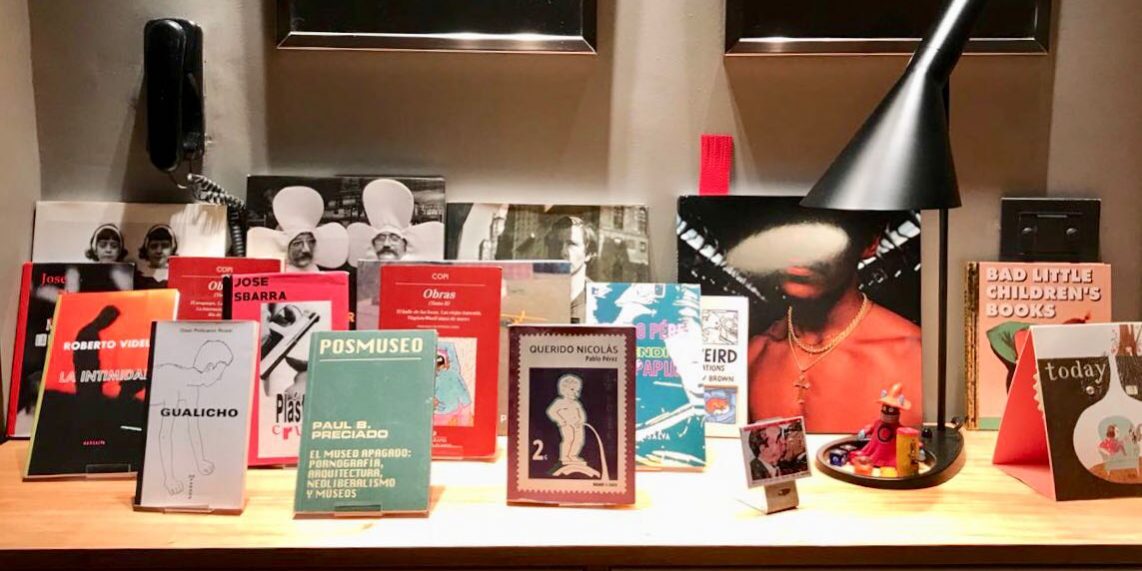
The Cock-Sucking Beggar, by Pablo Pérez
“I threw myself at his feet, kissed his thing, and wet it with my tears.” (Lorenzo Verdasco)
Born from the queer South American publishing scene of the early nineties, *El Mendigo Chupapijas* (The Dick-Sucking Beggar) is one of the most mature (though no less acerbic) fruits of beauty and happiness. First sold as a pamphlet (with a free toy!) and later adapted into a short film, Pablo Pérez , the author, always pushes the boundaries a little further. Reissued by Mansalva in 2006, with its volatile prose, shrouded in the sordidness and humor characteristic of the world that survived HIV, it helps us rethink the meaning of love, and makes us stop (and move) to consider the voraciousness of a beggar who, living through scarcity, devours everything in front of him.
It's enjoyable even before you buy it. The reaction of some booksellers to the abject title is amusing, as is the double taboo of poverty and homosexuality in the same book. A must-read.
Intimacy – Roberto Videla
“I go to the movies on my own initiative. I enter, as always, somewhat embarrassed. The woman at the ticket booth greets me warmly, of course: I'm a regular customer. (…) She gives me a candy, which she reserves for her favorites, I suppose, which is good for my breath, in case I have to kiss.”
A journey through the seedy underbelly of saunas, porn theaters, and cruising areas, recounted with the simplicity of someone describing Guernica without batting an eye. Roberto Videla (theater director, actor, and writer) has the audacity to write in the first person something that is clearly autobiographical. The duality of the author's enjoyment is evident in the experiences he has and recounts, or even those he has yet to recount. Reading *La Intimidad* (Mansalva Publishers) is like stumbling (the redundancy is fitting) upon a personal diary published in a Sunday morning paper, on an odd-numbered page, right at the top and in italics, where it becomes clear in each and every story that in the queer world, having non-monetary exchanges is as easy as entering a gas station bathroom at the appointed time.
The meticulous detail of what appears to be a taxonomy of the body and bodily fluids is highly enjoyable, as is the liberation from the limits imposed by the social self, in a subculture where who you are or who you have been doesn't matter. An ode to shamelessness and lack of prejudice.
Cruel Plastic – José Sbarra
"Whether you love it or not, it is always terrible" ( Marguerite Yourcenar)
Cruel Plastic is the story of a love triangle between a transvestite, Bombón (poet and prostitute), Axel the Pig, a 17-year-old boy in love with a bourgeois girl from Buenos Aires society (Linda Morris, the plasticized woman), and Axel's penis, which captivates both Linda and Bombón equally. The narrative unfolds through dialogues, hallucinations, and traffic signs, in a highly cinematic book that is expected to be adapted for the stage this year by Naty Menstrual (Batido de Trolo, Continuadísimo) in the role of Bombón.
Its author, José Sbarra, said in an interview with Enrique Symns: “I wrote Cruel Plastic to demonstrate that love doesn't exist. That love is cultural, that life is sex, that everything was clear in sex and I didn't achieve it.” His failure is the reader's delight in the poetry of the work, which is undeniably hilarious.
As a bonus, a decantation:
Don't go.
–This story is over.
–Is there another type?
–There are thousands of types.
–All made of plastic.
–They will be more appropriate for me, according to you.
"Why don't you lie to them instead of lying to me? Tell them you love them, but deceive them with me. Love only me, sleep with everyone, but love me."

The Museum in Black – Paul B. Preciado
“A rebellion of bodies is urgent and essential in the 21st century.”
A brilliant student of Derrida, an enfant terrible, Paul B. Preciado denounces the mercantilist logic of the museum, where the profit of the works (the indication of their price rather than their value) depends on the numbers shown in the box office receipts, with the (unbelievable) pretext of overcoming dependence on state funding, in a museum increasingly focused on the tourist.
His reflections on the bathroom as a place for verifying gender assignment are impeccable, where peeing = standing and pooping = sitting, where what matters in a bathroom is what one is going to do, but rather the match between one's appearance and the icon on the door (loafer-high heel shoe, man-woman, mustache-little flower), under penalty of social condemnation.
Paul Preciado directs the research and artistic production project: Technologies of Gender and promotes the theoretical and political initiatives of drag king, post-pornographic and transgender.
He was expelled from the Barcelona Museum of Contemporary Art (in an episode reminiscent of the sad actions and subsequent censorship of León Ferrari at the Recoleta Cultural Center) after presenting the exhibition "La Bèstia i el Sobirà" (The Beast and the Sovereign), where a German Shepherd mounted the Bolivian activist Domitila Barrios, who in turn mounted King Juan Carlos. A beautiful surprise that, exposing the behind-the-scenes workings of cultural productions, it was published by MALBA.
Gualicho – Gael Policano Rossi
“All of life is a conquest, the victory of human passion over the commandments of cowardice.” James Joyce
The first novel by poet and playwright Gael Policano Rossi features a man on all fours on its cover. Ironically, the publishing house (run by Mariano Blatt and Francisco Visconti) is called De Parado (Standing Up) and describes itself as “the gay publisher your mom warned you about.” They sell in off-the-beaten-path bookstores, but also offer their catalog through social media and Grindr.
In Gualicho, as in The Comedy of Errors , the protagonist receives a package that wasn't meant for him, containing a macumba that inevitably leads him to insert things into his anus, in a plot that is no longer quite Shakespearean. The satisfaction of anal delirium emerges as the only way to calm the feverish and delirious states that the gualicho produces. The sordid sequence escalates from timid fingers in the shower to teapots, fisting sessions, public gangbangs, and kilos of cocaine, in a book that is more pornographic than erotic.
The result is a super valid option for all those who are looking to get turned on rather than be intellectually challenged.
Published in December 2016, Blatt says: “For us, Gualicho has to be one of the novels of the summer. It takes place in a sweaty, sweltering Buenos Aires. A hot story with fresh writing. Heat is the best way to cool things down.” And he couldn't be more right.
The book's resolution is morally troubling. A dose of reality amidst all the fluff, the nonsense, the tenements, and the Buenos Aires affectations.
It's not my fault I was born so sexy – Eduardo Mendicutti
“On a dark night, with longing, inflamed with love, oh blessed fortune! I went out unnoticed, my house being already quiet.”
John of the Cross
Rebecca de Windsor, a trans woman who bears a striking resemblance to Amande Lepore, discovers while removing her makeup that (though still far from the first signs of any kind of decline) no woman, however female she may have been born, can be a femme fatale for the rest of her life. Accustomed to the excesses that characterize the world of transvestites, she sets herself the humble goal of leaving this world transformed into a saint. Surely the most successful and famous of them all.
Extremely worried about finding the right name (there's no room in heaven for two Saint Teresas), she embarks on a crazy journey through seven Spanish monasteries along with Dani, a bodybuilder who acts as Sancho, and who also seeks in such a pilgrimage to atone for God knows what sin.
Mendicutti is corrosive, he's hilarious. No one portrays the tension between the universality of the transvestite phenomenon and the local reality of a queer woman in a country with more cathedrals than gay saunas quite like him. A heavyweight to add to the scales denounced by Australian critic Dennis Altman, where homosexuality is, even today, more Americanized than ever.

The war of the faggots – Copi
“If God is with us… who is with them?”
Copi was a wonderful cartoonist, playwright, and novelist. The War of the Faggots is a masterpiece, but that's not saying much: Copi only ever wrote masterpieces.
The translation of the original ( La guerre des pédés, something like the war of the faggots or the war of the queers) chosen by El Cuenco del Plata even lends a friendly tone to a book that (although hilarious) still recounts a war. That the warring factions are cannibalistic hermaphrodites who live on the moon, that they fight against sadomasochistic transvestites for the conquest of Paris, that the Wailing Wall is proposed as a giant teapot for Palestinians to suck one's dick, are all generations and degenerations that only a genius like Copito (the nickname his grandmother gave Raúl Damonte Botana) seemed capable of conceiving.
[READ ALSO: Evita the transvestite and the body as the center in two of Copi's works]
The mission (or perhaps a premonition?) of the 'Interspatiale Homosexuelle' is amusing, an organization dedicated to protecting homosexuals worldwide at a historical moment when what was longed for was nothing more than civic access to activism, a bit of humor, and transgression of every possible norm. Ultimately, it's moving that the underlying issue is, as always, the resolution of love in an 80s universe that was close to collapsing under the devastation that HIV would bring.

Tell Me About Love – Pedro Lemebel
“What hurts is not being homosexual, but having it thrown in your face as if it were a plague.”
Chavela Vargas
Tell Me About Love is practically the last work published by Pedro Lemebel. And if he ever toned down his unconventional style, that can no longer be expected from a celebrated, multi-translated, multi-award-winning Lemebel, old and beginning to grapple with a brain tumor diagnosis.
It's funny to imagine Pedro writing "Tell Me About Love," all made up and in heels. Never before has such irreverence been seen since he founded Las Yeguas del Apocalipsis; never has he been so baroque, so critical, and so voluptuous when tirelessly hammering away at the blessed typewriter.
While the wealthy half of Chile was reflecting on the Chilean economic miracle in the bourgeois circles of Santiago, the other half, embodied by Lemebel, tells us in this book about the poor, marginalized, transvestite, and queer Santiago that—as always—fights to avoid being left untold, in stories that are meant to move you, to make you shudder, to make you laugh and to make you cry, and that distill resentment and anger in every letter he types.
A highly recommended short story from his 90s collection , Loco Afán: Crónicas de Sidario. Don't miss Los mil nombres de María Camaléon.
His family recounts, after his death: “Pedro suffered for a long time from laryngeal cancer and fought a great battle against this terrible disease, which tried to leave him without a voice, but who could leave Lemebel without a voice? His voice exists and persists.”
Without Lemebel, there would have been no Perlongher, the Aira we know wouldn't have been the same, and Copi wouldn't have laughed so much. Thank you so much, dear Pedro!
[READ ALSO: “Your voice persists”: Lemebel as told by his loved ones]

(*) He's a political scientist by profession, but defines himself as a voracious reader of queer literature, a photographer, a busybody, and a voyeur. We went to find him to get his summer reading recommendations, although he believes any time of year is a good time to dive into a book.