

This is how a diverse family lives amidst the LGBTphobia in Guatemala.
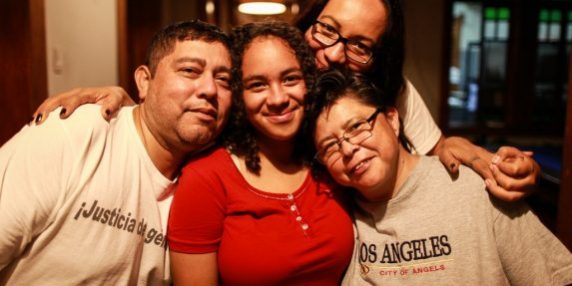
Two lesbian mothers, a daughter, and a heterosexual father. That's the clan of Claudia, Amarilis, Carmen, and Wilber, a diverse and visible family from Guatemala.

Share

By Javier Estrada Tobar, from Guatemala*
Photos: Carlos Sebastián
Carmen goes to school every day, enjoys playing sports, takes part-time jobs during vacations, and has already had her first boyfriend. She is 15 years old and dreams of traveling, studying at university to become a professional, and getting a good job. Her life is very similar to that of her classmates, but behind her upbringing are her two mothers, who are lesbians, and her father, who is heterosexual.
Together they form one of the many diverse families in Guatemala, and one of the few that aren't afraid to openly identify as queer and tell their story. Carmen, in fact, is her real name. And this story is about how they confront ignorance and hatred in a predominantly conservative society that marginalizes those who are 'different'.
Carmen arrived at her first day of elementary school in Zone 11 of Guatemala City, accompanied by her two mothers and her father. As she grew older, she drew a picture of herself with three adults in class when the teacher asked her to illustrate her family. And recently, at her quinceañera, the four of them—she, her two mothers, and her father—celebrated with their friends. For as long as she can remember, having a diverse family that cares for and loves her has been the norm.
A feminist family
"What I will never lack is love, and I have it multiplied by three," says Carmen, a smiling and cheerful teenager, who gets emotional when she talks about her family.
Claudia Rosales, 43, is Carmen's biological mother and lives with her partner, Amarilis Barrios, 49, Carmen's other mother. Claudia is also married to Wilber Asencio, 41, who is not Carmen's biological father, but he has acknowledged her as his daughter and loves her as such; he lives in a separate house but is also part of the family.
The three adults, Claudia says, consider themselves feminists and believe in responsible masculinity. They are also activists in organizations that work for the rights of women, the trans community, and sexual and reproductive health. Thus, they define themselves as a diverse family, outside the traditional family model of a father, mother, and children.
For Carmen, her family is special: Claudia decided to have her, so she was a wanted and loved daughter even before she was born; Wilber applies his knowledge of 'tender parenting' and she has always felt loved by Amarilis, with whom she has a very close relationship.
But outside their home, things are different. The bubble of acceptance and love ends at their front door.
 An invitation “to hell”
 An invitation “to hell”
In the middle of an interview, Carmen's smile fades to a serious expression. She takes a deep breath and pauses briefly when asked about the hatred directed at the LGBTQ+ community in Guatemala. She doesn't hide her discomfort as she recalls the bad experiences she's had, because she knows how difficult it is to be part of a diverse family.
"I've been told to go to hell several times. And the same thing happens to my parents, who have received invitations to hell all the time. Even my best friend told me to go to hell when I told her about my family."
Claudia Rosales was always concerned about her daughter's interactions with other children her age. One of the first warning signs came when she received a call from daycare because her daughter said she didn't know if she would marry a woman or a man when she grew up. It's an anecdote that makes them laugh now, but it caused some tension back then.
Situations like this continued as the girl grew into a teenager. When her best friend, a teenager who grew up in an evangelical family, rejected her for having a diverse family, Carmen was dealt a heavy blow. And she received many other hurtful comments like that one. But she has also learned to withstand them and respond.
—It's been tough with my classmates. In the case of my best friend, she went through a long process to get to know and accept me, and also to accept my family. Although it wasn't the same with other classmates.
Claudia, Amarilis, and Wilber nod in agreement as Carmen tells her story. All three, in one way or another, have also been discriminated against or stigmatized for the lifestyle they have chosen, but they are prepared to face the consequences.
Wilber Asencio says his mother once asked him if he was gay, and he replied no, but that he was attracted to trans women, which caused friction. He has also received offensive comments from coworkers who question why his wife is a lesbian and lives with another woman. They imply that his wife is cheating on him.
"These are battles I'm not going to fight anymore," he says.
Claudia Rosales and Amarilis Barrios have also experienced rejection from their own families, who are not entirely in agreement with their sexual orientation. Claudia's family does not accept a diverse family, and in Amarilis's case, there is increasing openness, but not complete acceptance.
—Families' rejection of diversity, discrimination, and exclusion are complicated, but that very thing makes us more united in our diverse family, which is our circle of mutual support—, says Claudia Rosales.
Escaping the radar of hate
Claudia Rosales is busy with her work at an organization that supports gender equality, but she takes a few minutes to answer this journalist's call. She answers the phone with excitement and speaks quickly:
—I know why you're calling. I'd be happy to introduce you to my family and we'll give you the interview. And there's no problem with showing our names and faces, because we're very proud of who we are and the love that unites our family.
In Guatemala, there is a growing group of diverse families, composed of gay, lesbian, bisexual, and transgender people, as well as polyamorous heterosexuals, who meet to talk, share their experiences, and support one another. They are visible every day and everywhere. But at the same time, they are invisible to the law and to the most conservative sectors, who deny their existence or believe they shouldn't exist.
[READ ALSO: 2018: Guatemala on alert and in debt to LGBTI+ rights]
—We are very proud of our family, but we don't want our daughter to be exposed to a situation where she is vulnerable—, commented a lesbian woman alongside her partner, at a meeting to discuss this report.
They were the ones who shared Claudia's contact information, and she agreed to give an interview.
These are not people living in hiding. Quite the opposite. Diverse families are in their homes, offices, schools, supermarkets, cinemas, banks, parks, and all public and private spaces, just like any other family.
Violence against the LGBTIQ community in Guatemala forces them to be less conspicuous and avoid speaking openly about their lifestyle.
The Public Prosecutor's Office received 83 complaints of attacks against people of diverse sexual orientations and gender identities between January 1 and July 17, 2018; most were for threats, discrimination, and minor assaults. Marco Tulio Escobar Orrego, the prosecutor against discrimination, believes that most cases of attacks or discrimination against the LGBTIQ community fall outside the justice system due to a lack of reports.
"There are many unreported cases of assault, and that is precisely why we must encourage the LGBTIQ community to report them, to end impunity," says prosecutor Escobar.
In the case of diverse families, they must confront prejudice and misinformation. The most common concerns are that lesbians and gay men are mentally ill, that lesbians are less maternal than heterosexual women, and that the relationships of lesbians and gay men with their sexual partners leave little time for their relationships with their children.
“Many people worry about children from diverse families; they think they’ll grow up with some kind of emotional problem, that they’ll be troubled or confused. They’re wrong. Loving parenting and education are what define a child’s development,” Wilber says.
[READ ALSO: #Guatemala Alert over a law against the rights of women and LGBTI people]
In fact, there are no serious studies or research demonstrating that children of same-sex couples are more likely to be homosexual than children of heterosexual couples. On the contrary, scientific evidence shows that the sexual orientation of parents does not have a greater influence on the identity of their children, and a study from the University of Kentucky is the most conclusive in this regard.
This aligns with the position of the American Psychological Association (APA), which relies on scientific research to assert that gay and lesbian parents are just as likely as heterosexual parents to provide a supportive and healthy environment for their children.
The evidence from the United States, where same-sex marriage has been legal in liberal states since before 2004 and adoption by same-sex couples has been legal since the 1990s, also suggests that children of lesbian and gay parents have functional social relationships with their peers and adults, the APA notes.
No answers for diversity
The lack of legal recognition for diverse families has serious consequences for the development of their members, says Sandra Morán , the first congresswoman to openly declare herself a lesbian.
Congresswoman Morán attempted to lobby for legislation to recognize same-sex civil unions in the national register. According to the congresswoman, the goal was to guarantee inheritance rights, social security benefits, and mutual protection for same-sex couples. Ultimately, opposition from conservative groups and the stagnation of the agenda following the arrival of the Pact of Corrupt Officials in the legislature discouraged further discussion of these ideas.
—Society, families and individuals evolve, but our laws continue to respond to the needs of the 1960s, when the Civil Code was created—, says the congresswoman.
[READ ALSO: #Guatemala The congresswoman who fights alone for LGBT rights]
An example of the lack of recognition for diverse families is exemplified by Fernando Meneses, a Guatemalan man who has been in a relationship for 22 years with Kevin Cole, an American. The couple, aged 46 and 54, met in 1996 and have built a life together ever since. However, their official documents list them as 'single'.
—For the past four years, we've been working on Kevin's Guatemalan residency application. It's been very complicated because, legally, there's no marriage between us. We know of a heterosexual couple who only had to get their residency in a year because they're married.
"Isn't that a disadvantage?" asks Fernando Meneses.
She explains that the lack of recognition for diverse families translates into a denial of rights. And that violates the principles of the Constitution, which, among other things, guarantees the protection of individuals, as well as freedom and equality in dignity and rights.
“It is necessary for states to guarantee access to all existing legal frameworks, including the right to marriage, to ensure the protection of all the rights of families formed by same-sex couples, without discrimination with respect to those formed by heterosexual couples,” the Court continued.
Luis Barrueto, president of Visibles, a Guatemalan movement that works for the inclusion of sexual diversity in society, believes that the recognition of equal marriage and diverse families is an outstanding debt of the States in a basic matter of justice and equity.
—This recommendation from the IACHR is fundamental because it establishes a precedent upon which the American states, including Guatemala, must act to recognize the basic rights of diverse families—, he explained.
For Fernando Meneses, the denial of marriage rights to same-sex couples has implications that go beyond the legal realm. It is something deeper that wounds the social fabric and affects all people, heterosexual and homosexual alike.
“We must defend love, respect, and tenderness in all its forms. Whether it's traditional or diverse families, we all have the right to be happy and to care for the people we love. That's why we defend marriage equality,” Meneses concluded.
* Nómada magazine .
We are present
We are committed to journalism that delves into the territories and conducts thorough investigations, combined with new technologies and narrative formats. We want the protagonists, their stories, and their struggles to be present.
SUPPORT US

FOLLOW US
Related notes
We are present
This and other stories are not usually on the media agenda. Together we can bring them to light.