

2018: Violence increased in Paraguay under an anti-LGBTI rights government
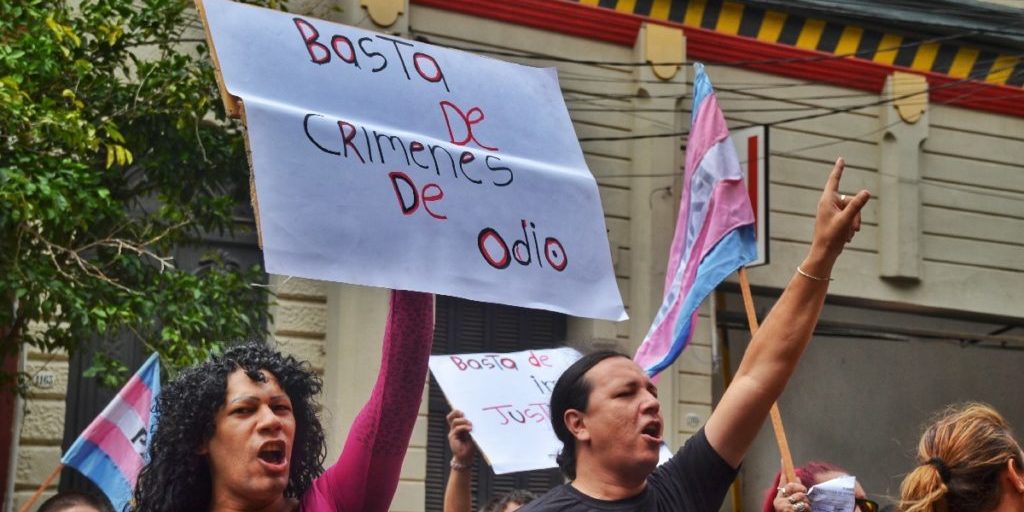
By Juliana Quintana. 2018 is another year that ends without the Paraguayan Congress addressing an anti-discrimination law. In the first year of Mario Abdo Benítez's government, no progress has been made in terms of legal regulations for the promotion and protection of the rights of lesbian, gay, transgender, and other LGBTQ+ people.

Share

By Juliana Quintana
2018 is another year that ends without the Paraguayan Congress addressing an anti-discrimination law. In the first year of Mario Abdo Benítez's administration, there has been no progress in terms of legal regulations for the promotion and protection of the rights of lesbian, gay, bisexual, transgender, and intersex people. On the contrary, levels of violence against this community have increased. There are no official statistics or public policies.
The government has hardened its stance against LGBTQ+ rights, both in international human rights forums and nationally, due to the lack of implementation of public policies. In addition to assimilating hate speech promoted by anti-rights groups, it continues to deny LGBTQ+ people access to basic rights such as employment, education, and justice, and, furthermore, not a single person has been convicted for the 61 trans femicides that have occurred from 1989 to the present day.
[READ ALSO: “Paraguay assumed an active role against LGBTI rights at the OAS Assembly”]
While there is no official data on violence and discrimination against the LGBTIQ+ community, several social organizations maintain a registry that is published annually. Activists Rosa Posa, Carolina Robledo, and Airym Sarta, from Aireana (Group for Lesbian Rights); Erwing Augsten, from Mansión 108; and Mariana Sepúlveda, from Panambí (Association of Transvestites, Transsexuals, and Transgender People of Paraguay) contributed a chapter to the report by the Paraguayan Human Rights Coordinator (CODEHUPY) on the human rights situation of LGBTIQ+ people in Paraguay during 2018.
72 reported attacks and 4 hate-motivated murders
The Panambí organization's center for documenting cases of violence against transgender people received 72 reports between January and October 2018: 4 were murders and 68 were other forms of violence. This year, Panambí launched a hotline to receive reports of violence against transgender people. According to the organization's president, Vicky Acosta, they received 100 new reports of discrimination between October and December of this year alone.
Transvesticides and transfemicides
According to Panambí's records, they received four hate crime reports this year. The report details the transfemicides of Naomi Gomes and Nikol Ortellado.
Naomi Gomes Rivas , a 29-year-old transgender woman, was murdered in the Naranjo area, near the city of Piribebuy (100 kilometers east of Asunción). Her family had reported her missing on Monday, August 27. The perpetrator, 19-year-old César Guzmán Franco Ruiz, confessed to killing her with a machete and then burning her body. He also led the police to the location where he had buried Naomi's body. Some evidence collected from the crime scene was sent to the Public Prosecutor's Office in Caacupé.
Nikol Ortellado , a 24-year-old trans woman, was murdered in Puerto Obligado (located about 60 kilometers from the city of Encarnación, bordering the Argentinian city of Posadas) two days before the Pride march in Asunción. In the early hours of Thursday, Nikol was stabbed multiple times and suffered internal bleeding that caused her death.
[READ ALSO: “Waiting for death”: how trans people live and die in Paraguay]
“The discrimination we experience is very strong, even more so with this National Congress that has just declared itself pro-life and pro-family,” Acosta states. “This is very dangerous for the gains we have already made in terms of rights. Today we deeply mourn the murders of our sisters and we are worried that this will increase because a very strong anti-rights wave is coming to our country.”
Lince Group: persecution and arbitrary detention of trans people
In a context where Paraguay ranks last in South America in the PISA tests (which assess academic skills for young people) and where the proposal for mandatory military service has resurfaced, authorities are proposing that young people join the Motorized Tactical Operations Unit, also known as the Lince Group. This branch of the police is notorious for arbitrary arrests and systematic human rights violations.
According to public complaints gathered from the press, there were five arbitrary arrests by this group during 2018:
- February 28, 2018 (Asunción): A transgender person was physically assaulted in a public place without a warrant, allegedly due to “suspicious behavior.” When they tried to record their arrest, their cell phone was broken. At the Third Metropolitan Police Station, they were physically and psychologically assaulted because of their gender identity.
- April 16, 2018 (San Lorenzo): Transgender sex workers were arrested and physically assaulted by police officers from Police Station 30. The arrest was made following a complaint from a person who said they had been robbed by the same women.
- May 19, 2018 (Caaguazú): A young man was stopped on the street by two officers from the Lince Group who demanded he remove a nose piercing. Police authorities acknowledged the officers' misconduct and recorded it as a prior incident in the police justice system.
- August 28, 2018 (Asunción) : Officers from the Lince Group, without a warrant, conducted a physical search of two people in Plaza de los Héroes. They forced them to the ground with their hands behind their heads. A young man who was filming the incident with his cell phone was discovered by one of the officers. They threw his phone to the ground and demanded his identification. Since the young man did not have it, they told him he had to be taken to the police station to verify his personal information. The young man was beaten during the transfer, and one of the officers told him, "I hope they shoot your mother and your daughter in the head for trying to tarnish the Lince Group."
Aireana's Rohendu telephone line ("we listen to you" in Guaraní) received 144 calls between October 2017 and October 2018. This figure decreased compared to 2017 (203), however, cases related to violence between couples and family discrimination increased.
“This year we’ve had some truly terrifying cases of domestic violence related to the control and violence exerted over girls. Several cases involve lesbian teenagers or young women who experience violence within their families. But for every one who dares to speak to us, how many more must remain silent?” activist Rosa Posa told Presentes.
Finally, the HIV and Human Rights Counseling and Complaints Center received 218 cases classified according to the affected population, from October 2017 to the same month in 2018. Between these three civil society services, they accumulated 294 cases linked to discrimination and violence towards people because of their sexual orientation or gender identity .
Source: Codehupy.
General elections: absence of public policies for the LGBTIQ+ community
This year there were general elections in Paraguay, and during the election campaign, the rights of LGBTIQ+ people were notably absent from the government proposals of the candidates with the highest voting intentions.
President-elect Mario Abdo Benítez adopted a rhetorical approach that promoted a single family model based on marriage between men and women and compulsory heterosexuality. Furthermore, he declared during his campaign that he would veto any bills that threatened this institution . In this way, the new government poses a threat to the fundamental principle of the universality of rights and reinforces its discriminatory stance toward gender and sexual diversity.
[READ ALSO: #Paraguay Chamber of Deputies declared itself “pro-life”: “It violates the Constitution”]
“We believe this government is the same as the previous one; there hasn't been much change in that respect. It's heavily influenced by the most fundamentalist anti-rights groups and plays a very sad role internationally. This whole thing about denying LGBTQ+ rights, wanting to erase that term, wanting it to disappear—we're on that path, with a government that's very openly against our rights,” Posa stated.
Queer artist charged with “exhibitionism”
In May of this year, the Paraguayan prosecutor's office charged Brune A. Comas for a performance he gave at the Besatón Festival, organized by the group "Somos Gay" (We Are Gay). In his performance, he denounced the violence and discrimination suffered by the LGBTQ+ population in Paraguay. The Secretariat for Children and Adolescents accused him of "acts of exhibitionism." Amnesty International launched a social media campaign to have the charges dropped. On Monday, a demonstration was held in support of his dismissal, and on Wednesday, the results of the preliminary hearing were announced, in which the court decided to apply a conditional suspension of proceedings, meaning he will not go to trial.
[READ ALSO: Prosecutor pursues LGBT activists who participated in Kiss-In]
Political pressure from anti-LGBTI rights groups
Two years ago, the approval of resolutions declaring municipalities and cities "pro-life and pro-family" began to spread across the country at the request of anti-rights groups linked to municipal and departmental politics. Today, nearly ten cities have joined.
In September, the city of Encarnación censored the first LGBTI Pride March, claiming that the city had recently declared itself “pro-life and pro-family.” The mayor of Encarnación, Luis Yd , denied Diversxs Encarnación, the organizers, permission to use the public space. Despite this, the march proceeded from the pergola at San José Beach, on the banks of the Paraná River, to the Plaza de Armas.
Similarly, in January 2018, the Municipality of Ciudad del Este closed a business for selling “transgender” dolls. Through Resolution No. 481, the Municipality stated that the sale of such items “represents a serious risk to children, who, upon contact with such objects, become victims of alteration, impairment, or damage to their natural perception of human sexuality, which constitutes child abuse.”
We are present
We are committed to journalism that delves into the territories and conducts thorough investigations, combined with new technologies and narrative formats. We want the protagonists, their stories, and their struggles to be present.
SUPPORT US

FOLLOW US
Related notes
We are present
This and other stories are not usually on the media agenda. Together we can bring them to light.