

Leo Grosso: "Making yourself visible opens doors for those who are not visible"
For the first time this year, a sitting national deputy (Evita Movement) publicly acknowledged his non-conformist sexual orientation in Argentina. Interview with Leo Grosso.

Share

By María Eugenia Ludueña
Photos: Leo Grosso's Instagram
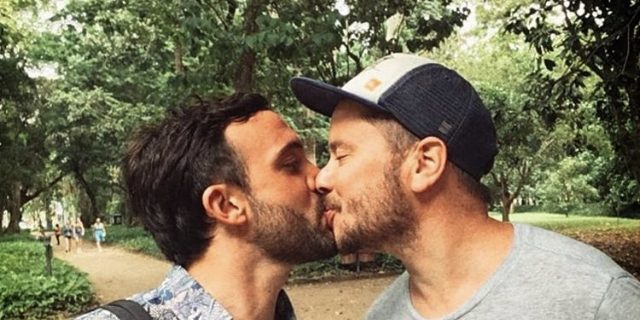
During the 2010 holidays, the year same-sex marriage was legalized in Argentina, Leonardo Grosso, then 27, came out to his family. His second coming out took eight more years. It was public. For the first time, a sitting national deputy (Evita Movement) made his non-conformist sexual orientation visible in Argentina.
“I never imagined I’d be doing this. Maybe because, as my friend told his mother when he came out, ‘no child clarifies their sexuality if they’re heterosexual.’ I’m 35 and have been an activist since I was 17; this has always been a contradiction in my life. I’m gay, and that’s how I choose to identify. As my friend Jáuregui said, ‘In a society that educates us to be ashamed, pride is a political response,’” he posted on his Instagram on November 17, before heading out for the Pride March in Buenos Aires.
-When did you start thinking about this public coming out?
-It was always very uncomfortable. Coming out is an individual and collective process. The walls of the closet are filled with things we think are always the way they are. The closet represents the fear of others' gaze, of disapproval. It has to be dismantled. I strongly remember the feeling of being able to build a social majority with the young women in the streets fighting for abortion rights. I can't explain it rationally.
-It has its rational basis…
I can explain that patriarchy is a problem and we have a common enemy. But I've rarely felt that everything was alright there. Like when same-sex marriage was legalized (July 2010). That and Néstor Kirchner's death (in October) were two powerful moments. All of that made me come out and tell my family and friends.
-Were you in a relationship?
-Yes. I told my family at five in the afternoon. And by nine I was having dinner with my partner and my family because it was Christmas.
At that time, his grandmothers were still alive, but they've passed away. His mother and father, his three siblings, and his nephews and nieces were also there. He had told his siblings before, just the two of them. One night, he invited them over for breaded cutlets. They were late arriving. Leo was getting nervous. He set the stage, warning them that he was going to say something important. When he did, his twin sister sighed with relief. "Oh, dude, I thought you were going to tell us you were moving abroad."
-At that time, it had to do with a climate of acceptance, with a public discussion building legitimacy around something that affects your life. When Piter Robledo was attacked, the President herself (Cristina Fernández de Kirchner) received him in her office and expressed her solidarity. I felt that climate was under attack in recent years.
 Leo Grosso and his partner Guillermo, with Tomás and Joaco, who were kicked out of this pizzeria in October.
-Because?
-For several reasons. One is that when neoliberalism advances and the popular majorities recede, both the popular majorities and minorities are affected, and a climate of hatred is generated. The pedagogy of cruelty. Macri represses, fires, and is complicit in discrimination. And that, later, generates social unrest. A year ago, two young men were in downtown Buenos Aires, in a fast-food restaurant, and one of them (Jonathan Castellari) was attacked with shouts of “fucking faggot, I’m going to kill you .” Two young women were kissing on the subway in Constitución, and one of them has a case against her for resisting arrest . Neither Larreta nor Macri nor Congress nor any authority supported those people. A few months ago, two young men were fired from a Buenos Aires pizzeria for kissing. The reaction came from the community and activists, not from the institutions. To that, we must add the Latin American context.
-Was there anything holding you back from coming out of the closet?
– The closet is oppression, repression, a social context that holds you back. Politics is incredibly patriarchal and sexist. I saw this climate under attack and decided to take public political action. I felt a responsibility to do it for my fellow queer people. One excuse was, “My friends, colleagues, and family already know. I handle it naturally; the only thing I don't do is post it on Facebook or talk about it with journalists.” But questioning or criticizing isn't enough. We have to take action. That was perhaps the most compelling reason that pushed me to do this. Making yourself visible opens doors for those who aren't visible. I received several really positive messages and guys telling me, “Now I've come out too,” a huge hug from people, from politics, from the community. Everything is better on this side of the closet.
-Did you expect that answer?
-No! One is terrified. We suffer a lot throughout our lives.
-Did you suffer discriminatory and violent acts?
-Not like the ones I mentioned before. But yes. Our society discriminates, excludes, and stigmatizes.

-When did you feel like this?
-All my life. As a kid, I didn't like soccer, I never did, and they made me play. You know your whole life that you're not into women, and from the time you're old enough to understand, people tell you who your girlfriend is. I even had a girlfriend. It's really tough: society keeps pushing you into a dead end where it seems like there's no other way out. It's dangerous and unfair to have to hide to kiss someone you like or not be able to hold hands in the street. You don't need to be called a fucking faggot or suffer a hate crime, because you experience that all the time.
-What repercussions did it have in the political sphere?
-Very positive feedback from all sectors, from right to left. Saying so is a political response that warrants a political opinion. It was also, in a way, a challenge to politics and activism. "Hey guys, this is what's happening here, let's stop looking the other way." I received a lot of support from the leaders of opposition blocs, from members of parliament from the ruling party, especially from the women in that sector.
-You said that Argentine politics is sexist. What was and is your political journey like within that power structure?
"I think I spent a lot of time thinking about it, even about why not before, right? Politics is the fight for power. We want to put it at the service of the popular majorities, but it's still power. Power is sexist, patriarchal, discriminatory, and exclusionary. It permeates organizations, their logic. Even the most grassroots organizations are sexist. The Evita Movement really supported me, but it wasn't easy either; it was a process. I've been called a 'cocksucker' or a 'milk-swallower.' When my comrades told someone who spoke like that, 'You're homophobic,' that person would say, 'Oh, excuse me, I didn't know Leo was gay.' Politics has a lot of that. Berni once said he didn't have enough testosterone to tell them things to their face. They would subtly provoke you. Sexual orientation is used to devalue words. Women know this because they suffer it intensely."
-How do you build an anti-patriarchal policy?
I think these things force that discussion forward. Feminism has opened doors and debates that will make politics less sexist, less patriarchal. The debate, due to its scale and legitimacy, has already impacted all political spaces within Argentine structures. And that brings us into that debate as well. When we passed the Equal Marriage Law, we had built a political majority and social legitimacy so that those who oppose it are no longer a force. But not a mobilized social majority like the feminist movements of today. This context is more progressive. We need to forge a very strong alliance to dismantle the patriarchy.
-How do you see the LGBTIQ+ movements in relation to feminism?
I think the struggles are interconnected and come in waves. The LGBTQ+ movement before and after Diana Sacayán is not the same; she saw the Gender Identity Law passed but couldn't see the quota law implemented in the province of Buenos Aires. Society fights to make democracy, or the way we organize ourselves, a little more humane each day, and it progresses with advances and setbacks. Today, feminism is leading the way. But the LGBTQ+ community has won rights like marriage equality and the Gender Identity Law, which were fundamental to their demands. There's still a long way to go, and until hatred and discrimination cease, there will always be a long way to go.
-The Evita Movement is very close to the Catholic Church, which condemns homosexuality, among other things. How do you navigate that contradiction?
"I don't see it as a contradiction. Juan Grabois, the Pope's man, congratulated me publicly. I think it's less problematic than everyone believes. Peronism has a level of organization with a lot of contradictions. I didn't receive any ill will from anyone in the Church."
-And did you get a good vibe from the priests?
"We work closely with many priests in the neighborhood. None of them congratulated me, but I continue working with all of them and I know everything is fine, both before and now. It's not a contradiction for us, and I imagine it isn't for them either."
-When did you start to realize you were gay?
Being a queer person is a political concept. Perhaps it's because of my interactions with the trans women and queer people in the neighborhood that I identify with that identity. "Queer" is more feminine. "Gay" is almost accepted by the system. It seems to me that it's the most dissident, disruptive, and uncomfortable way for the patriarchy to be. To be on a more sisterly level with my comrades. That's what some media outlets highlighted when I took this step: "He identifies as queer."
-Aside from activists and political leaders, what other figures in the LGBT community do you pay attention to?
I like what Ricky Martin thinks, for example, when he says he'd love for his children to be gay. Saying that pushes a boundary. Generally, people say it's fine if I or so-and-so is gay, but I hope your children aren't, because they'll suffer. Ricky Martin makes it clear that being gay can be a very happy thing. I think the same.
-You were one of those who supported the national transvestite trans job quota bill: why didn't it advance this year?
"It was one of the slogans of the march, and it would have been a way to send a message when more than 60 trans and travesti people have been killed in 2018. The PRO party blocked it. The most conservative sectors hold the key to which committees operate; they held up the debate in the Labor Committee, claiming there were too many differences, when we were actually building a consensus for a draft opinion. They can't publicly say, 'What's this about a quota for trans people?' The government says, from a liberal perspective, that it's against quotas, but they have their own oligarchic quota. The national government can't hire people either because of a decree. But we believed it had to be passed anyway, because the State sends signals, and signals shape social behavior. If the State promoted a trans job quota, it would be a sign that it was embracing a population that suffers more than any other. And in this neoliberal context of poverty, if there aren't jobs for the middle class, imagine what it's like for a trans woman in the Greater Buenos Aires area."

-What other debts does Argentina have with the LGBTI+ community?
"Discrimination still exists, and the State isn't clear in taking action and creating the right context. The violence and lack of inclusion faced by transvestites and trans people is one issue. There are also thousands of young people repressed in their homes, in a society that doesn't accept difference. And although there are laws, it's not resolved. Some might challenge me on this, but when you see anti-rights groups, against abortion, with arguments against comprehensive sex education, we can regress. They've managed to articulate a lot of prejudices, and we don't have such a coherent or effective discourse. They oppose that to the 'Not One Less' movement, to abortion, and they're going to oppose that to diversity. When they say 'Don't mess with my children,' they're suggesting that education can define a person's sexual orientation, and they're putting it back on the list of diseases."
-What would you say to yourself if you were still about to come out of the closet?
Do it quickly, because you'll be happier. Because part of the prejudice others have is also part of your own. Being freer is always better. There's no way it can be worse. When you're more authentic, you're more relaxed, more aware. Do it for others, for those who come after you. Be brave. I missed out on a part of my life in secrecy. I missed out on my full adolescence. Once, I was overcome with anguish thinking about how I didn't dare, how I couldn't. It was a debt I owed: to try to make sure no one else has to go through that. Live as you want. Be brave. Let's help others come out of the closet. How? By advocating every day with the pedagogy of love.
*Analuz Carol, national deputy for Tierra del Fuego (Front for Victory) assumed her seat in 2015 and in 2016 married her partner, Ana Paula Cejas.
We are present
We are committed to journalism that delves into the territories and conducts thorough investigations, combined with new technologies and narrative formats. We want the protagonists, their stories, and their struggles to be present.
SUPPORT US

FOLLOW US
Related notes



We are present
This and other stories are not usually on the media agenda. Together we can bring them to light.