

#25N Diverse women from Paraguay took to the streets against gender violence
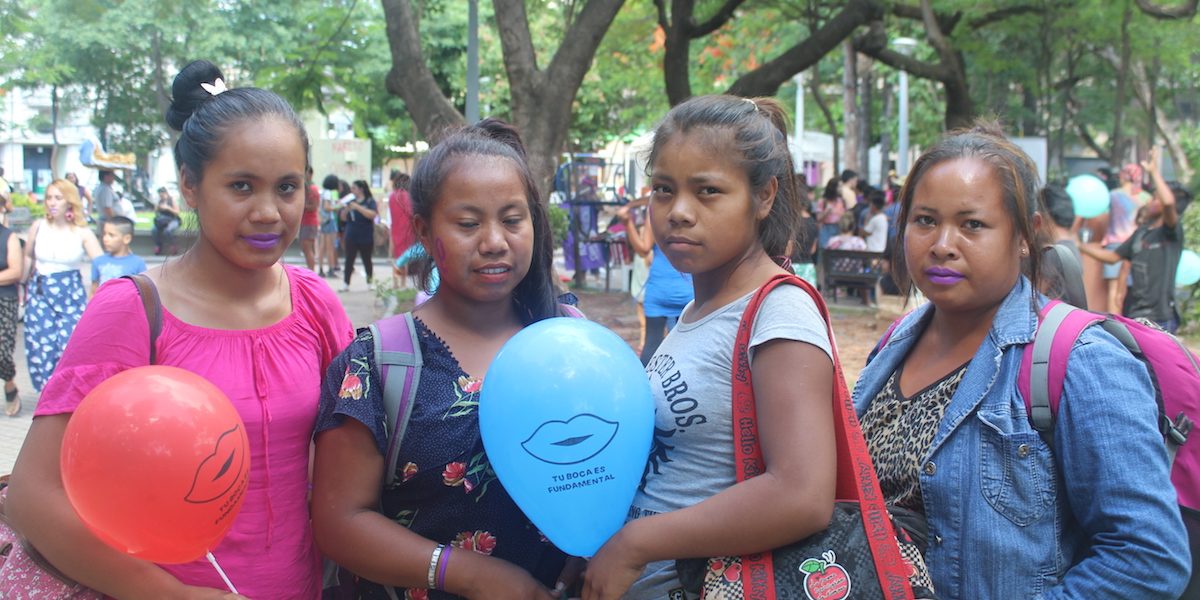
More than 3,000 rural women, activists, residents of the Bañado Sur neighborhood, lesbians, trans women, cisgender women, students, and sex workers marched through the streets of Asunción, Paraguay, to demand an end to femicides, discrimination, and gender-based violence. They did so under the banner "We will not be silent anymore," on the International Day for the Elimination of Violence against Women, November 25th.

Share

By Juliana Quintana, from Asunción
Photos: Marcos Rojas
More than 3,000 rural women, activists, residents of the Bañado Sur neighborhood, lesbians, trans women, cisgender women, students, and sex workers marched through the streets of Asunción, Paraguay, to demand an end to femicides, discrimination, and gender-based violence. They did so under the banner "We will not be silent anymore," on the International Day for the Elimination of Violence against Women, November 25th.
“ Lesbian women also suffer violence, and we face double discrimination. One of the first areas is within the family, when we express our sexual orientation and encounter reproaches and punishments. We also suffer violence in our workplace where we are forced to hide our identity or suffer unjustified dismissals ,” said Carol Sotelo, an activist with the Lesvos group.

The march was organized by the feminist movement at 4:00 PM. Gatherings took place in O'Leary Square and Democracy Square, where there were stalls selling clothing, scarves, crafts, and food. Around 6:00 PM, the groups marched towards the Costanera (riverfront promenade) in Asunción.

Under a blazing sun, hundreds of teenagers wearing glitter makeup sang “che rete, che mba'e” and about the fall of the patriarchy, while young women dressed in yellow were in charge of security.
 “Coming out as a teacher is a responsibility to students because it fills a cultural gap in history. For example, we can't teach literature and talk about Federico García Lorca without mentioning that he was killed for being gay. To those who tell me not to interfere with their children, I reply that I have to interfere because I teach them not only to read and write, but also to accept differences: bodily, sexual, and neurological differences,” noted Natalia López, a lesbian woman and English teacher at the Asunción school.

For the inclusion of trans women
Trans women also demanded access to economic, social, and cultural rights for all women in all their diversity. Furthermore, they demanded justice and reparations for hate crimes against them, including the 61 murders recorded in Paraguay since the end of the dictatorship in 1989 that remain unpunished to this day.

“Trans resistance, women’s resistance, must make us stronger,” said human rights activist and Panambi leader Yren Rotela to Presentes, when asked about the rise of the anti-rights movement “Don’t Mess With My Children.” “It’s a very dangerous message of hate toward the diverse women’s community,” she added.

“Now our main focus is Casa Diversa, a new project I'm part of, run by Yren Rotela. We have underage girls staying at this trans house who are in need, homeless, or rejected by their families,” continued Tami Tozzy, a trans activist at Casa Diversa.

Bisexual women, present!
Andrea Areco, from the feminist organization La Feroz Colectiva, said she feels free to embrace her bisexuality, “ free to make this identity visible as one that is not a transition, that is not synonymous with promiscuity, that is not synonymous with anything else. It is an identity with which many women and men identify. I want to say enough to the invisibility of bisexuality. We exist, we are here, we perceive ourselves, we want to feel free, fulfilled, and whole.”
 Despite Paraguay's Comprehensive Law for the Protection of Women against all forms of violence, 51 femicides and 164 attempted femicides have been recorded in the country so far this year, according to data from the Gender Violence Observatory. The most recent case was that of Lidia Meza, the 18-year-old murdered at the Specialized Group of the Armed Forces.

Among the groups that marched yesterday were Aireana, Lesvos, La Feroz Colectiva, the Feminist University Platform (PUF), Escalando, Panambi, Conamuri, Amnesty International, Fuerza Común, and the leftist movement Frente Guasu. At the same time, around 15 people identifying themselves as “pro-life” demonstrated in front of the Pantheon of Heroes against the feminist mobilization, timidly shouting “Long live religion!” Among them was Gabriela Vergara, known for her anti-rights activism on social media. “Patriotic team defending the national heritage from the victimhood feminist march,” she wrote today on her Facebook account in the caption of a photograph.
The march along the riverfront culminated at a stage where the names, the method of femicide, and the status of the cases of women murdered in 2018 were read aloud. In a sisterly ritual, the women protesters chanted in unison: “Not one less, we want to live.” When Meliza Fleitas’s name was mentioned, a collective cry echoed throughout the entire demonstration: “We are not all here, Meliza is missing.”
We are present
We are committed to journalism that delves into the territories and conducts thorough investigations, combined with new technologies and narrative formats. We want the protagonists, their stories, and their struggles to be present.
SUPPORT US

FOLLOW US
Related notes


We are present
This and other stories are not usually on the media agenda. Together we can bring them to light.