

Clarín continues to fuel hate speech against LGBTI+ people
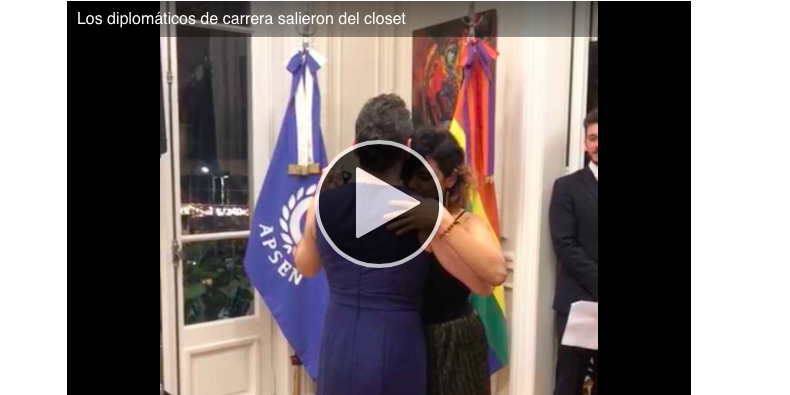
Why is this media outlet, which does not usually cover issues of violence against LGBTIQ+ groups, and is not interested in the human rights of these people, now making news of an activity at the Ministry of Foreign Affairs framed within Pride Week?


Share

Clarín published an article today that we don't quite understand. Why is this media outlet, which doesn't usually cover violence against the LGBTIQ+ community and shows no interest in the human rights of these individuals, now making news of an activity at the Ministry of Foreign Affairs during Pride Week?
The article, written by Natasha Niebieskikwiat and titled “Diplomats also celebrated Gay, Trans, and Bisexual Diversity Week,” completely omits lesbians and other LGBTQ+ identities. It's a collection of stigmatizing clichés, delivered in a tone that only seeks to ridicule the LGBTQ+ community. From the headline – “They showed up in dresses and heels” – to the mention of a “divide” between sources “for” and “against” the event.
[READ ALSO: Despite the laws, transvestites continue to be denigrated on TV]
It also states (and it is highlighted in bold) that: “ Several diplomats decided to attend dressed in dresses, skirts, and heels, since a few of them go to work like that.” Does this refer to trans people as people who dress up? Does it refer to non-binary people as people who dress up? Referring to “cross-dressers” is how the police have historically persecuted and harassed transvestites and trans people, protected by the Codes of Misdemeanors.
This article adds to a history of articles published by the newspaper with a discriminatory journalistic approach and stigmatizing treatment. On October 14, hours before the National Women's Meeting march in Trelew, it published an article titled: “ National Women's Meeting: They're selling gasoline in bottles and suspect they're making Molotov cocktails,” which it chose to illustrate with a photo of a trans activist, Alma Fernández, leading a march to demand an end to transphobic and transphobic murders (news that Clarín also rarely covers). In a clear act of transphobia, Clarín chose a trans person to illustrate the article, even though the majority of attendees at the National Women's Meeting were cisgender, and moreover, an activist.
 We are not making a value judgment about the activities at the Foreign Ministry, nor are we familiar with the internal workings mentioned in the article. However, we do know when communication ignites the spark of prejudiced violence. These actions don't operate in isolation, but rather based on a social complicity that allows for expressions such as the diplomats deciding to "express their life choices." Sexual orientation and gender identity are not choices, nor are they conditions. This article—which lacks a single cited source—is more akin to a political operation than a news report. And in doing so, it violates all kinds of rights.
[READ ALSO: Television and trans identity: the five forms of violence we face every day]
Clarín says it consulted “sources for and against—who did not want to be identified.” In a country with same-sex marriage and gender identity laws, this type of communication seems to incite debates on rights issues (and in a space like the Foreign Ministry) supported not only by Argentine law but also by international organizations. To cite just one, the Court
In January of this year, the Inter-American Court of Human Rights (IACHR) issued a landmark ruling stating that the rights of same-sex couples and transgender people are protected by the European Convention on Human Rights. Furthermore, it ordered signatory states to guarantee the full exercise of these rights. Ensuring their full exercise also means refraining from stigmatizing these identities through media coverage. Meanwhile, the Clarín Group continues to fuel hate speech against LGBTI+ people.
We are present
We are committed to journalism that delves into the territories and conducts thorough investigations, combined with new technologies and narrative formats. We want the protagonists, their stories, and their struggles to be present.
SUPPORT US

FOLLOW US
Related notes
We are present
This and other stories are not usually on the media agenda. Together we can bring them to light.