

Why a national transvestite and transgender employment quota law is urgently needed
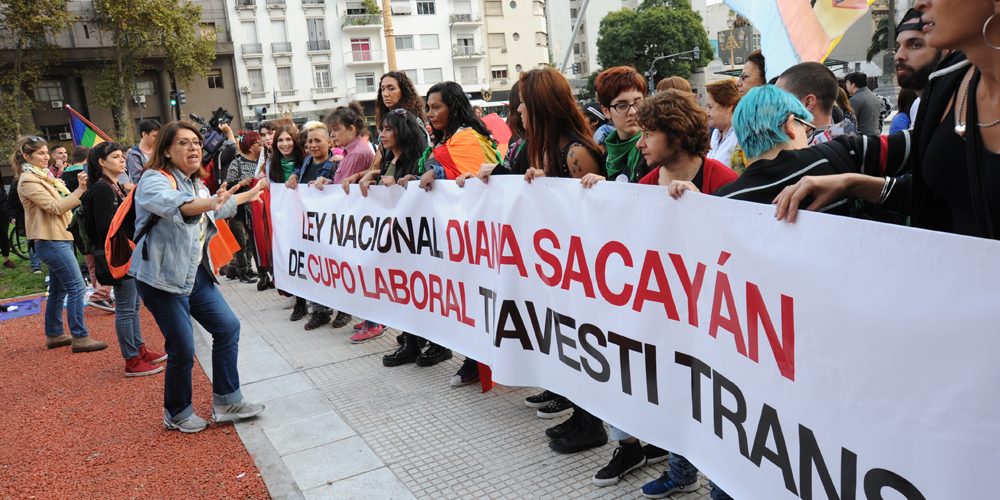
On Friday, the labor committee of the Chamber of Deputies postponed the discussion of the Diana Sacayán national transvestite employment quota bill, "a fundamental right that attacks the heart of social transvesticide"

Share

On Friday, the Labor Committee of the Chamber of Deputies postponed the debate on the Diana Sacayán National Transgender Employment Quota Bill, "a fundamental right that strikes at the heart of social transvesticide," which was scheduled for today. Say Sacayán reviews the achievements and shortcomings of the path envisioned by Diana. "Today there is no town, city, or province that does not demand this right for our comrades."
By Say Sacayán*
When we say that the transphobic murder of Diana Sacayán had a profound impact, we mean that it triggered a state of alert within the trans community. Because it exposed, like never before, the cruelest manifestations of hatred and violence directed at our identities, and in Diana's body—a political body, a body that embodied resistance and intensity in every way—it marked a turning point for our community.
We cannot forget that Diana was murdered just days after the passage of the law establishing a quota for transgender and travesti people in public employment in the Province of Buenos Aires, a law that revolutionized the agendas of the transgender and travesti movement. And today we know for certain that this law has forged its own path, because today there is no town, city, or province that does not demand this right for our comrades.
[READ MORE: This is the map of the transvestite trans job quota in Argentina]
That struggle that Diana started in 2010 with the first presentation of a bill of this kind, and which a handful of comrades fought for alone until we achieved it, also led us down the path that Diana herself planned: to present this project at the national level.
For that, it was necessary to work on a historic ruling - after a trial where we were able to talk about all the violence - about the state of vulnerability that exists, about the structure of that violence, the reason for the average life expectancy of 35 to 40 years, and we incorporated and defined the term "social transvesticide" describing it as the chain that leads to those violent deaths.
[READ MORE: “Transvesticide, the final link in the chain of daily violence against transvestites and trans people” ]
The judiciary could not deny the argument we had been building day by day, both politically and legally. Meanwhile, the number of new ordinances and laws establishing employment quotas for transgender people multiplied across the country, spearheaded by various organizations—including those that had previously resisted this measure—and which adopted Diana's proposal.
We didn't wait: we went all in to demand the implementation of the law in the province, and we already presented the Diana Sacayán Law in the National Congress and thus fight for this: the lack of access to formal employment.
The first bill was introduced in March 2016 by National Deputy María Isabel Guerín (Front for Victory) and replicated the one approved by the Buenos Aires legislature in 2015, authored by Karina Nazabal (FPV). Since then, about ten proposals based on this law have been introduced, but they have all lapsed.
Therefore, to strengthen this demand, we formed the National Front for the Diana Sacayán Transgender Employment Quota Law. It comprises more than twenty organizations from across the country, and we have reintroduced the bill authored by Representatives Mónica Macha (FPV), María Isabel Guerín (FPV), and more than 50 representatives from all political parties.
Throughout this year, we carried out a series of awareness-raising activities to promote this bill, such as the celebration of International Workers' Day in Plaza de los Dos Congresos and an event at the Chamber of Deputies. We met with most of the deputies who had submitted similar proposals, achieving a consensus text, and secured a commitment from the Labor Legislation Committee to include this issue on its agenda.
This soon brought a counterattack from anti-rights sectors and their extraordinary lobbying efforts, which pressured the president of the commission and the deputies who were members, preventing the meeting on Tuesday, November 20, where there was a great possibility of obtaining a signed majority opinion and sending it to the following committees before reaching the floor, thus postponing its consideration.
The current context of setbacks in rights compels us to redouble our efforts to achieve public policies and legislation for our community. Despite the anti-rights campaign, we are fully confident that, just as we succeeded with Diana in the province of Buenos Aires and changed history, there will also be a Diana Sacayán Law at the national level.
*Trans activist, member of the Anti-Discrimination Liberation Movement (MAL).
We are present
We are committed to journalism that delves into the territories and conducts thorough investigations, combined with new technologies and narrative formats. We want the protagonists, their stories, and their struggles to be present.
SUPPORT US

FOLLOW US
Related notes


We are present
This and other stories are not usually on the media agenda. Together we can bring them to light.