

Landmark ruling: house arrest for a trans man to "prevent cruel treatment"
In an unprecedented ruling, a court decided that he will serve his sentence at home with an electronic ankle monitor and alongside his mother.


Share

By Paula Bistagnino.
In an unprecedented ruling, the Argentine justice system granted a transgender man house arrest based on the fact that his detention conditions did not respect his gender identity. Held in pretrial detention for two months, BLDM, 26, will be able to serve his entire sentence at his mother's house.
“The only precedent I have, and the one I used to make the request, is the only other case involving a trans man. But there’s an important difference: in the previous case, the ruling was based on institutional violence and mental health reasons. And not, as in this case, on the issue of gender,” explains public defender Sergio Meirovich, BLDM’s lawyer, to Presentes.
An unprecedented ruling in an exceptional case
Meirovich received the case because he was on duty as a public defender for Mobile Legal Unit Number 1 in Economic Criminal Matters. “When he arrived at the courthouse under arrest, he told us he was a trans man. So we assessed that he couldn't go to a men's prison or a women's prison. But at that moment we decided that he should go to a special section of a women's prison,” he explains.
According to the lawyer, a trans man in a women's prison is an exceptional case. "There is no prison population of trans men, that's the reality. However, there is a population of trans women and specific wings or programs for them."
The public defender emphasizes that the entire action of the Federal Criminal Economic Court No. 10 and the presiding magistrate, Diego García Berro, “was impeccable with respect to the gender issue. Rights were guaranteed at all times, in the treatment, in access to health and the continuity of hormone treatments, and in the consideration of their identity to evaluate the request we made. It was an exemplary interdisciplinary approach.”
Although there was no institutional violence in this case, from the beginning of BDLM's detention there were problems with his fellow inmates. Therefore, the detainee's mother expressed her son's distress to his lawyer. The possibility of requesting house arrest then began to be considered. Meirovich sought advice from the Gender Commission of the Ombudsman's Office and the Social Problems Program of the National Public Defender's Office.
“All the necessary steps were taken to assess his detention conditions and then to determine if house arrest with his mother was viable. Initially, it was rejected, and rightly so, because the reports from the prison indicated no violation of his rights or worsening of his detention conditions. But then, on appeal, it was proven that he was in a depressive state and that he had been treated disrespectfully by the other inmates and staff,” the lawyer explained. He added that the pretrial detention was never questioned “because it is very well justified.”
The case has already been referred to the Federal Criminal Economic Court, which will oversee the house arrest. “Unless he violates some of the rules, his house arrest will not be lifted. It remains a sentence of deprivation of liberty, strictly enforced and non-negotiable.”
[READ ALSO: A ruling urges guaranteeing the health of trans and transvestite people detained in Florencio Varela]
The ruling: risk of undignified, inhuman or cruel treatment
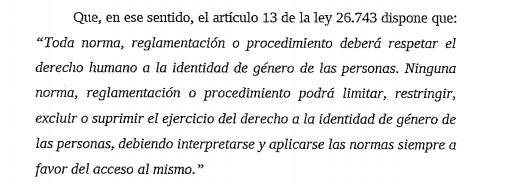
In the presentation, the defense attorney requested house arrest for BLDM, arguing that “the prison complex is currently not equipped to house a trans man.” Meirovich noted that BLDM suffered discriminatory treatment from his fellow inmates and the prison staff responsible for his care, which led to his transfer to an isolation unit.
The court ruled by majority vote—two to one—to overturn the appealed decision and grant BLDM's request for house arrest under electronic monitoring. He is now on the waiting list to receive the ankle bracelet that will be used to monitor his compliance with the terms of his confinement at home. "Like any detainee, he is absolutely prohibited from leaving his residence."
Judges Edmundo Samuel Hendler and Juan Carlos Bonzón granted the request, understanding that subjecting BLDM to detention conditions that do not respect her gender identity “could constitute undignified, inhuman, or cruel treatment” according to constitutional principles, international treaties, and the Gender Identity Law. They explained that although she was housed in the Ezeiza Women's Federal Penitentiary Complex 4 at her own request, the prison “does not safeguard her needs as a transgender person.”

[READ ALSO: Demands for justice for the death of a trans woman detained in Florencio Varela]
The dissenting vote was that of Judge Roberto Hornos, who did not grant the request but asked the Ministry of Justice and Human Rights of the Nation, which oversees the Federal Penitentiary Service, to "establish as soon as possible a specific program for transgender men in the context of confinement."
“It’s a very positive ruling because even the dissenting opinion includes a call for public policies to guarantee the rights of detained trans men,” the lawyer explains. Just as such policies already exist for trans women.
The arguments of the National Penitentiary Prosecutor's Office, which presented itself as amicus curiae, were based on this: "The specific program for trans women in the context of confinement housed under the jurisdiction of the Federal Penitentiary Service" does not resolve the issue since "in none of the points does it contemplate the needs and particularities of trans men."
For Meirovich, this case could serve as a precedent for other trans men deprived of their liberty. “In the case of trans women, it’s different, but it can be considered when making requests regarding detention conditions. Undoubtedly, it’s an unprecedented ruling.”
We are present
We are committed to journalism that delves into the territories and conducts thorough investigations, combined with new technologies and narrative formats. We want the protagonists, their stories, and their struggles to be present.
SUPPORT US

FOLLOW US
Related notes

We are present
This and other stories are not usually on the media agenda. Together we can bring them to light.