

Unprecedented in Latin America: Non-binary people obtained gender-neutral documents
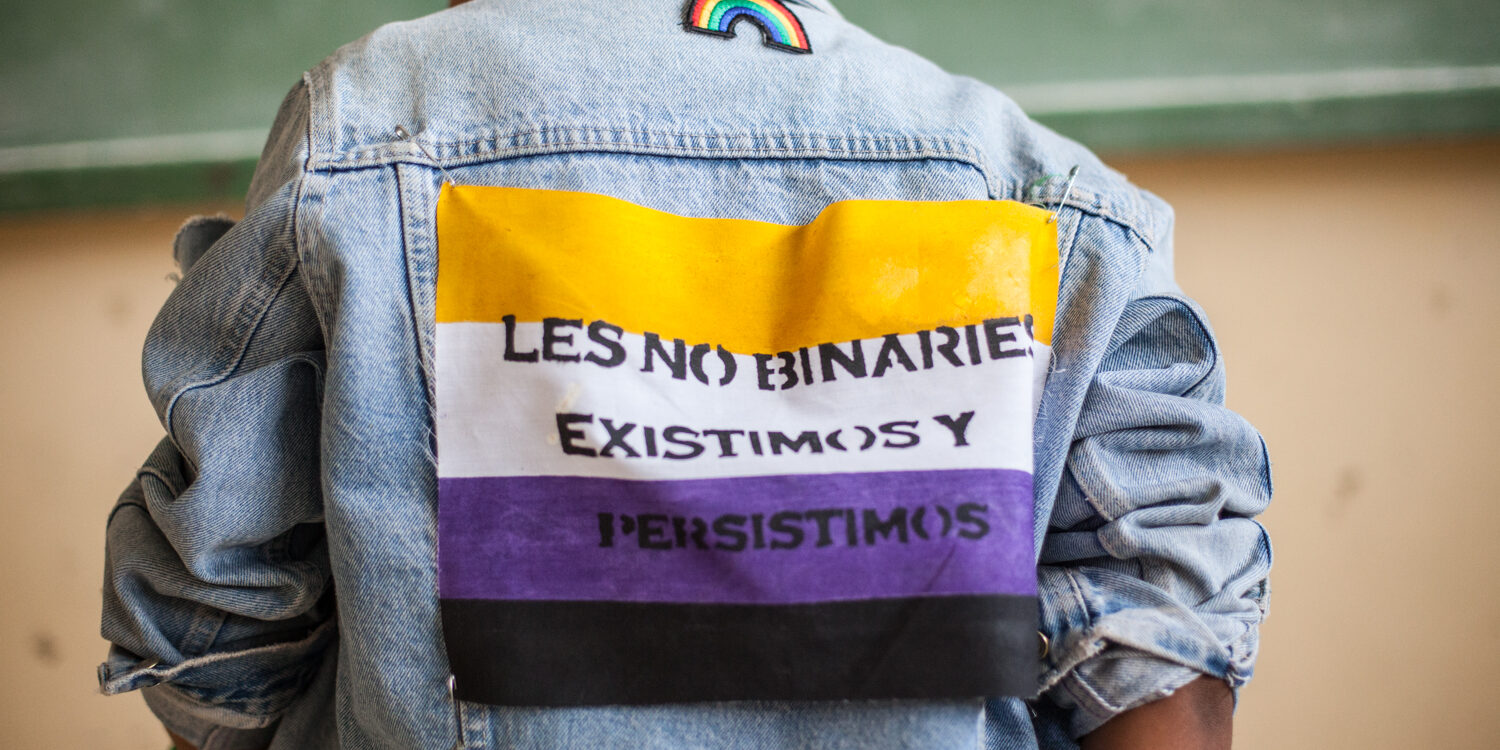
For the first time in Latin America, a civil registry office has amended the birth certificates of two non-binary individuals, removing any gender designation. The Mendoza civil registry made this unprecedented decision on Friday, November 2nd. This sets a precedent in accordance with the Gender Identity Law passed in 2012.

Share

By Lucas Gutiérrez
Photo: Luli Leiras
For the first time in Latin America, a civil registry office has amended the birth certificates of two non-binary individuals, removing any gender designation. The Mendoza civil registry made this unprecedented decision on Friday, November 2nd. This sets a precedent in accordance with the Gender Identity Law passed in 2012.
“This is the first case that has been resolved at the administrative level because in others there have been more generic resolutions that have had to be taken to court,” Eleonora Lamm, deputy director of Human Rights at the Mendoza Provincial Court, who accompanied one of the petitions, that of Gerónimo Carolina González Devesa, told Presentes.
A non-binary person identifies neither as a man nor as a woman. Gerónimo Carolina González Devesa is a doctor, is 32 years old, and lives in Mendoza.
González Devesa approached Lamm when the prepaid medical service required him to change his National Identity Document (DNI) in order to have a pectoral masculinization operation.
“He explained to me that he didn’t want to change to male. I told him that the Gender Identity Law allowed him to propose another option that was neither male nor female. I accompanied him to the Civil Registry of Mendoza where the request was made and I issued a ruling to accompany his gender identity change form,” Lamm says.
 Gender Identity Law
 Gender Identity Law
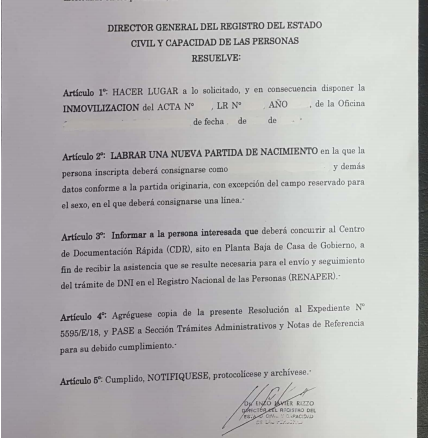
That same day, the Mendoza government issued a statement informing that, through Resolution No. 420/2018, these two requests were granted, rectifying birth certificates so that a line is entered in the field reserved for sex. With this, they can now change other documentation that will no longer state either F or M.
“The Civil Registry of Mendoza acted very well, especially through its legal advisor, Dr. Julieta Mazzoni, and the director Enzo Rizzo, who were committed to the case, inquired about the scope of the Gender Identity Law and tried to find this answer which is the most guaranteeing of rights,” says Dr. Lamm.
Resolution No. 420/2018 cites, among others, Article 2 of the Gender Identity Law (26.743) which states: “the internal and individual experience of gender as each person feels it, which may or may not correspond to the sex assigned at birth, including the personal experience of the body.”
“Biology is not destiny”
SaSa Testa is a gender-fluid non-binary person who tells Presentes: “Being a non-binary person means being able to break free from the established patterns that a patriarchal society has imposed on certain bodies. Patriarchy has managed to establish a discourse where if you are born with something they have decided to call a penis, you will be assigned the attributes of a man, of masculinity, and if you are born with something that the discourse says is called a vagina, you will be assigned the category of woman or feminine, and all of this goes hand in hand with certain possibilities or limitations that the same discourse and the same historiography, which is patriarchal and cisgender, have established for interpreting certain bodies. Therefore, non-binary identity comes to question these logics, which are also logics of a power structure.”
Testa has just published their book, 'I Am Sabrina, I Am Santiago: Fluid Gender and New Identities,' an autobiography of a non-binary person. In a conversation with this publication, they mention their plans to amend their birth certificate to remove the sex/gender designation. “What just happened in Mendoza is very important, as the first document without a sex/gender designation serves to demonstrate that biology is not destiny and that identities are neither universal, nor ahistorical, nor timeless. That one can construct, deconstruct, reconstruct, and name oneself as one truly wants, as one truly feels,” says SaSa Testa.
We are present
We are committed to journalism that delves into the territories and conducts thorough investigations, combined with new technologies and narrative formats. We want the protagonists, their stories, and their struggles to be present.
SUPPORT US

FOLLOW US
Related notes
We are present
This and other stories are not usually on the media agenda. Together we can bring them to light.