

How are anti-rights groups born and financed in the region?
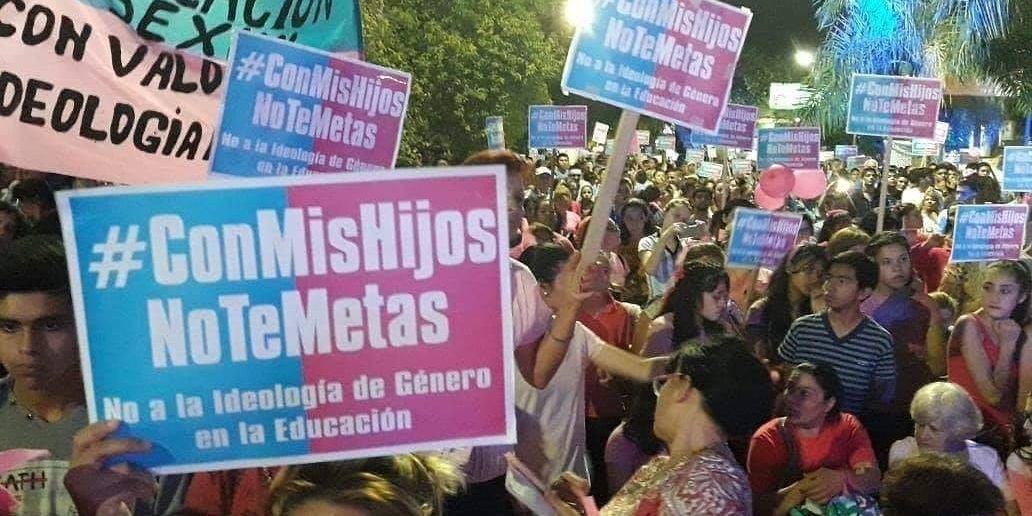
A regional investigation coordinated from Brazil by Sexuality Policy Watch, a public policy observatory focused on sexual and reproductive health, aims to study how anti-rights groups are gaining a foothold in Latin America. The study will be conducted in ten countries.

Share

This article is published in partnership with the Uruguayan media outlet La Diaria.
A regional investigation coordinated from Brazil by Sexuality Policy Watch, a public policy observatory focused on sexual and reproductive health, aims to study how anti-rights groups are gaining a foothold in Latin America. The study will be conducted in ten countries, and in Uruguay it will be led by Mujer y Salud en Uruguay (MYSU) and two professionals specializing in religion and politics.
Lilián Abracinskas, from MYSU, explained to La Diaria that the study will engage in dialogue with a similar investigation conducted in Europe, funded by the Friedrich Ebert Foundation, which traced the origins of the concept of gender ideology and why it was coined. The conclusion reached was that the Catholic Church commissioned a devoutly Catholic Irish intellectual to theorize on this topic as a reaction to the outcomes of the United Nations World Conference on Women, held in Beijing in 1995, where commitments to gender equality first emerged.
Fractures and reactions
The research to be conducted in Latin America seeks to determine how anti-rights groups gain influence, who their spokespeople are, how they express themselves, what communication strategies they use, and who financially supports them. “Because they are becoming a reactive actor. In reality, it is an old actor, reacting because the entire rights agenda, and particularly the sexual and reproductive rights agenda, is fracturing their value system, morality, and social contract. And they are reacting with a virulence that is also worrying,” Abracinskas stated.
He added that there are indications in the region of links between these groups and ultraconservative or neoliberal businesspeople, as well as far-right parties. “Furthermore, they infiltrate state institutions and begin to operate from within them, particularly in departments and in the Ministries of Education and Health. In Uruguay, we know little about them, beyond the evangelical caucus. We don't have much of an understanding of how they operate within departmental governments, or who the businesspeople are that support them,” Abracinskas noted.
Fanatical Catholics and Evangelicals
He explained that these groups have two forms of intervention from a religious perspective. On the one hand, through the institutional framework of the Catholic Church, “which always operates in the upper echelons, because due to its history of colonialism it is always closely tied to power.” On the other hand, there are evangelical groups, which target the poorest and least educated segments of the population. He clarified that this is not true of all evangelicals, but rather “a particularly fanatical faction, which also has no qualms about lying, making unsubstantiated claims, and employing a pseudoscientific discourse that masks religious beliefs.”
She asserted that “the big problem” with these groups is “the incitement of hatred” they promote. “They demonize those who think differently, attributing intentions to them that have nothing to do with reality. They convince people that you're more or less the personification of the devil, coming to disrupt the family and make everyone gay or trans. You think, 'Oh, how ridiculous, who could believe that?' But you have 46% who vote for [Jair] Bolsonaro [in Brazil]. Let's not underestimate them,” the activist warned.
She added that the idea is to “generate a narrative” that highlights how these movements arise as a reaction that jeopardizes progress in human rights, and that they also have electoral and institutional manifestations. The goal is also to gather information to frame the strategies of progressive social organizations. “Because there is a complicated situation in the region, and when it swings toward fanatical right-wing extremism, there is a lot at stake, a lot at risk, and what we have been able to achieve can quickly crumble if there isn't a citizen defense of what has been gained,” Abracinskas stated.
We are present
We are committed to journalism that delves into the territories and conducts thorough investigations, combined with new technologies and narrative formats. We want the protagonists, their stories, and their struggles to be present.
SUPPORT US

FOLLOW US
Related notes


We are present
This and other stories are not usually on the media agenda. Together we can bring them to light.