

#33ENM2018: Trelew shone with a diverse and plurinational feminism
The 33rd National Meeting of Women, Lesbians, Bisexuals, Transvestites, and Transgender People concluded today with a vote by acclamation to choose La Plata as next year's host city. This Monday holiday, Trelew awoke to the remnants of the arrests of women—all of whom have since been released thanks to the efforts of a network of feminist lawyers—and police repression, toward the end of a march that stretched for dozens of blocks.


Share

By Maru Ludueña
Photos: Luli Leiras
The 33rd National Meeting of Women, Lesbians, Bisexuals, Transvestites, and Transgender People concluded today with a vote by acclamation to choose La Plata as next year's host city. This Monday holiday, Trelew awoke to the remnants of the arrests of women—all of whom have since been released thanks to the efforts of a network of feminist lawyers—and police repression, toward the end of a march that stretched for dozens of blocks.
 For more than three hours, a seemingly endless line, cheered on by 50,000 women, wound its way through Trelew. With joy and serenity, chants, flags, and plenty of green and purple glitter, the feminist tide swept through the city center and also the dirt streets of the working-class neighborhoods.
 Despite the peaceful atmosphere, there was repression by mounted police and the Gendarmerie, women were injured by rubber bullets, and a dozen people were arrested. The Organizing Committee of the Encuentro held the provincial government of Mariano Arcioni and the Minister of Security, Federico Massoni, responsible.
 “Once again, the security forces and the state's repressive apparatus are interfering to tarnish the women's movement gatherings,” the Commission stated in a press release issued early Monday morning, the last day of the meeting. The Feminist Lawyers Network appealed to anyone with videos and photos of the repression to come forward.
 Sexual diversity shouted loudly
 Sexual diversity shouted loudly
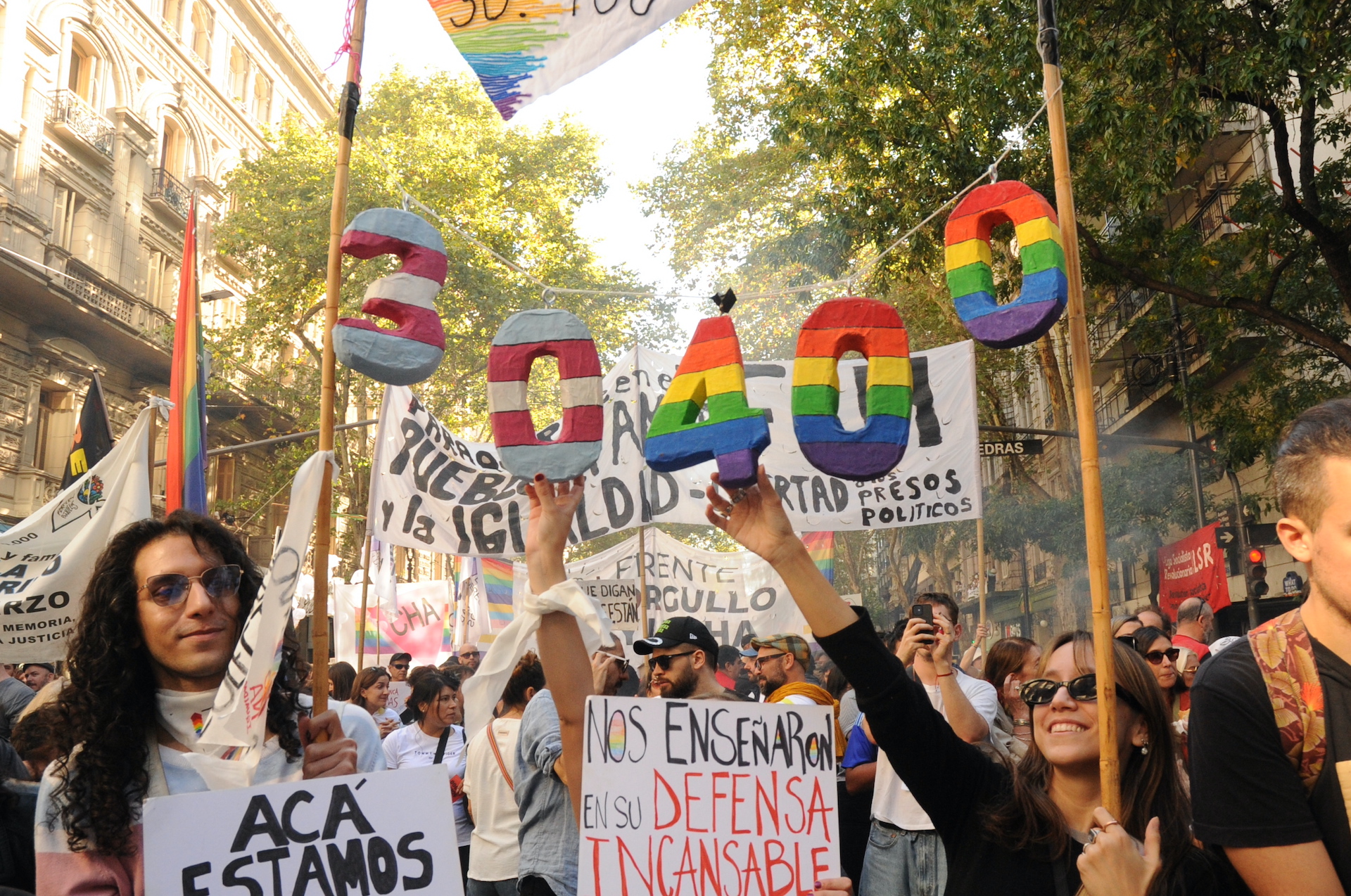
 Sexual diversity made its presence felt at the march. This was evident in the large number of rainbow flags. The Permanent Lesbian Assembly (which also included bisexual activists) and Otrans Argentina, the organization that brings together trans people, transvestites, and migrants, also marched with their own flags. Other trans and transvestite women, however, stayed until nine o'clock at night drafting the conclusions of the workshop at the Encuentro (Meeting) that had brought them together during these days.
 In general, many LGBT+ people marched within political and social organizations. This time, they displayed the flags of gender commissions and sexual diversity groups in the streets. For many, this represents progress.
“We are very happy because we were able to secure La Plata as the next venue for the Meeting. Three of us from our delegation spoke: one colleague from the Río Santiago Shipyard, another about the disappearance of Johanna Ramallo, and myself about trans and travesti issues. We succeeded in getting the issue discussed and La Plata chosen almost unanimously as the next venue,” Claudia Vasquez Haro, president of Otrans, told Presentes. She noted that in the province of Buenos Aires, the trans and travesti employment quota has not yet been regulated. She added that they will take this opportunity to demand its implementation.

Stop the murders of trans women and legalize abortion
 Stop the murders of trans women and legalize abortion
 Another fact that is gradually gaining strength: that other groups are taking up the slogans of transvestite and trans people, demanding an end to transvesticide and a transvestite and trans job quota throughout the country, as happened on Saturday.
 Legal abortion was one of the most prominent demands, with songs echoing throughout the march. The campaign for safe, legal, and free abortion was one of the most important.
New generations, present
 New generations, present
Throughout the march, the demand for an end to institutional violence was also present. Santiago Maldonado was remembered. So was Marielle Franco, the lesbian and city councilwoman who was murdered. And there were signs with the hashtag #EleNao (Not Her).
“Ancestral, plurinational memory,” “The struggle begins in my hat,” “Manolo, Manolo, iron your shirt and give yourself a blowjob,” were some of the chants that echoed along the more than 30 blocks of the feminist celebration. This time, a notable presence in the march and workshops was that of a new generation of young women under 18, some of them the first generation to have access to Comprehensive Sex Education.
 Yesterday they sang "Woman, listen, join the fight" and looked into the eyes of the women and girls who watched the march pass by from the sidewalk in front of their houses, and those who jumped to the rhythm of the songs behind the fences of the houses.
Curiosity and aggression
 Curiosity and aggression
 Yesterday, the residents of Trelew watched the march with curiosity and interest. They photographed it with their cell phones, looking interested and expectant, as if the misgivings and anxieties that many media outlets had stirred up beforehand had already been dispelled. Some local women even joined in, smiling, winking, and raising their fists.
 At night, some people threw stones that broke the windows of several buses leaving Trelew, and over the weekend there were also incidents of intimidation and stones thrown at a school, although these could be considered isolated events. It was three days of feminist celebration that brought slogans, music, struggle, and vibrant colors to the aridity of Patagonia.


We are present
We are committed to journalism that delves into the territories and conducts thorough investigations, combined with new technologies and narrative formats. We want the protagonists, their stories, and their struggles to be present.
SUPPORT US

FOLLOW US
Related notes


We are present
This and other stories are not usually on the media agenda. Together we can bring them to light.