

What knowledge do transvestites possess that universities despise?
I supported the initiative of those students who were demanding a trans job quota. But from what position can this demand be made for an educational space where there are no trans people?

Share

By Quimey Ramos*
A couple of Saturdays ago, I went to an event advocating for trans job quotas at the Faculty of Humanities in La Plata, as part of the student occupation against education cuts. The event was in support of a trans job quota at the University. However, I encountered a striking situation: among all of us there, I was the only trans person. From what perspective do we make demands on behalf of a community when that community isn't even present?
I embraced the initiative of those students who, amidst the whirlwind of sustaining direct action, were demanding a trans job quota. But from what position can a trans job quota be demanded for an educational space where there are no trans people?
In presenting her book "Travesti: una teoría lo suficiente buena" (Transvestite: A Good Enough Theory), Marlene Wayar spoke about her concept of "nostredad" (ourness): the capacity to recognize ourselves as a "we" within otherness. This capacity, set in motion from the moment we embrace the other within ourselves, allows us to empathize with the pain and oppressions experienced by that other, so that when the other is violated, we will not remain unmoved.
Have we stopped to think about the perspective from which we are making demands on behalf of a social group about which we have no understanding based on our personal experience?
[READ ALSO: Television and trans identity: the five forms of violence we face every day]
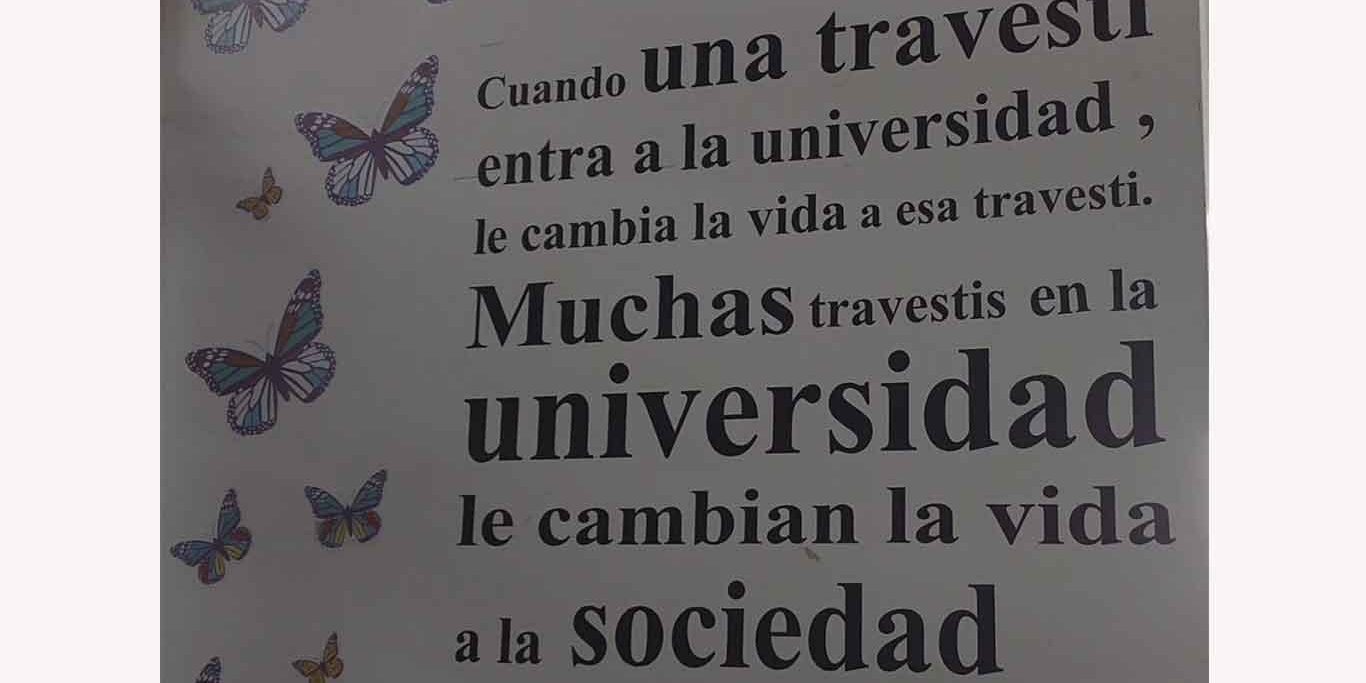
For her part, Lohana Berkins said: "When a trans woman enters university, her life changes; but many trans women within the university change the life of the entire society."
What proportion of that knowledge, jealously guarded by universities as a vestige of ecclesiastical abbeys, is a privilege that we should turn into a right for everyone, and what percentage is knowledge made by the established power for itself, and therefore disposable?
Places to stand
What knowledge do trans women possess that universities despise, thus closing their doors to us? And if I embrace the "us-ness" that Marlene invites me to embrace, what does this tell me, as a university student, about my body and its place in the world, about the possibilities I have to freely construct it, and above all, about those possibilities I lack if trans women are not where I am?
[READ ALSO: PRESENTES TE:VE Quimey Ramos demands national law for trans employment quotas]
Where is my potential self in that social body that is called trans-travesti?
How could I become a transvestite, as a desired possibility, if I have fully internalized that my body will not be desired in many spaces?
These questions, which I wish to raise rather than answer, are necessary for the struggle for a pluralistic and critical university to advance.
If transvestites must be detransformed to enter university, then it's not my fight.
Building connections and bridges where we recognize ourselves in each other, whether we are on the inside or on the outside, is fundamental to constructing different kinds of knowledge. A collective that can stop the arm of austerity.
*trans teacher and activist
We are present
We are committed to journalism that delves into the territories and conducts thorough investigations, combined with new technologies and narrative formats. We want the protagonists, their stories, and their struggles to be present.
SUPPORT US

FOLLOW US
Related notes
We are present
This and other stories are not usually on the media agenda. Together we can bring them to light.