

March against cuts in Public Health: there are already shortages of HIV medication
People living with HIV are facing uncertainty about what will happen to their medication and care, as the 2019 budget proposal will not be enough to cover it.

Share

By Lucas Gutiérrez
This Thursday, October 4th, a nationwide march in defense of public healthcare in Argentina will take place in Buenos Aires. It will begin at the former Ministry of Health and end at Plaza de Mayo. People living with HIV/AIDS face uncertainty regarding their medication and care, as the proposed 2019 budget will not cover it. Today, they not only face budget cuts, but also a bill rejected last year , concerns about the merger of five hospitals which they say would worsen medical care, the ill-advised statements of Dr. Abel Albino, and further reasons to demand their right to healthcare.
The recent downgrading of the now former Ministry of Health to a Secretariat entailed adjustments and cuts to the 2019 budget. It is in this context that the director of the National Directorate of AIDS, STIs, Hepatitis, and Tuberculosis, Sergio Maulen, submitted his resignation. On September 3, in response to the director's resignation and the austerity measures, workers in the area issued a statement declaring that "the continuity of access to prevention, diagnosis, and treatment for people served by the programs that comprise this Directorate is not guaranteed."
Cuts and the dollar effect
“Without medication, we die,” states José Maria Di Bello, secretary of the Positive Effect Group Foundation. Regarding the 2019 budget proposal, he tells Presentes: “Considering a dollar above 40 pesos, the AIDS Directorate needs 5.2 billion pesos, and the budget allocates 3.1 billion, 2 billion pesos less, provided the dollar doesn't skyrocket.” Di Bello adds that 70% of Argentine purchases are in dollars, so if the amounts are considered in that currency and compared to 2018 purchases, the activist summarizes that “it's 43 million dollars less.”
“15,000 people would be left without treatment,” he continues. The 2018 epidemiological bulletin from the now-defunct Ministry of Health reported that more than 120,000 people are HIV-positive, of whom 7 out of 10 receive care in the public health system. “If the budget is approved under these conditions, we can expect shortages and partial distribution. Back in 2001, I had to go to the pharmacy every day to get my medication; they would give me pills for the next day,” he adds.
There are already shortages
Di Bello reports that some hospitals in La Matanza are already experiencing medication shortages. “A colleague informs us that Atripla is not being distributed; instead, the individual drugs that make it up are being distributed separately.”
On September 6, the heads of provincial HIV/AIDS programs, meeting at the Ministry of Health, issued a statement sharing the concerns of the former Ministry's staff. In the statement, they also expressed their concern about the elimination of local programs, budget cuts, and under-execution. "The state of public health in our country is extremely worrying," they concluded.
Expiring stock
Fabio Núñez is the coordinator of the Human Rights area within the Directorate of AIDS and STIs and explains to Presentes that the AIDS Directorate is currently under the charge of the Undersecretary of Prevention and Control of Diseases, Miriam Burgos, while a replacement for the outgoing director is sought.
“The authorities committed to finalizing the overdue payments to suppliers and completing the delayed purchases of reagents and some essential medications. We are approaching the expiration date of our current stock,” Núñez added.
Meanwhile, HIV+ people are sharing on social media that the medication they are being given in public hospitals has an expiration date that is very close or has already expired.
The Directorate, in addition to HIV and AIDS, is responsible for viral hepatitis, sexually transmitted infections, tuberculosis, and more. “Ninety percent of the Directorate’s budget is for supplies, treatments, reagents used to detect infections, antiretroviral medication, and more,” explains Núñez. “This year, no informational or preventative materials were printed, and the purchase of condoms is still incomplete.” Meanwhile, the “At What Price” observatory shared information that in 2016 and 2017, approximately 40% of the planned quantity of condoms was distributed.
Regarding the budget, Núñez confirms what José María Di Bello said and shares the situation in provinces like Catamarca, where the provincial health insurance system is not covering all of its members, who end up being referred to the public system. “The provinces are being overwhelmed; we were informed of medication rationing in Córdoba, even though there was no shortage of medication,” says Núñez. The adjustments and cuts in the Ministry of Health, plus the rise in the dollar, are also affecting health insurance providers and private healthcare plans.
Chains in Congress
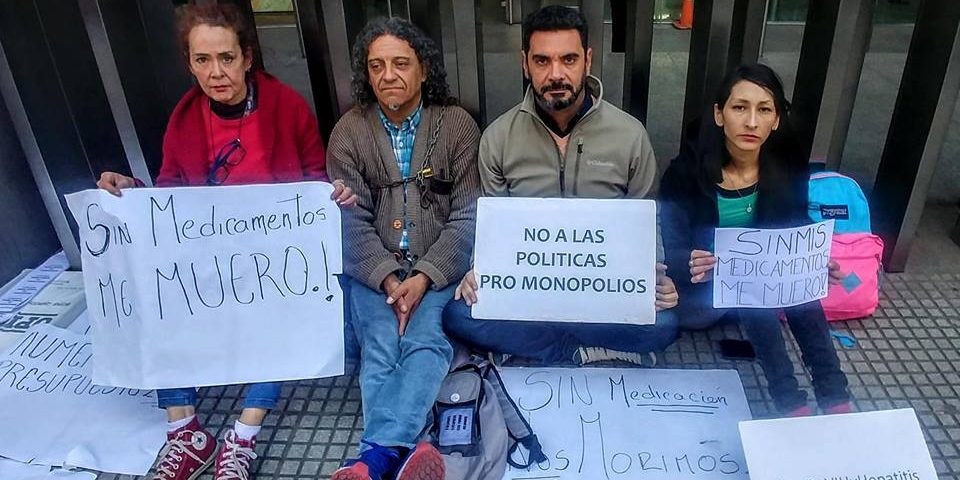
Gastón Llopart, a lawyer and activist, went to the annex of the Chamber of Deputies on Wednesday the 26th, along with members of the National Front for the Health of People with HIV, to witness the budget debate in the Budget and Finance Committee. “They wouldn't let us in, so we spent hours on the sidewalk trying to speak with the deputies. In that context of desperation, three of our comrades decided to chain themselves to the gates,” Llopart says.
https://www.facebook.com/FrenteNacionalporlasaluddelaspersonasconVIH/videos/2163351033920250/
“We chained ourselves up because we truly believe we are chained to the decision of the deputies if they don't get us the medications as they should,” says activist Angel Pepey in the video that went viral on social media. On Tuesday the 2nd, he chained himself up again to the deputies' wing, waiting for answers along with other activists.
“We are afraid, worried and desperate about the possibility that we may run out of medication next year; there are already some issues with shortages of medication as well as reagents in the greater metropolitan area,” he explains.
Llopart adds that on Wednesday the 26th, the only officials who approached them to talk were Representative Adrián Grana and Representative María Fernanda Raverta. Raverta is also the one who introduced the HIV, STIs, and viral hepatitis bill this year, along with various government organizations, NGOs, networks of people living with HIV, and civil society. Last year, the HIV, STIs, and viral hepatitis bill lost its parliamentary status after failing to be considered in committee in either the Chamber of Deputies or the Senate.
[#NoMoreTime: Protesters demand HIV/AIDS law be debated in front of Congress]
Sabrina Balaña is a member of the Health Sovereignty Foundation and a parliamentary advisor on health. Regarding the 2019 budget proposal, she told Presentes: “The allocation for the Directorate of AIDS and STIs shows a 3% reduction from its initial budget in 2018, and a 3.8% increase in pesos is planned for 2019. However, considering the projected average inflation, this increase is effectively nullified. This amount represents a reduction in dollar terms.”
Balaña states that the reduction in the distribution of condoms, medication, and reagents for detection of both HIV and hepatitis could lead to a serious worsening of the epidemic, "contradicting our country's agreements with international organizations such as the UN, to ensure that 90% of people with HIV receive a diagnosis, that 90% of those receive treatment, and that 90% achieve undetectable viral loads."
We are present
We are committed to journalism that delves into the territories and conducts thorough investigations, combined with new technologies and narrative formats. We want the protagonists, their stories, and their struggles to be present.
SUPPORT US

FOLLOW US
Related notes


We are present
This and other stories are not usually on the media agenda. Together we can bring them to light.