

#Guatemala The congresswoman who fights alone for LGBT rights
A lesbian activist, she is the only one among 158 legislators who champions the diversity agenda in Congress. “My country is sexist and racist,” she says.


Share

By Rosario Marina, from Guatemala.
Sandra Morán is the only congresswoman who defends the rights of the LGBT community in Guatemala's Congress and also the only openly lesbian member of the House. She states: "Guatemala is sexist and racist." She introduced the country's first gender identity law, but it was rejected. She also introduced a bill to make hate crimes based on gender identity or sexual orientation an aggravating factor in homicides. That bill also failed to pass.
Since 2016, the year she was elected, she has been alone: of the 158 members of Congress, she is the only one proposing laws that seek to guarantee the rights of gay, lesbian, bisexual, transgender, and transvestite people. Of the five members of the left-wing coalition, she is the only woman. In total, there are only 31 women in the Guatemalan Congress, representing less than 20%.
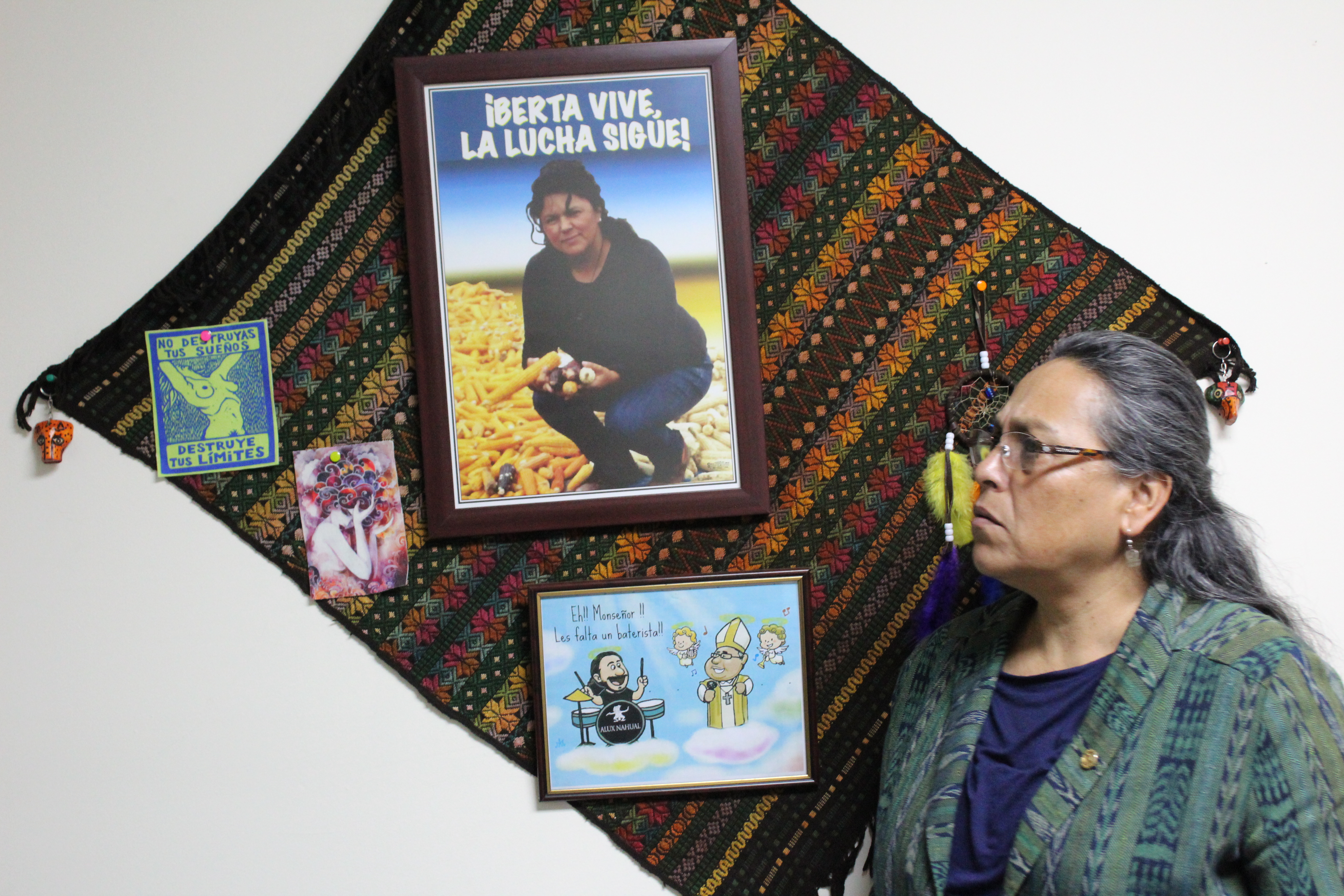
His office, on the second floor of a building near Congress, is simple: four chairs with indigenous prints, a table, the Guatemalan flag and the flag of his party—Convergencia—and images on the walls. A calendar of the Antiprincesses, a photo of Berta Cáceres—the Honduran social leader murdered in 2016— and a recognition from LGBTQ+ organizations.
 –Do you feel like a champion of the LGBT cause?
 –
–"I'm part of the community. And I've framed my work as advocating for all rights for all people. I work with Indigenous communities, with women. I'm not solely focused on diversity; it's one element of my political agenda, but it's a crucial one because if I don't do it, nobody will."
-What rights do transgender people have in Guatemala?
Trans people are people living in poverty, from the lower middle class, who have to find ways to make ends meet, and that includes sex work, working in salons, selling food, or providing services. These are very limited opportunities. We live in a country where poverty, extreme poverty, is widespread and affects all segments of the population. Seventy percent of the population works in the informal sector. It is in this sector that you find most trans people.
-What is the situation of the LGBT community in general?
We are a country where churches have increasingly exerted a strong influence on public opinion. It's now evident that many people, including the president (Jimmy Morales), are reverting to the idea of the heterosexual family as the norm. Diverse families are no longer recognized as families. Homosexuality is once again being portrayed as a deviation, a sin, or an illness. Even though these are outdated ideas from the last century, they are being reintroduced. Confronting this reality is daunting: we've made progress, but we've reached a breaking point. Despite what we've achieved so far, it's incredibly difficult.
-Would you say there has been a setback in recent years?
-You could say that what they want is to prevent us from moving forward. And that there's a clear fear of change, but this isn't just happening in Guatemala; it's something that's affecting the world and Latin America very strongly. These more conservative ideas express a fear of the progress of diversity, of what they call this "gender ideology," which is supposedly guiding the whole world against us.
READ ALSO “Unstoppable”: the book that tells us about LGBTI rights in Latin America
Alone in Congress
Sandra has been involved in social movements for 40 years. Until 2015, when the people took to the streets to demand the resignation of former president Otto Pérez Molina, accused of corruption, she had never been part of any political party, but she was invited and elected.
Now, for these organizations, she is their voice in Congress. “She is the only openly lesbian congresswoman who was elected as such. This opens a crucial door for the political participation of the LGBTIQ community in Guatemala,” explains Luis Eduardo Barrueto of the organization Visibles. Activism relies on her, and she on the organizations.
–What laws have you introduced to seek to gain rights for the community?
 –
–-Law 5395, the Gender Identity Law. With that, on the one hand, we gained visibility, we gained a voice in the discussion. The law received an unfavorable opinion; it didn't go beyond the working committee. However, for the first time in the history of Congress, a law of this kind moved forward. And we broke new ground. The existence of trans people was discussed in the political and public spheres, and the actions against their very existence were brought to light. I think it's like a thermometer: it allows us to measure where we stand and what the scope of action is.
-What were the reactions to the presentation of the Gender Identity Law?
-It became clear that there is terrible transphobia and a possibility of greater violence. But it's important that for the first time a member of parliament, that is, me, dares—because that's the kind of daring we're in—to present something and represent the community. Because I could have been in the closet too.
The law addressed the recognition of identity, changes to official documents, and access to the rights everyone should have. People can already change their name. They can go to the RENAP (National Registry of Persons); they've already won the right to change their name and their photograph, their physical appearance. This has been the work of trans organizations through a more direct agreement. The goal of the law was to take another step forward. But it wasn't achieved.
-Is there any public policy designed for this group?
The Guatemalan state was ordered to implement a public policy following a case before the IACHR (Inter-American Commission on Human Rights). But at the moment, progress is stalled. This is because the government, which is based on evangelical churches, is hesitant to take any missteps. And for them, a misstep would be moving forward with a diversity policy.
-Do you think this government might consider it?
No. Especially now that it's closing ranks and constantly talking about the heterosexual family, about life. This government is no longer doing that. We have to wait and see what the next government will be like, whether it will be a continuation of this one or if there will be a possibility of change. That's the challenge for us.
-Do you feel a little alone with these issues in Congress?
"The thing is, I'm actually on my own. Although there are some members of parliament who don't necessarily disagree, the problem is that these kinds of laws cost us votes. Now they're even less likely to do this kind of thing because we're already in an election period."
-Are there any statistics on the LGBT community?
My colleagues are talking about 15,000 people, but I don't know. They didn't want to include it as a question in the census. For me, it was very difficult to believe they would ask that question, given that so many people are in the closet. But it also means we don't have official statistics.
-What is Initiative 5272?
Law 5272—a law that is about to be passed and that threatens the rights of women and LGBTQ+ people— is a counter-law to my agenda. It remains a threat. The law is still in effect and could be enacted at any moment. It's not the only one; there are about 10 laws that threaten certain social groups, aimed at controlling demonstrations and the opposition social movement. They are the government's response to public demonstrations and the fight for rights.
-Would you define Guatemala as a sexist country?
-Oh, quite. And racist.
We are present
We are committed to journalism that delves into the territories and conducts thorough investigations, combined with new technologies and narrative formats. We want the protagonists, their stories, and their struggles to be present.
SUPPORT US

FOLLOW US
Related notes
We are present
This and other stories are not usually on the media agenda. Together we can bring them to light.