

Three years after the transphobic murder of Marcela Chocobar: threats and impunity denounced
Marcela Chocobar was last seen alive in the early morning of September 6, 2015 in Río Gallegos.


Share

By Belén Manquepi Gómez , from Río Gallegos (Argentina)
Three years have passed since the murder of Marcela Estefanía Chocobar, but her body has still not been found and there is still no trial date. She was last seen alive in the early morning of September 6, 2015, in Río Gallegos. Two people remain in custody for the murder of the 26-year-old trans woman, and the presentation of evidence continues. On this anniversary, a new demonstration will be held today in downtown Río Gallegos to demand justice for the murder of this trans woman, along with a discussion on hate crimes.
They report threats against the family
On August 23, 2018, one of Marcela's sisters, Elizabeth Chocobar, was at the bus stop at the corner of Tucumán and Maipú streets when she saw a car driven by a man she recognized. The car continued on its way but returned minutes later. The driver made a threatening gesture, running his hand across his neck, making sure Elizabeth saw him. She reported that the man was Adrián Fioramonti, one of the three people arrested in 2016 in connection with the investigation into her sister's murder. After posting bail of 50,000 pesos, Fioramonti was released. He was later acquitted due to "lack of evidence."
Although it wasn't the first time Marcela's sisters had crossed paths with Fioramonti, they weren't expecting a threat. In this context, Judith explained, "We don't know how to deal with the justice system. The person who threatened my sister knows how to operate; he has political connections, he knows people, he knows how to handle himself when he has a complaint against him."
The criminal complaint was filed in Court No. 2 and will be added to the case.
The investigation today
The prosecution has requested that the charge of "simple homicide" be changed to "hate crime." The case is currently before the Oral Court of the First Judicial District of Río Gallegos, awaiting a trial date.
Marcela Chocobar was last seen alive leaving a pub in downtown Santa Cruz, getting into a red Renault 9. Days later, her skull, along with some clothing and a wig, was found in a vacant lot in the outlying San Benito neighborhood. Ángel Azzolini (currently in pretrial detention in Puerto San Julián) and Oscar Biott (also in pretrial detention in Río Gallegos) were arrested in connection with her murder.
“The presentation of evidence has been ongoing since last year. We requested a meeting with the prosecutor, and we are still waiting. We also requested a search warrant for Laguna Ortiz, where there were indications that the cell phone might be located. It appears in security camera footage and film photographs; they were at Laguna Ortiz. We requested a search warrant for Laguna Azul because Biott and Fioramonti used to climb in Laguna Azul. They know it's shallow, they know how to carry equipment, and they can do it very easily,” stated Judith Chocobar.
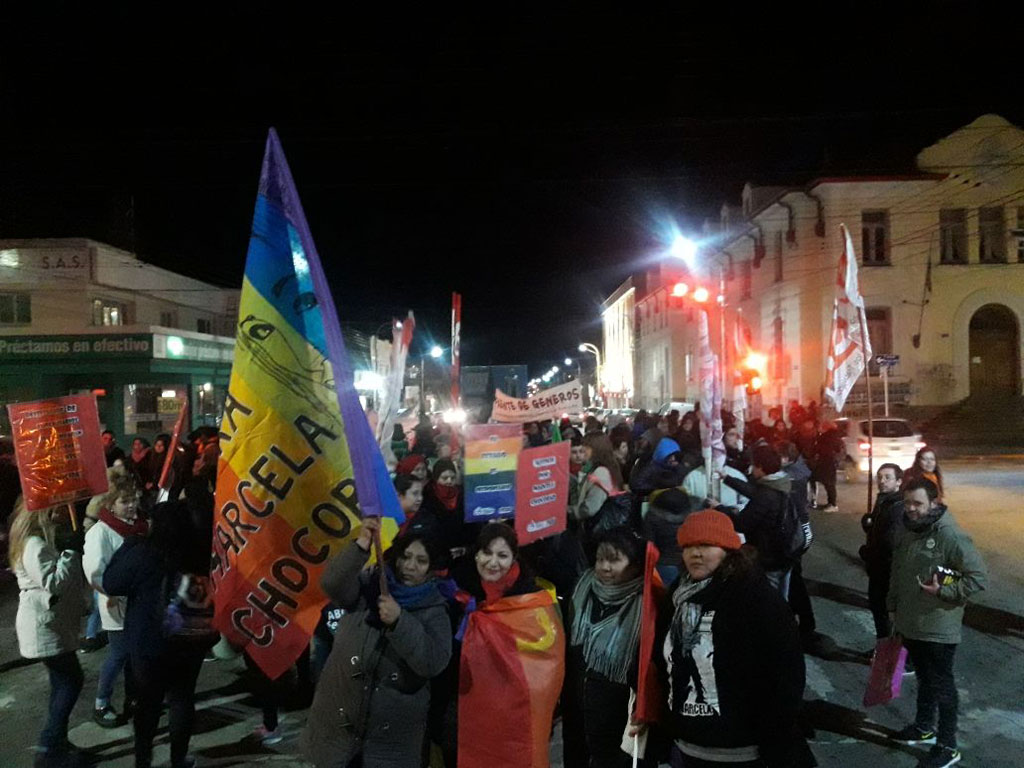
Demand for Justice for Marcela Chocobar at the Ni Una Menos march in Río Gallegos.
Begging for justice
“What keeps us fighting is the impunity that exists. And not having anywhere to leave a flower, not having held a proper wake, a proper farewell—we still haven't said goodbye to her, she's always present. That's the struggle that drives us,” says Judith Chocobar. And she asks: “How can something like this happen in such a small city and remain unpunished?”
She emphasized the support of organizations like Las Rojas and the Plenary of Women Workers, saying, “They encourage us to keep going, to make sure this doesn't end here. We get tired of begging for justice. We don't have powerful surnames, we don't have political connections, we don't have money. Because we lack that position, we are vulnerable victims of this system. If we were someone else… if this happened to a judge, a prosecutor, or someone we knew, they would have much easier access to everything. We, the vulnerable victims, have to beg for justice, but that doesn't discourage us. We will continue fighting no matter what. The struggle is for justice, and it will always be for justice, so that this never happens again.”
The young woman's death marked a turning point for the trans community in Río Gallegos. "There aren't many of us trans women; the number increases at certain times of the year when we have 'migrant trans women,' as we call them, who come here, live off prostitution, come to the city, and work in prostitution," Delfina Brizuela, who knew Marcela and now works in the province's human rights secretariat, told Presentes.
"Here we also have people who kill out of hatred for their gender."
Delfina Brizuela met Marcela and remembers her as "a girl full of dreams. She really liked taking care of herself, she was very fun. She fought hard to achieve what she had, she was very trusting, she believed that all people were good, she had no malice."
Brizuela says that “the fear remained, even though each woman knows the risks involved in opening the door to a stranger while working, not knowing who you might meet, or getting into a car, not knowing who you're getting in with or if you'll even get out. That fear is present in those who work in prostitution. Trans women who work, after this, are hesitant about who they open the door to.”
These were things they thought only happened in big cities, like Buenos Aires or Córdoba. “You never imagine it could happen in a small town like Gallegos. When you see the brutality of Marcela’s murder, you realize it happens here too, we have murderers here too, we have people who kill out of hatred, because of gender, because they are a trans person .”
Brizuela says that at the national level, the scenario for transvestites and trans people is worrying: “So far this year, from January 6th to today, we have had 49 deaths of trans women, some murdered and others due to abandonment by the National State.”
Anniversary activities
- This afternoon, at 4 pm there will be a talk at the Santa Cruz Cultural Complex, with the participation of Judith Chocobar; Nadia Astrada and Delfina Brizuela (Secretary of Human Rights of the province), Roxana Rodríguez from the Directorate of Sexual and Gender Diversity, and the lawyer Giorgio Benini.
- Starting at 6:00 PM on Néstor Kirchner Avenue (formerly Roca) and San Martín, Marcela Chocobar's family will hold a demonstration to raise awareness of the hate crime that remains unpunished.
We are present
We are committed to journalism that delves into the territories and conducts thorough investigations, combined with new technologies and narrative formats. We want the protagonists, their stories, and their struggles to be present.
SUPPORT US

FOLLOW US
Related notes


We are present
This and other stories are not usually on the media agenda. Together we can bring them to light.