

Córdoba is pushing for trans inclusion in the workplace: stories behind the struggle
Two legislative initiatives for transgender labor inclusion were presented in Córdoba, one at the municipal level in the capital and the other at the provincial level. As with the debate on legal abortion, their approval depends on broad consensus among legislators committed to gender rights and sexual diversity. Thus, the testimony of how the transgender community survives in extreme conditions entered the legislative chambers.

Share

By Alexis Oliva, from Córdoba
“I never imagined or dreamed that we would come here to present a project from our community,” said Natalia Herrera, a member of the Trans Córdoba Textile Cooperative.
“The opportunity to have a job takes you out of a life without hope and strengthens you as a person,” added her emotional colleague, Morena Saavedra.
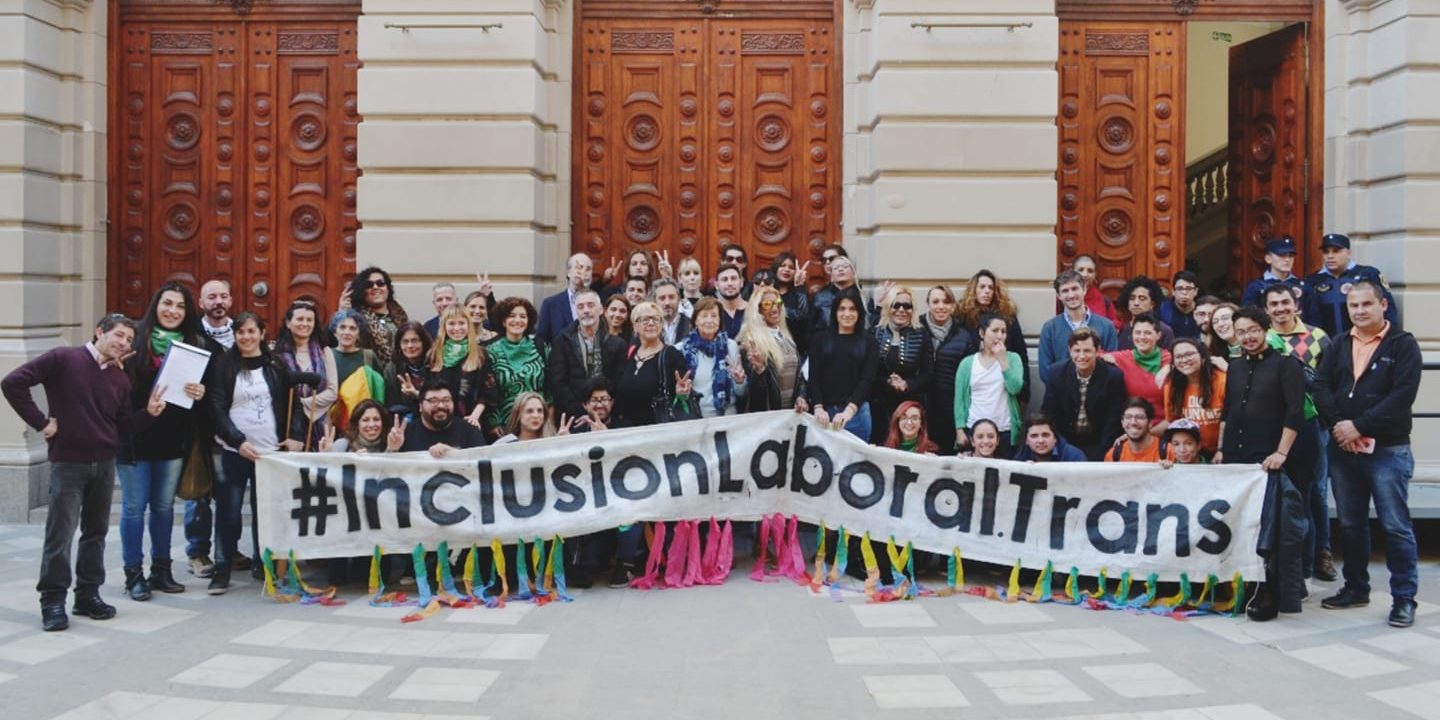
It was 10 a.m. on Thursday, June 28, International LGBTIQ+ Pride Day, and the draft Municipal Ordinance for Trans and Travesti Labor Inclusion, promoted by the Putos Peronistas group, the Trans Center of Córdoba and the cooperative itself, with the support of the LGBTIQ+ League, Devenir Diverse, the Federal Trans and Travesti Call of Argentina, the university movement La Bisagra and Juntos Por Sociales, with the slogan "in the face of the transvestization of poverty, transvestization of resistance", had just been submitted to the Gender Commission of the Cordoba City Council.

Councilwoman Nadia Fernández with activists from Centro Trans Córdoba. Credit: Centro Trans Córdoba
“An institutional framework for equity”
For the first time, the initiative is being introduced with the signature of a councilwoman and a chance of achieving broad consensus. Nadia Fernández, from the Union for Córdoba bloc, the largest minority in the City Council, explained to Presentes : “I am confident that it will be approved, because it is a project open to modifications, as long as they mean more rights and not fewer. We are going to engage in intensive dialogue with the ruling party (Radical Civic Union), where there are also colleagues who are active in this movement, so that it can be possible.”
If approved, the ordinance would include “awareness and training campaigns in the public sector, but also for businesses that are suppliers to the Municipality, who will receive incentives each time they hire one of the women from the collective. Furthermore, it would create opportunities for cooperatives and micro-enterprises, with microloans, economic incentives, and support.”
In turn, the incorporation into the municipal state employee staff will depend on the modification of other regulations such as the municipal statute and the competition ordinance, but Fernández is confident in “generating an institutional framework of equity so that the trans community can participate in competitions under the same conditions as everyone else.”
The corner or dignity
For Ana Laura Torres Vera, a member of Travas Peronistas and advisor to councilwoman Fernández, reaching this point is the result of “our work, persistence, and efforts to ensure that new generations are treated with the dignity they deserve in their gender roles. Those of us who have been fighting for years have achieved progress in various areas, but we want the benefits to extend beyond those of us who have been fighting; we want them to be for all our comrades and future generations.”
“We’re denied jobs simply because we’re trans,” says Victoria Romero, president of the Córdoba Trans Center. “That’s why we’re not demanding job quotas, but equal conditions like any other rights holder. Our organizations are united by the same struggle, because the streets are killing us. And if we don’t have options, our most likely fate is to end up standing on a street corner.”
“The time to expand rights is every day.”
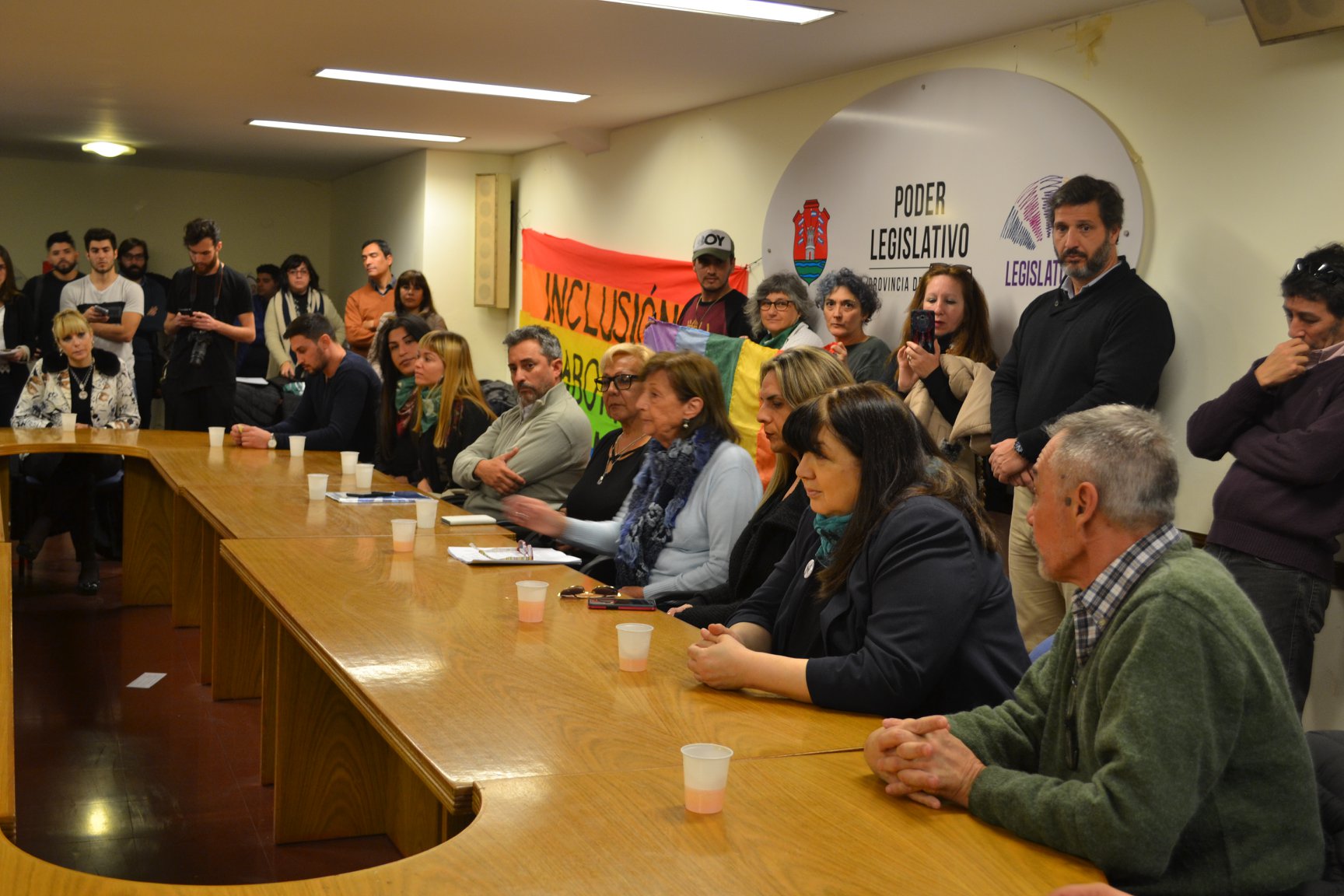
The hopeful and festive atmosphere moved to the Provincial Legislature, where at 2 PM Devenir Diverse and La Bisagra, with the support of the LGBTIQ+ League and the Federal Call, submitted their bill for the Promotion of Formal Employment for Trans and Travestis People, which has the support of legislators Ilda Bustos and Ricardo Vissani, from Union for Córdoba –the majority bloc in the Provincial Legislative Power–, Carmen Nebreda, Vilma Chiapello, Franco Saillén and Martín Fresneda, from Córdoba Podemos –Cordoban Kirchnerism– and Liliana Montero –a single-person bloc–.
[READ ALSO: The first university cafeteria run by trans students]
Contributing to the eradication of workplace discrimination based on gender identity and/or expression; ensuring the full enjoyment of human rights for transgender and transvestite people; facilitating their access to and retention in the formal labor market; promoting respect for their labor rights; and fostering their ongoing job, technical, and/or professional training are some of the project's objectives. The committee room where it was presented yesterday was filled with leaders and activists from political, social, human rights, and gender diversity organizations, provincial legislators committed to the initiative, National Deputy Gabriela Estévez, Mercosur Parliament Representative Cecilia Merchán, and former Deputy Mayor Carlos Vicente, all surrounded by rainbow flags.
Martín Apaz, an activist with Devenir Diverse, emphasized that the fight for trans and travesti labor rights “has a double meaning today” in a context of “the erosion of labor and social security rights.” “In this social movement, we believe there is no right or opportune moment to expand rights; it’s every day, because the situation is truly a social emergency,” he added.
 “A society governed by human values”
 “A society governed by human values”
Legislator Ricardo Vissani thanked them for the invitation to share the project, highlighted the support of some leaders of the CGT Córdoba and stated that "the struggle to win these rights will be framed within the struggle of the labor movement and within the overall fight that we Argentinians are waging to defend our rights and working conditions."
In turn, Franco Saillén stated: “As a working man and in my role as a legislator, I must support this project. We have already been working on this process within our organization. I come from Surrbac, the waste collection workers' union, where eleven trans women work. We are proud to take this qualitative step toward unity for all of society, for workers, and for gender equality. But the first entity that must become part of this process is the national, provincial, and municipal government.”
[READ ALSO: #Cordoba Hate crime against a young trans woman: “She was brutally and treacherously murdered”]
“We are facing the will of those who only see the market as a way to regulate our society. Our society must be regulated by human values, by the interests of the people, by everything that makes us better, that brings us closer together, and that prevents discrimination, exclusion, and marginalization. That is the society we aspire to, and a bill is just the tip of the iceberg of what needs to be done,” said Ilda Bustos, legislator and former general secretary of the Graphic Workers Union of Córdoba.
For her part, legislator Carmen Nebreda maintained that “this struggle to achieve, not just a quota, but the incorporation into formal employment of the most vulnerable sectors of society, is fundamental to building a better society. The only way to achieve this is by standing together—social organizations and those of us with political responsibility. Even if we are few in number on the inside, if there are many on the outside, we will always be stronger.”
“We are here because we want you to live”
In August 2016, the city of Bell Ville became the first in the Mediterranean province to approve an ordinance for transgender employment inclusion. Karim Tuma, a leader of the LGBTIQ+ League in the Unión department, was one of the proponents of the current provincial bill: “We continue to demand not only jobs, which are in high demand in our city, but also an end to prostitution throughout the Unión department. Unfortunately, it is the only employment option available to our transgender sisters due to their exclusion from all areas of life, not only employment but also social and educational exclusion. We are here and we will continue to be here because, unfortunately, we are a nuisance. We will continue to be a nuisance because that is what keeps us going. Know that we are here above all because we want to live.”

Luciana Volpini, representative of the League in the Marcos Juárez department, recounted that “Corral de Bustos was the second town in the province to approve a trans employment quota as an ordinance. Today, our trans colleagues have access to formal employment. The only alternative was prostitution. I am a sex worker; I have no other choice in life. My family throws me out on the street, and I have no access to healthcare. We are being discriminated against, abused, and murdered. So far this year, 41 women have died, either by suicide or murder. How important this ordinance is in a small town, because it allows us to have access to work, education, and housing.”
“For labor and social security inclusion”
The head of the Córdoba Podemos bloc and former National Secretary of Human Rights, Martín Fresneda, stated: “I come from the human rights movement; I am the son of disappeared persons, and I was thinking about the countless dreams and expectations that are here. The responsibility we assume is not merely formal; it is a real responsibility to build the necessary consensus for this to become law. It is of no use to us if this remains only within a parliamentary minority. These projects are the most legitimate because they arise from necessity, from history, and from lived experience. I am convinced that we will achieve victory, because look at the broad political, student, worker, and civil society movement that came together to support this project, which has historical roots and aims to dismantle inequalities in an unjust society.”
 Next, Gabriela Estévez, a national deputy from the Front for Victory, called for action "to ensure this right is effective so we don't have to keep talking about the need for labor inclusion and can move on to fighting for other things because this will already be resolved. The commitment to making this right effective and ensuring it becomes law is guaranteed. Stop trans femicides! For a trans labor inclusion law and a trans pension inclusion law, so they have the right to comprehensive healthcare and employment."
“We are tired of burying girls”
Finally, Ivanna Aguilera, president of Devenir Diverse and vice president of the Argentine Trans and Travesti Federal Network, stated: “The State’s neglect and contempt for us is so profound. Before, they killed us in prisons and on the streets. They don’t imprison us like before, they don’t punish or break us like before, but they kill us in other ways. The State kills us with oblivion, forcing our sisters to go out on the streets just to be able to eat the next day. None of us want to be prostitutes. We want to choose how we want to make a living, how we want to develop ourselves, we want a life expectancy other than 32 to 36 years. The few of us older women who remain are tired of burying young girls.”
“It is urgent that we take to the streets to fight for this, because it is urgent that our sisters stop dying and it is urgent that they begin to exercise what all of you do: the right to work. That is why, comrades, we must take to the streets to fight for this, because what is not named does not exist. We exist and we resist!” Aguilera concluded.
We are present
We are committed to journalism that delves into the territories and conducts thorough investigations, combined with new technologies and narrative formats. We want the protagonists, their stories, and their struggles to be present.
SUPPORT US

FOLLOW US
Related notes
We are present
This and other stories are not usually on the media agenda. Together we can bring them to light.