

Historic sentence: Life imprisonment for hate crime against Diana Sacayán's killer
The Oral Criminal and Correctional Court No. 4 of the City of Buenos Aires unanimously sentenced Gabriel David Marino to life imprisonment for the murder of transgender human rights activist Amancay Diana Sacayán. In its verdict, the court determined that it was a hate crime motivated by gender-based violence (aggravating circumstances 4 and 11 of the Penal Code). This is an unprecedented and historic ruling. This trial marked the first time the term "transvesticide" was used in court records.

Share

By María Eugenia Ludueña and Ana Fornaro.
Photos: Ariel Gutraich.
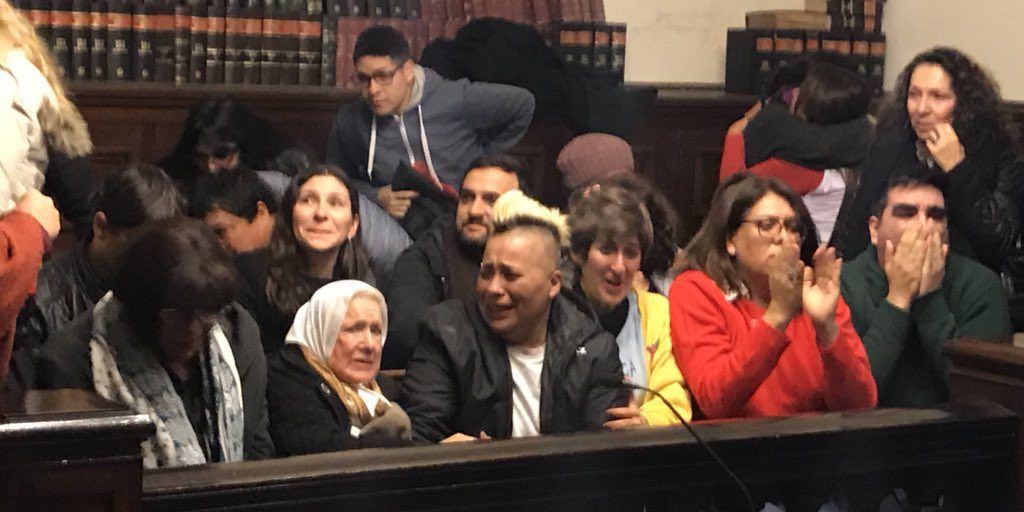
Criminal and Correctional Court Gabriel David Marino to life imprisonment by majority vote In its verdict, the court considered it a hate crime and that gender-based violence was a factor, according to sections 4 and 11 of article 80 of the Penal Code. It is an unprecedented and historic ruling. In this trial, the term "transvesticide" was used for the first time in court records. "This is a paradigm shift. It's the best verdict we could have had. It's the first time justice has been served for a transgender woman," said an emotional Sasha Sacayán, Diana's brother, to Presentes. The presiding judge read the verdict after midday, following a recess after the prosecution and defense heard their arguments. When the verdict was announced, the sixth floor of the Palace of Justice erupted in applause, and in the courtroom, activists and family members released the tears they had held back during 12 grueling hearings. In the plaza across from the courthouse, where activists had been present at every hearing, an open-air radio broadcast had been set up, and hundreds of people listened to the verdict from there. Afterward, activists and friends of Diana, Sasha Sacayán, Romina Pereyra, Alma Fernández, and Darío Arias spoke. In this trial, which began on March 12, it was proven that Diana Sacayán was stabbed to death in the early morning of October 11, 2015, in her apartment in the Flores neighborhood of Buenos Aires. Her body had more than twenty cuts two days later, and according to expert Roberto Cohen, who performed the autopsy, she was murdered “with ferocity .” The crime scene was described by the first witnesses as “a horror movie.” Diana had been bound and gagged, and after being murdered, her body was covered with her mattress.
 Diana was 39 years old: she had outlived by four years the average life expectancy for transvestites and transgender people in Latin America: 35. For half her life, she had worked to secure rights for the trans community, one of the most violated and criminalized groups. She was one of the driving forces behind the Gender Identity Law, the creator of the transvestite and transgender employment quota in the province of Buenos Aires, a member of the Sexual Diversity Program at INADI (National Institute Against Discrimination, Xenophobia and Racism), a champion of the fight for trans rights, secretary of the International Lesbian, Gay, Bisexual, Trans and Intersex Association for Latin America and the Caribbean (ILGA-LAC), and a leader of the Anti-Discrimination Liberation Movement (MAL). Gabriel David Marino, 25, went to trial accused of “triple aggravated homicide due to gender-based violence, hatred of gender identity, and premeditation, in conjunction with robbery.” Investigators believe a second person participated in Diana's murder, but has not yet been identified. That section is still in the investigation stage and remains an unknown.
 The lawsuits and the prosecutions: life imprisonment
The lawsuit, led by Luciana Sánchez—representing Say Sacayán, Diana's brother and coordinator of MAL (Anti-Discrimination Liberation Movement, founded by Sacayán)—had requested to sentence Marino to life imprisonment as the criminally responsible perpetrator of the crime of transvesticideThis is the aggravated homicide due to hatred of the transvestite gender identity of Amancay Diana Sacayán (article 80, paragraph 4 of the Penal Code), in ideal concurrence with article 80 paragraph 11, for having been committed by a man against a woman through gender violence (femicide), in ideal concurrence for having been committed with treachery and in real concurrence with simple robbery, for having appropriated 20 thousand pesos from Diana.
The lawyer highlighted that 'having a gender perspective from the beginning - thanks to the work of the Specialized Prosecutor's Unit for Violence against Women and LGBTIQ+ People (UFEM) And the Justice for Diana Commission made it possible to collect evidence of the motives behind her murder. “Unlike other cases, it is not common to have the quality and quantity of evidence we had in this trial to identify the elements of hate. In general, hate crime scenes are tainted, not addressed with rigorous protocols, and go unpunished,” Sánchez said in her closing argument.
 The lawsuits and the prosecutions: life imprisonment
[READ ALSO: Unpublished interview with Diana Sacayán: “I speak from the politicized transvestite core”]
The lawsuit filed by INADI (National Institute against Discrimination, Xenophobia and Racism), led by Juan Kassargian, had also requested life imprisonment for Marino. Kassargian urged the Court to take into account the aggravating factors of hate, gender violence, and cruelty and treachery.“We frame his murder as a hate crime, also called by academia “due to discrimination or prejudice”, because the perpetrator selects the victim for belonging to a minority and also sends a threatening message to the group to which he belongs.” The Public Prosecutor's Office -Ariel Yapur for prosecutor no. 9 and Mariela Labozzetta from UFEM - had requested sentence Marino to life imprisonment for triple aggravated homicideThe prosecution argued that the crime was committed due to gender-based prejudice, involving gender-based violence, and because of the perpetrator's relationship with the victim. In their closing argument, the prosecutors emphasized the importance of framing the homicide correctly: that "the crime be called by its name: a hate crime and a transphobic hate crime, to begin to dismantle the path of invisibility and impunity for this community." The prosecution stated that robbery could not be proven at trial and dropped that charge. 12 hearings, 30 witnesses, a historic event
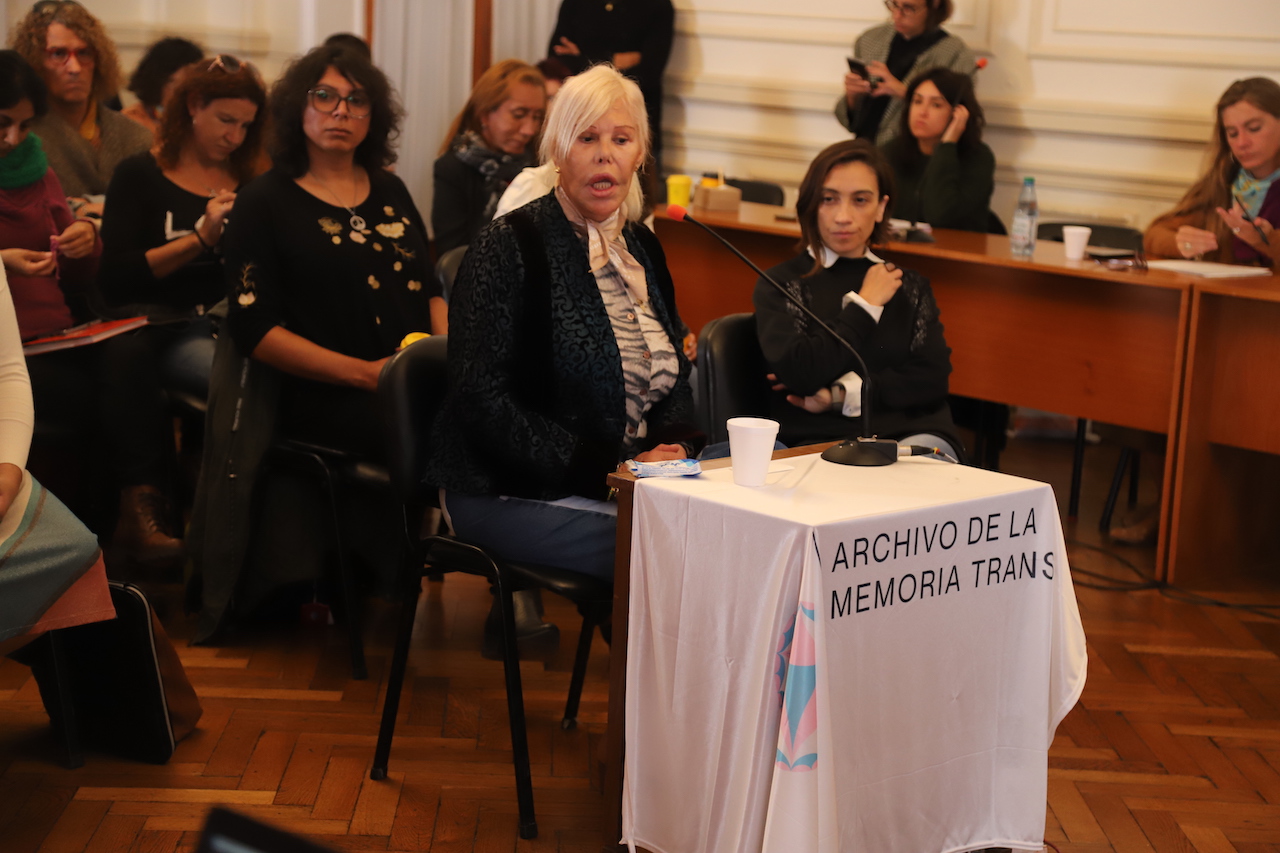
The lawyer and the prosecution also requested the court a series of reparative measures for the trans and transvestite women community. Over the course of 12 hearings, the court—comprised of Adolfo Calvete, Ivana Bloch, and Julio César Báez—heard nearly 30 witnesses. These included experts, forensic specialists, scientists, and a large number of transvestites and transgender people. For the first time, the justice system heard the accounts of this community, not from the perspective of the prosecution, but from their position as victims within a stigmatized community whose most basic rights have been violated.
Throughout the hearings, the voices of transvestites and trans people testified not only to the loss that Diana's murder represented for the community but also to the structural violence they face daily. This was made possible by the work carried out by the plaintiffs, the prosecutors, and the Justice for Diana Sacayán Commission.
12 hearings, 30 witnesses, a historic event
The lawyer and the prosecution also requested the court a series of reparative measures for the trans and transvestite women community. Over the course of 12 hearings, the court—comprised of Adolfo Calvete, Ivana Bloch, and Julio César Báez—heard nearly 30 witnesses. These included experts, forensic specialists, scientists, and a large number of transvestites and transgender people. For the first time, the justice system heard the accounts of this community, not from the perspective of the prosecution, but from their position as victims within a stigmatized community whose most basic rights have been violated.
Throughout the hearings, the voices of transvestites and trans people testified not only to the loss that Diana's murder represented for the community but also to the structural violence they face daily. This was made possible by the work carried out by the plaintiffs, the prosecutors, and the Justice for Diana Sacayán Commission.
 The Commission—comprised of activists and LGBTQ+ organizations—was one of the main driving forces behind the trial. In its closing argument, the prosecution acknowledged the Commission's role in advancing the public and oral proceedings.
The role of activism
Each hearing unfolded in a packed courtroom. Activism was also strong outside the courthouse. At each hearing, people were called upon to participate and raise awareness of the trial from Plaza Lavalle. This disrupted the area's routines, the attire and mannerisms of lawyers and court officials, with open radio broadcasts, cultural activities, and more. a music festival. Amaranta Gómez Regalado –activist muxe and an anthropologist with an international career- She traveled especially from Mexico to testify as an expert witness.us His words before the court were a masterclassAimed at a broad audience, the presentation addressed gender identity, politics, culture, and violence within the regional context. It was a kind of cultural translation of the reality experienced by trans people in Latin America, highlighting both commonalities and differences, and explained to the justice system. “We have come this far with the certainty of having succeeded in raising awareness in a large part of society and moving many of the political, social, and judicial actors involved in this process. We hope that the Judiciary will rise to the occasion and issue an exemplary ruling, declaring that Diana's murder was a hate crime motivated by prejudice against her transvestite gender identity, and that this Judiciary will speak out for the first time in history about the deaths of transvestites and trans people and recognize that this was a transvesticide,” the Commission stated in its latest communiqué. ]]>
We are present
We are committed to journalism that delves into the territories and conducts thorough investigations, combined with new technologies and narrative formats. We want the protagonists, their stories, and their struggles to be present.
SUPPORT US

FOLLOW US
Related notes
We are present
This and other stories are not usually on the media agenda. Together we can bring them to light.