

A play about trans love
The play "If You Love Me, Love Me Trans" speaks of desires, unfulfilled dreams, and hard-won victories. It is performed by the 7 Colores Diversidad Theater Company, directed by the trans playwright Daniela Ruiz.

Share

By
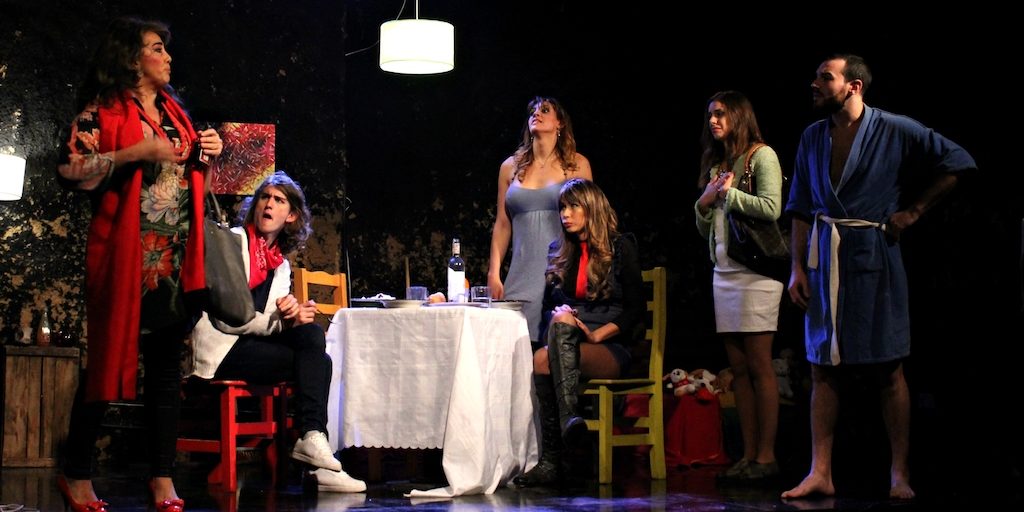
Ivana Romero Photos: Lucía Benavente/Courtesy of 7 Colores Company Raúl stands before his mother, María del Rosario, a charmingly unhinged woman. When she speaks to the audience, she says things like, “I’m very clear on the difference between ‘elles,’ ‘ellxs,’ and ‘ellas,’ but people still don’t understand a thing.” You have to see how María bristles when her son confronts her: “This is Brenda, my girlfriend. Yes, she’s a trans girl.” Brenda is the first to be surprised. Also on stage are her trans friend Camila and Joseph, a queer young man. The three of them share a house. That’s where Raúl takes his bag. Behind them arrives his mother and even his ex-girlfriend, Mercedes. The small stage barely contains the brilliance of the characters as the audience applauds and chants, “He told her, he told her.” Raúl’s declaration is a vindication rarely heard in real life. If You Love Me, Love Me Trans* speaks of: what is desired, what remains unfinished, what is won through sheer struggle . It is presented by the 7 Colores Diversidad Theater Company, directed by playwright Daniela Ruiz, a trans woman.
 The play itself is directed by Esteban Yukelson. “The company emerged in 2016 as a synthesis of the Theater for Diversity Workshop, which we held at the Alfonsina Storni Cultural Center, at the time with the support of the City Government. The workshop was designed to integrate the LGBTIQ community into the theater world and create a new employment option with a gender perspective. Our company is independent of any political group and is self-managed,” explains Ruiz after the play, which is generally followed by a discussion. This time, the guest was trans rights activist Lara Bertolini, who is also a court employee and law student.
  "If you love me, love me trans" is a piece of graffiti that the members of 7 Colores saw and embraced as part of the cause. They are: Micaela Bayer (Brenda); María Pía Martignoni (Camila); Soelí Naveyra (María del Rosario); Juan Manuel González Rotstein (Raúl); Emmanuel Martínez (Joseph); and Chloe Montero (Mercedes). – A little while ago you mentioned that the Company is characterized by its diversity. In what sense do you mean that? Daniela Ruiz: 7 Colores is made up of queer, cis, and trans people. But we all agreed that it was necessary to create theater that breaks down structures and, above all, promotes trans visibility . Our goal is to tell stories that encourage reflection on gender roles, stereotypes, and labels that are present in the society we live in . All members of the company are committed to supporting and defending LGBTQ+ rights and raising awareness of the trans employment quota bills, as well as the anti-discrimination law . That's why we also presented an adaptation of The House of Bernarda Alba during Diversity Week.
 – How did the story you tell in If You Love Me, Love Me Trans come ? Micaela Bayer: – We developed it collectively based on personal experiences. For example, I started doing theater and many people didn't realize I was trans. On top of that, I work in a domestic violence office that's part of the Federal Police. Where was I going to find a place for myself? I hid; I couldn't express myself. So when I joined the company, I dared to speak out and show myself as I really am. And I discovered that what was happening to me was happening to many of us. María Pía Martignoni: – I come from far away, from Tucumán, and now I'm proud to be a university student: I study Social Work at the University of Buenos Aires. But how many trans girls do you see at university? We're considered a body, a dark object of desire, but saying "I'm dating a trans girl" is something else entirely . It's hard for people to understand something as basic and simple as the fact that we are people, with our desires, our lives, our contradictions. Because to all the work we have to do with our families, with our communities, add the debate with organizations and with state policies, which also want to put us in the boxes that suit them. So, for us to fall in love and for someone to choose us out of love is something simple yet groundbreaking at the same time.
 – Desire, in that context, seems to articulate that entire life experience. Daniela Ruiz: Yes, we are proud to talk about what we want, in the terms we believe we should. This work expresses the desire to live a life without restrictions and the desire to love and be loved , even though love is a complicated concept. But anyway, I'm not heteronormative for wanting to be loved, for wanting a partner, as is often questioned, even by feminist or LGBTQ+ rights organizations. The play deals with love because love is what was denied to us. María Pía Martignoni: Do you know what it's like for us to have a mother-in-law? Most trans women never meet their mothers-in-law, nor are we seen or accepted as girlfriends. It's rare for a man to say, "I love this trans woman and I can handle her." Besides, we're used to being stared at from birth. And the person who's with us has to get used to that. That just as they look at and question us, they'll be questioned too. Micaela Bayer: The play also challenges men in the construction of their masculinity. If you love a trans person, you're outside the norm. And they don't always accept that.
 – Why do they refer to the play as a “tragicomedy”? Daniela Ruiz: Because it reflects trans culture with its light and dark sides. Many people tell us, “Oh, don’t call yourself ‘faggot’ or ‘transvestite,’” and we call ourselves whatever we want because it’s not an insult. I mean, it’s the people who insult you who don’t know you. But the play aims to reflect a real situation without losing its sense of humor. That’s where our everyday relationships come in, which are neither the stereotype of a novel written with a heteronormative perspective nor what many people think without knowing us, even though they speak on our behalf . The play is built around our voice. And it’s a voice that has also learned to laugh.
 Micaela Bayer: – In certain contexts, with certain people, you have no choice but to laugh at yourself. And it’s not easy. I have coworkers who have treated me like a man, for example. So I say things like, “Listen, I got breast implants; at least with all the effort I put in, treat me like a woman.” And that’s it, you break through.
 – Why aren’t there trans playwrights and actresses as visible as, for example, Daniela Vega, who won an Oscar for A Fantastic Woman ? Daniela Ruiz: And what are we, darling? Can’t you see us? (laughs). Well, the truth is, we’re constantly constructing and deconstructing ourselves. The play is also about that, about how we perceive ourselves as people, as playwrights, as actresses, creating a specific discourse that has nothing to do with some preconceived ideas based on heteronormativity . Daniela Vega’s case is very specific because the truth is, she has a very heterosexual life in that film. We have it more complicated because we still don’t enjoy certain rights, which are seen as privileges: walking down the street peacefully, having a stable job, studying, for example. That's why we want to speak for ourselves and for them to stop speaking on our behalf without taking us into account.
 María Pía Martignoni: In theater or film, the roles of trans women are still played by cis men . Hello, here you have wonderful trans actresses and playwrights. Do you really want to see us? But it's not all bad because we've indulged ourselves. Since 2016, we've been performing this play in the city. And we've also taken it to cultural and educational centers in the province of Buenos Aires. And even last year we were at Unit 32 of the Florencio Varela Penitentiary. We all know what prison is like and the lack of opportunities. So performing there was transformative. Acting in general is transformative. It's a way of saying "we're here" and of continuing to open doors for ourselves and for others.
 "If You Love Me, Love Me Trans" can be seen this Sunday the 10th at 7 pm at JJ Circuito Cultural, Jean Jaurés 347. This time, the guest for the discussion afterward is Gabriela Mansilla, whose daughter Luana was the first trans girl in Argentina to obtain her ID card after the Gender Identity Law was passed in 2012. Admission is by donation.
[READ MORE: Interview with Gabriela Mansilla: "The battle for trans children doesn't end with the document"]
]]>We are present
We are committed to journalism that delves into the territories and conducts thorough investigations, combined with new technologies and narrative formats. We want the protagonists, their stories, and their struggles to be present.
SUPPORT US

FOLLOW US
Related notes

We are present
This and other stories are not usually on the media agenda. Together we can bring them to light.