

Diana Sacayán trial: defense presented arguments and sentencing will be on June 18
The 11th and penultimate hearing of the trial for the transvesticide of human rights defender Diana Sacayán began two hours later than planned, lasted four hours, and focused on the defense argument of the accused Gabriel David Marino.

Share

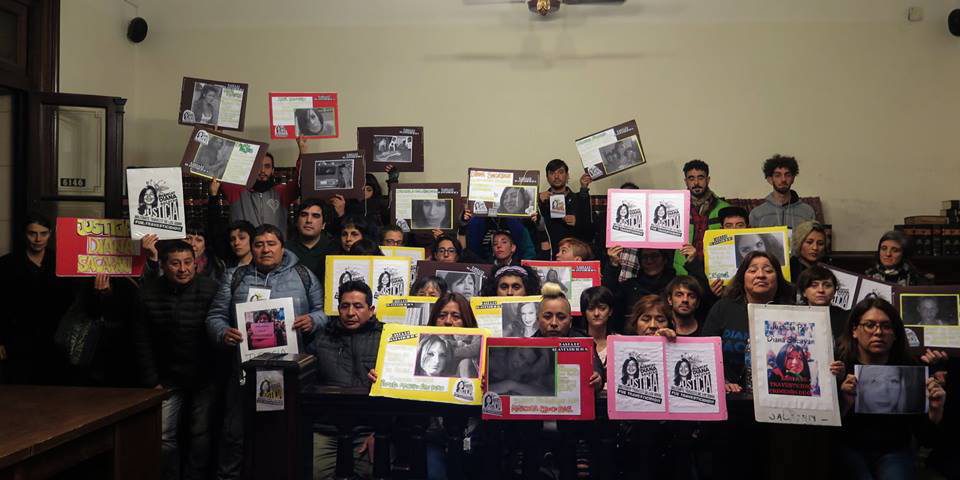
By Ana Fornaro and María Eugenia Ludueña Photos: Juan Cigale and Ariel Gutraich The 11th and penultimate hearing in the trial for the transphobic murder of human rights defender Diana Sacayán began two hours late, lasted four, and focused on the closing arguments of the defense for the accused, Gabriel David Marino. As throughout the trial, the courtroom was packed with Diana's family members, activists, and journalists. Those who couldn't get in watched the proceedings on a television set up in the courthouse hallways. The activists carried signs demanding justice for Diana, as well as portraits of other victims of transphobic violence. After a grueling day that lasted almost six hours, both activists and family members were deeply affected by a closing argument they considered "full of transphobia" and disrespectful of Diana's life and activism. The verdict is scheduled for June 18, the same day the rebuttals and surrebuttals will be heard.
[READ ALSO: #DianaSacayánTrial: the fourth hearing focused on who the accused is]
The representative of the Public Defender's Office, Lucas Tassara, gave a two-part presentation. In the first part, he reviewed what he called "evidence that no one saw," requesting the acquittal of his client, and in the second, he attempted to refute the aggravating circumstances requested by the prosecution, comprised of the Public Prosecutor's Office, he Inadi and the family disputeThus, the lawyer ruled out gender-based violence, prejudice, and premeditation as factors in Diana's murder. According to the lawyer, it was neither a hate crime nor a transphobic hate crime, but rather "common murder with a knife." Before beginning, he told the judges of the Oral Criminal Court No. 4, composed of Adolfo Calvete, Ivana Bloch, and Julio Cesar Báez: "We are dealing with a very complicated case, but one with an easy solution: that is the good news. What is at stake here is not respect for gender identity, but rather the criminal facts." Lawyer Lucas Tassara with the accused Gabriel David Marino
Thus, for more than two hours, the focus was on the alleged time of Diana's death, contradicting what Marino said in his only testimony at the trial. “I swear to God I was never at the scene of the crime.“—His lawyer said that the accused had indeed been in Diana’s apartment with another person on the night of October 10 and had left—as shown in the security videos—at four in the morning on Saturday, October 11. But, according to him, Diana was still alive. There he alluded to the “approximate” nature of Diana’s time of death according to the report of forensic doctor Roberto Cohen, who in his testimony stated…”the ferocity with which she was murdered, evidenced by the multiple injuries.After requesting the acquittal of his defendant, he spoke to the judges about “rationality” versus “emotionality” and returned to his opening statement, but this time he said it was not a “complicated” case but an “easy” one. “I agree with the prosecutor that it is a very easy case to prove; the difficult part is making the decision because it will be unpopular.” In the end, both the prosecution and the family's legal team expressed reservations regarding the material presented by Tassara.
Lawyer Lucas Tassara with the accused Gabriel David Marino
Thus, for more than two hours, the focus was on the alleged time of Diana's death, contradicting what Marino said in his only testimony at the trial. “I swear to God I was never at the scene of the crime.“—His lawyer said that the accused had indeed been in Diana’s apartment with another person on the night of October 10 and had left—as shown in the security videos—at four in the morning on Saturday, October 11. But, according to him, Diana was still alive. There he alluded to the “approximate” nature of Diana’s time of death according to the report of forensic doctor Roberto Cohen, who in his testimony stated…”the ferocity with which she was murdered, evidenced by the multiple injuries.After requesting the acquittal of his defendant, he spoke to the judges about “rationality” versus “emotionality” and returned to his opening statement, but this time he said it was not a “complicated” case but an “easy” one. “I agree with the prosecutor that it is a very easy case to prove; the difficult part is making the decision because it will be unpopular.” In the end, both the prosecution and the family's legal team expressed reservations regarding the material presented by Tassara.

Denying hate
After a twenty-minute recess, Tassara spent an hour and a half trying to prove that Diana Sacayán's murder was not motivated by hatred of trans identity or gender-based violence. He argued that the twenty or so stab wounds were "defensive" and that there was no particular cruelty involved, despite the statements of witnesses who saw the body, the forensic doctor, and the testimony of expert witness Amaranta Gómez Regalado. He also downplayed the normative scope of the Inter-American Court of Human Rights' (IACHR) advisory opinion and the definitions in its report on hate crimes against LGBTI people. However, he used examples of other hate crimes documented by the IACHR and other cases of gender-based violence where, according to him, there was cruelty evident in the condition of the bodies. For the lawyer, Diana's body was not "sufficiently" damaged. Another of Tassara's strategies was to claim that his defendant is also part of the LGBTI community. “He’s the ‘G’,” she said. And she added: “They weren’t in a romantic relationship, just casual encounters, and if there were a power dynamic involved, it would be the other way around because Diana Sacayán was an activist. […] If he really was the perpetrator, the problem was drugs, either being under their influence or experiencing withdrawal.”[READ ALSO: #DianaSacayánTrial: the autopsy showed that she was murdered with ferocity]
To downplay both Marino's preliminary statement—which was read during the oral proceedings and in which the accused claimed that the person he had been with in the apartment had murdered Diana—and his testimony, the prosecutor argued: “Marino is not a very lucid person. He doesn't fully understand the accusation.” The prosecutor again urged the judges to be “impartial” and not to feel pressured by the scrutiny of “the families, international organizations, and the press.” Family members and activists, dismayed by what they heard during the closing arguments, and as a symbolic act—with the permission of the judicial authorities—took a photo in the empty courtroom with images of other victims of transphobic murder whose crimes never reached this judicial stage or received any public attention. The prosecution's rebuttals and surrebuttals will take place on Monday, June 18, and the court will announce the verdict.We are present
We are committed to journalism that delves into the territories and conducts thorough investigations, combined with new technologies and narrative formats. We want the protagonists, their stories, and their struggles to be present.
SUPPORT US

FOLLOW US
Related notes


We are present
This and other stories are not usually on the media agenda. Together we can bring them to light.