

Two trans activists fight in court for the right to their names
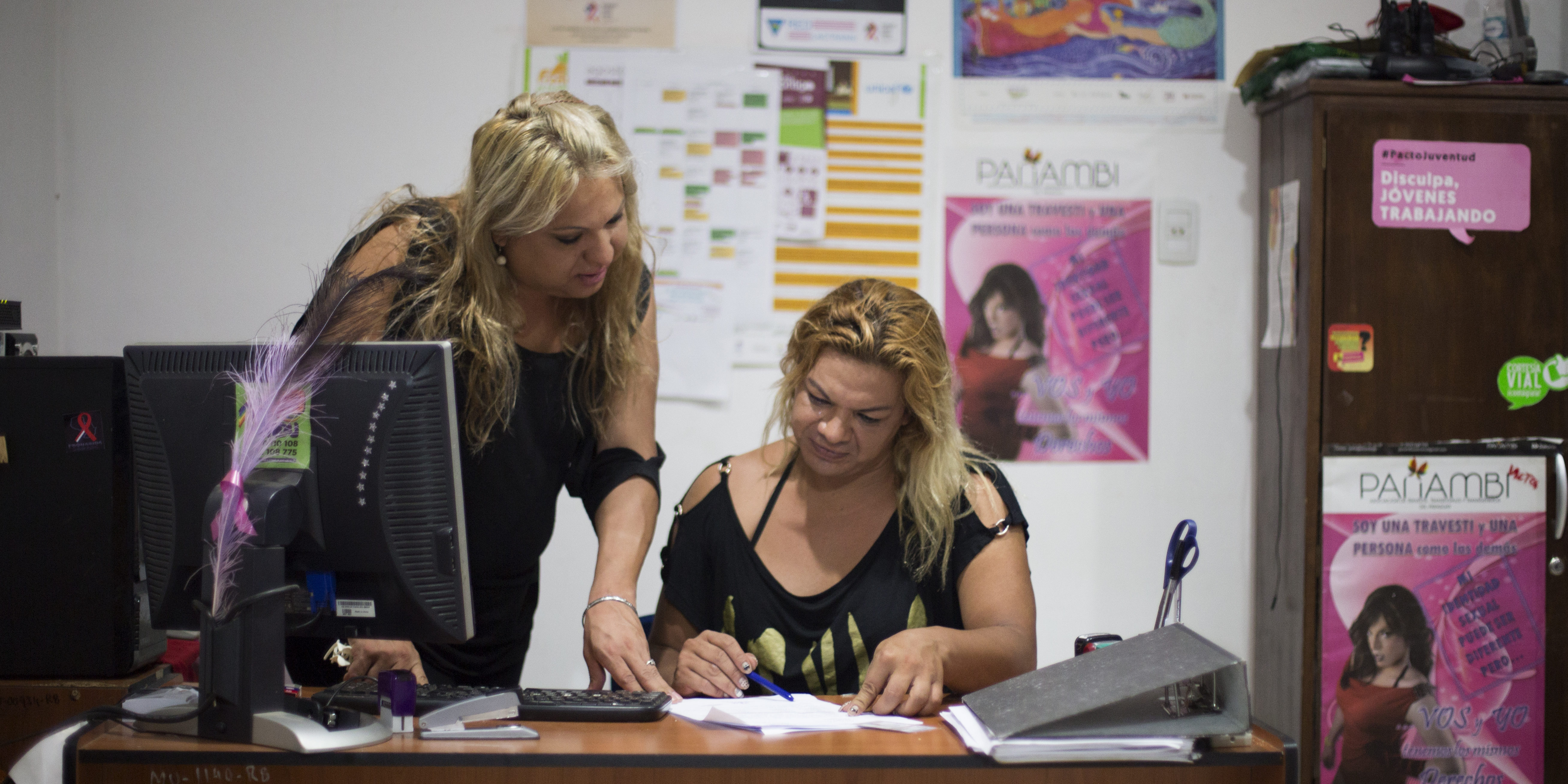
Mariana Sepúlveda and Yren Rotela are human rights activists and leaders of Panambí, an organization that defends and promotes the rights of transgender people. Paraguay does not have a gender identity law, but they successfully obtained a court order granting them legal name changes. However, the Paraguayan Public Prosecutor's Office appealed in both cases, and they are now awaiting a ruling. Here they share their stories, two tales of struggle.

Share

By María Sanz, from Asunción. Photos: Jess Insfrán Pérez and Mariluz Martín. In December 2016, Mariana Sepúlveda and Yren Rotela filed a petition in an Asunción court to change their names on their official documents. They did so invoking the Paraguayan Civil Code, which in Article 42 specifies that judges must authorize changes or additions to a name or surname. In practice, changing a name is a quick and relatively simple legal process. But Mariana and Yren were the first transgender people to make this request in Paraguay, and they faced delays, psychological evaluations, and legal obstacles. In March 2017, months after filing the petition, Judge Julia Rosa Alonso ruled in favor of changing Yren Rotela's legal name on her documents to reflect the name she has used for years. She became the first transgender person to access this right in Paraguay. In April 2018, another judge, Karen Leticia González Orrego, ruled that Mariana Sepúlveda's name change request was also valid. However, the Paraguayan Prosecutor's Office appealed both cases, and they remain unresolved. For Mariana and Yren, this is not just another administrative procedure: using their names means accessing their right to identity, which, they point out, is protected by Article 25 of the Paraguayan Constitution. Both activists told Presentes that dealing daily with a name that doesn't represent them diminishes their self-esteem and limits their ability to exercise other rights, such as access to healthcare and education.
Mariana Sepúlveda: eighteen years being Mariana
Mariana Sepúlveda is 33 years old, works at Panambí, and lives with her parents in a neighborhood near the Botanical Garden of Asunción. At 15, when she embraced her identity as a trans woman, she took the name Mariana, which she has used ever since. “At that time, a soap opera was on TV, Mariana of the night"And they started calling me that. It was because I had started going out at night to do sex work. And I kept that name," she tells Presentes. At first, only her friends called her Mariana. At home, she was "Manu," short for Emanuel, her legal name. It took her almost two years to prepare her parents to accept her gender identity. "One day, we were at home, and my mom turned around and said, 'Mariana, come here.' And I don't even know what I felt at that moment: tears welled up, I cried... I felt so happy that my family called me Mariana... That's what it feels like to be accepted," she recalls. Over time, not only her mother, but also her siblings and her father accepted her name and the fact that she was a trans woman. But, no sooner had she embraced her identity than Mariana was expelled from the public school where she was studying accounting in her first year of high school. And she began working on the streets as a sex worker due to her family's financial difficulties. As a trans teenager, it was impossible for her to find another job.
Metamorphosis
Mariana began her involvement in trans activism through the Panambí association. The association's name means "butterfly" in the Guarani language. And, like butterflies, Mariana says that she underwent a metamorphosis within this organization. Encouraged by her fellow members of the association, which offered training and literacy courses for trans people, Mariana completed her secondary education at an adult education center. However, even there, her name and identity were not always understood. “When the teacher came in to take attendance, I had to run to explain to him that my name was Mariana, or to ask him to please call me by my last name. "With the female teachers, everything was fine. But in some cases, with the male teachers, no matter what I said, they called me by my legal name. And my classmates, especially the men, laughed in the background," she explains. Despite the obstacles, Mariana completed the training, and the time came to receive her certificate. “I spoke with the director to ask if, when I went up to pick up my diploma, she could call me by my chosen name. She said no, that it was prohibited by the Ministry of Education. I then asked her to at least call me by my last name, and she refused. So I told her I would come to pick up my diploma after the ceremony because I wasn't going to tolerate that kind of discrimination. In the end, she told me to come, but she set conditions: that I shouldn't even think about wearing a dress or a party skirt, or high heels,” the activist recounts. With her certificate in hand, Mariana decided to continue her studies and enrolled in a degree program in Communication for Development at the National University of Pilar. Mariana says that the atmosphere there is much more open, and that, for the first time in her entire academic life, her gender identity is accepted by her classmates and professors.
Yren Rotela: a name for a 180-degree turn
The name of Yren Rotela, 37 years old and a representative of Panambí, appears in several official documents, both in Paraguay and internationally. It is written at the top of the invitations that, as an activist, the Paraguayan Ministry of Public Health or the Ministry of Women have sent her to participate in workshops, presentations, meetings, or debates. It is the name that appeared at the table when, in 2015, Yren presented to the Inter-American Court of Human Rights the data from an investigation into hate crimes against trans people. And that's the name the organization used. Amnesty International to award him, also in 2015, the Peter Benenson Prize for her work as a human rights defender. On her identity card, her passport, and even on her registration as an alternate candidate for the Senate in the last general elections in Paraguay, the name that appears is different. “It’s not that I dislike the name my family gave me, but it’s served its purpose. It doesn’t bind me. And my parents don’t call me that anymore. At the same time, I didn’t want to completely separate myself from the name they chose for me. So, I reversed it, and it became Yren. And that changed everything,” she tells Presentes. [READ ALSO: #ParaguayElections: Yren Rotela is the first trans candidate]
Before recognizing herself as Yren, more than a decade ago, the activist had other names. In her neighborhood, she was Giselle, a name she associates with the ridicule she received for her gender identity, and one she never identified with. “When I was fourteen or fifteen, the telenovela ‘María la del Barrio’ was on TV, and there was a character named Soraya, a woman who suffered inside but appeared strong on the outside. I adopted that name because it was like putting on a suit to show I was strong, in the face of so much violence,” she recalls.
 [READ ALSO:
 A new stage
But the name Yren symbolized a new stage in her life, marked by her activism in defense of trans rights. “I was at the gates of the cemetery, and it was like I was reborn. My work with the police began, to defend my economic territory, where I could survive as a sex worker. I began my activism and my contact with feminism. I learned about the struggles of Lohana Berkins, Diana Sacayán, and Marcela Romero. Until then, my role models had been beauty queens or trans women in show business, like Florencia de la V. I did my own therapy, on my own. And one day I looked in the mirror and took the time to see who I was, to accept my body just as it was.”[READ ALSO: Yren Rotela, the spokesperson for trans people who is calling for #8M]
Yren maintains that her name is neutral, non-binary, and insists that perceiving a name as masculine or feminine is a social, cultural, arbitrary, and subjective matter. She explains that the Public Prosecutor's Office appealed the decision to change her name, arguing that it tends to "induce error regarding her sex," something prohibited by Article 56 of the [relevant legislation]. Civil Registry CodeHowever, this rule only applies to the registration of newborns, not adults. Furthermore, the activist maintains that there is no record of anyone else named Yren in the country, nor is there any official list of which names are for women and which are for men.Bureaucracy and psychology
With sponsorship from Inecip (Institute for Comparative Studies in Criminal and Social Sciences), five activists from Panambí began the process of legally changing their names, but so far only Mariana and Yren have managed to complete all the necessary documentation to continue. “They asked for so many documents: certificates, criminal records, documents, and even photos from your fifteenth birthday to prove that you were already using your name then, that you were already assuming your identity,” explains Mariana. She was able to prove that she has been using the same first and last name for more than eighteen years, but says that this is not common among trans people in Paraguay. But the documents weren't enough. Before issuing a ruling, the judge required Mariana to undergo a forensic psychological evaluation at the Prosecutor's Office. The exam consisted of interviews, drawing tests, and questionnaires with more than 500 questions, which the activist underwent once a week for more than a month.
 Bureaucracy and psychology
 [READ ALSO: Paraguay: Trans people doubled their reports of violence]
“They wanted to rule out that she had “gender dysphoria”, among other things. They asked me if I had had sex with women, if I had had sex with men, if I believed in Catholicism, if I used drugs, if I smoked, if I drank alcohol, if I loved my father, if I loved my mother, what my love life was like, what my childhood had been like… It was like stripping my entire life bare. The questions were repeated because they wanted to see if I was lying or if there were contradictions,” Mariana recounts. Finally, the forensic psychologist's examination by the Prosecutor's Office was favorable to the name change, and the judge used it as further evidence to rule that Mariana's name should appear on her documents. However, after the ruling, the Prosecutor's Office filed an appeal, which Judges Eusebio Melgarejo Coronel, Raúl Alfredo Gómez Frutos, and Giuseppe Fossati López, of the Fourth Chamber of the Court of Appeals in Civil and Commercial Matters of Asunción, will have to resolve. If her name change is denied, Mariana is prepared to exhaust all national avenues and appeal to the Inter-American Court of Human Rights. The process can last for years, a time during which she feels that her access to rights is being curtailed. Everyday situations and resolutions that are not fulfilled On the day of the interview with Presentes, Mariana arrived in a hurry at Panambí's office. She had just come from the dentist. “What I feared so much happened,” she said upon arriving. “They called me by my legal name. Before going in for my appointment, I spoke with the person in charge of the records and told him that, please, when it was my turn, they should call me by my chosen name, which is Mariana. But when it was my turn, the man came out and said: Emanuel. He looked around to see if that Emanuel appeared. I pretended not to notice.” ñembotavy (“the oblivious one,” in Guarani), I was on my phone, I approached slowly so that no one would notice. You're there, with a feminine appearance, and they call you by your legal name. You feel like running away,” Mariana recounts.[READ ALSO: #Paraguay: They entered the Judiciary to defend trans colleagues]
He explains that, in Paraguay, it has been in effect since 2016. Resolution 695 of the Ministry of HealthThe resolution states that in public health services, “the socially chosen name of transgender people, with which they identify, may be used.” Mariana made a point of reminding the staff who attended her at the health center of this resolution from her first visit, but once again she found it was not being followed. “The resolution hasn’t been made known to all departments within the Ministry of Health, and that’s a major failing of the State. It leaves you feeling powerless. The only health services where our gender identity is respected are those that deal with HIV, where they give you the test and that’s it… But if you go for other ailments, they’ll call you by a name you don’t identify with,” she says.Exposed and violated
Yren explains that the fact that her chosen name isn't legally recognized exposes her to other violations of her right to her own image and privacy. “When you go to do any paperwork, you see your ID card being passed from hand to hand, and the officials laugh and make comments. Many of my trans friends, especially teenagers, are forced to remove their makeup and pull their hair back to have their ID photo taken. And a photo of my own ID card was leaked and circulated on social media, with my legal name, my photo, and the section that indicates 'male sex,' and I was ridiculed.” In the media, I've also been on the front page several times, using my legal name, and they didn't call me "she," but "he." Journalists have no idea of the damage that can cause me. “Or my father, who has to listen to his coworkers’ comments when they buy the newspaper,” Yren reveals. Like Mariana, the confusion created by her documents has led to detentions and interrogations at airports in the United States and Panama, where she has gone as a representative of Panambí or the Latin American and Caribbean Trans People's Network (Redlactrans)And, like Mariana, she has a judicial facilitator card, issued by the Paraguayan Judiciary, which lists her under her chosen name, Yren Rotela. She considers it a contradiction that the same institution that recognizes her as Yren is now trying to deny her name change. “I distrust the Paraguayan justice system, which has been corrupt and aggressive towards us. There are the unpunished murders of my comrades (59 trans murders remain unsolved since 1989). We have already filed several urgent appeals for the Court of Appeals to respond, and the deadline is approaching. The name change is for a just cause, which has been demonstrated with witnesses and documents. If we succeed, it will be a victory, setting a precedent so that other comrades can take the same step more quickly,” Yren declares.We are present
We are committed to journalism that delves into the territories and conducts thorough investigations, combined with new technologies and narrative formats. We want the protagonists, their stories, and their struggles to be present.
SUPPORT US

FOLLOW US
Related notes
We are present
This and other stories are not usually on the media agenda. Together we can bring them to light.