

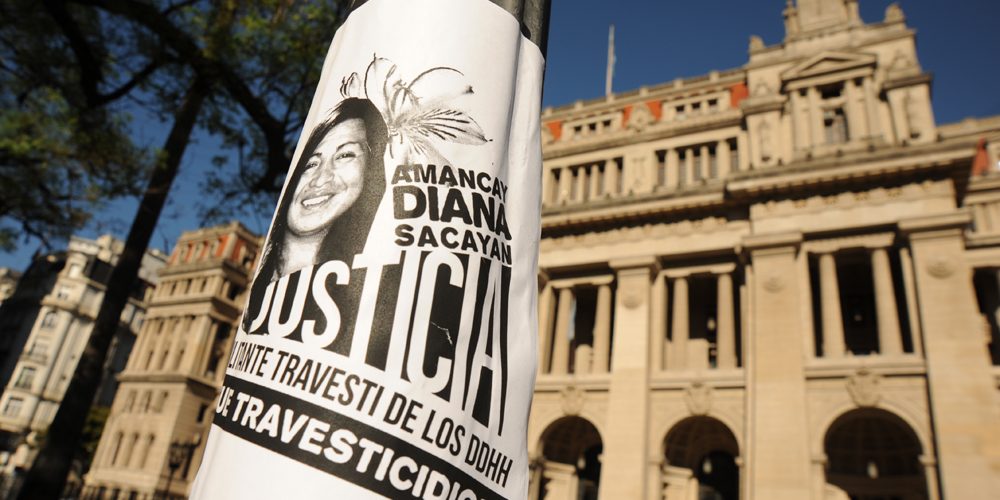
#DianaSacayán "The violent death of a trans woman is a transvesticide," said the prosecutor's office.
At the tenth hearing, prosecutor Ariel Yapur and Mariela Labozzetta, head of the Specialized Prosecutor's Unit for Violence against Women and LGBTIQ people (UFEM), asked for Marino to be sentenced to life imprisonment for the transvesticide, a crime motivated by gender prejudice, of Diana Sacayán.

Share

By María Eugenia Ludueña and Ana Fornaro
Photos: Presentes archive/Ariel Gutraich/CIJ In the tenth hearing of the trial for the death of Diana Sacayán, a courtroom—as always packed—listened and was moved by the closing arguments delivered by prosecutors Ariel Yapur, from the General Prosecutor's Office No. 5, and Mariela Labozzetta, from the UFEM (Specialized Prosecutor's Unit for Violence against Women and LGBTIQ People), before the Oral Criminal Court No. 4. They requested that Gabriel Marino be sentenced to life imprisonment for the crime of triple aggravated homicide: for having been committed due to gender prejudice, with gender violence as a factor, and due to his relationship with the victim. And they emphasized the need for a “correct classification”: that “the crime be called by its name: a hate crime and transphobic murder, to begin to undo the path of invisibility and impunity.” Photo: CIJ (Judicial Information Center) From left to right: Kassargian, Sánchez, Yapur, and Labozzetta. Scheduled for 9:30 a.m., the hearing began at 10:40 a.m. on the sixth floor of the Buenos Aires courthouse. Much of the Sacayán family was unable to attend yesterday. Sisters and aunts arrive at each session of the trial wearing T-shirts demanding Justice for Diana, but this week there were two hearings, and they attended on Monday, when INADI (National Institute Against Discrimination, Xenophobia and Racism) presented .
[READ ALSO: #DianaSacayánTrial: INADI requested life imprisonment for transvesticide]
Even so, many people were left outside the packed courtroom. They followed the trial on one of the screens on the sixth floor, via the ttransmission from the Judicial Information CenterTheir applause echoed through the aristocratic building—because inside courtroom 6146, a sacred silence reigned during the five hours of the closing argument—at two points. First, when Prosecutor Yapur—who presented the sections of the argument related to the evidence and the legal classification—stated: “Since this is a case of violence against a member of a group that is subject to violence and stigmatization, we are dealing with a case that must be called a transvesticide, as Diana herself called it. A social transvesticide,” the prosecutor said. The other point: when Labozzetta requested the sentence, based on the fact that “the Public Prosecutor’s Office has established that Gabriel David Marino murdered Diana Sacayán on October 11, 2015, along with another man who has not yet been identified.” And he asked for life imprisonment “for having committed a hate crime, a transvesticide.”
Evidence: “overwhelming conclusiveness”
The prosecutors requested Marino's acquittal for the theft of the money from Diana's house. They argued that there was no evidence to support his claim. However, they found the evidence placing him at the scene of the crime and involved in Diana's murder "overwhelmingly compelling. We rarely have so much evidence, and such clear evidence," said prosecutor Yapur. [embed]https://www.youtube.com/watch?v=c50-8xF2E5A[/embed] prosecution's argument It was valuable for many different reasons. To prove Marino's involvement, the prosecutor presented security camera footage from a clothing store that recorded him entering the Flores building where Diana lived at 10:35 p.m. on Saturday, October 10. He also showed him leaving with another person—who has not yet been identified—at 3:38 a.m. on Sunday. He recalled that The building manager was the last person to see Diana alive When the activist went downstairs to open the door, first for the young man in the sports jacket (he's in the recordings) and then for Marino, whom she kissed on the mouth.Two people at the crime scene
Laboratory tests found Marino's fingerprint on the bedroom door where Diana was murdered, and his DNA under the fingernail of the victim's right middle finger. The prosecutor displayed a diagram of the crime scene, interspersed with photographs of the room and of the autopsy to narrate the sequence of the brutal murder. To establish that “the tremendous attack clearly points to two people,” he returned to two different shoe prints found on the body: one marked with blood on an arm and another, distinct, so brutal that it left a pointed sole imprinted under the skin of his chin, as shown in a chilling autopsy photo.[READ MORE: Autopsy says Diana was brutally murdered]
A simple, complex, and historic case
Once again, the court and the public mentally visualized throughout the account how Diana was attacked, tried to defend herself – “the accused engaged in hand-to-hand combat” – was subdued, savagely beaten, gagged, tied up, stabbed; Meanwhile, in the living room of his apartment, a YouTube playlist of cumbia from Santa Fe and Colombia continued playing nonstop until after 5:00 a.m. The prosecution considered it "a straightforward case from a factual and evidentiary standpoint." However, they emphasized that the legal classification "deserves careful consideration." Yapur dedicated a large part of his closing argument to this aspect.
The interpretation of hate
The prosecution noted that Article 80, Section 4, punishes hate crimes based on “racial, religious, gender, or sexual orientation, gender identity, or gender expression.” However, “There have been few cases prosecuted under Section 4, such as the murder of a young gay man in San Juan. Therefore, the Court faces a historic opportunity, also in the eyes of the international community.” Yapur emphasized the significance of this trial. He made this clear from the outset of his argument and reinforced the idea throughout: “Presiding over this trial carries enormous professional responsibility. Not only because it is one of the few cases of violent deaths of trans women or transvestites—as Diana prefers to be called—that has gone to trial, but also because there is an immense opportunity for the court to address Section 4—which, in my opinion, has been misused. And because this trial is being closely followed by organizations and bodies within the international human rights community.” The prosecutor emphasized the State's obligation to comply with its international human rights treaties regarding the punishment, prosecution, and prevention of these crimes. One of the most frequently cited documents in the argument was the report by the Inter-American Commission on Human Rights, published in 2015, shortly after Diana's murder. The prosecutor recalled, among other things, that this report expresses concern about Diana's murder as a trans woman and human rights defender.Violence motivated by prejudice
She also spoke about the characteristics of these crimes, the cruelty and brutality with which they are perpetrated (something proven in various reports). And she reviewed the multiple injuries on Diana's body: her disfigured face, her head, the wounds on her breasts, and her buttocks. "The extremely high degree of violence is directly related to her transvestite gender identity and her activism." Yapur explained that the traditional position of legal doctrine interprets the fourth clause from the context of the "individual subjectivity" of the perpetrator. She proposed another interpretation: the crime committed due to the structural discrimination against vulnerable groups that deserve special protection from the State, given that they are vulnerable minorities. The prosecution even suggested going beyond the concept of hate crime, "because These events are better understood in the context of prejudice-motivated violence.As the IACHR report states: “Violence is a social phenomenon and not just an individual or isolated event. Crimes based on prejudice constitute rationalizations or justifications of negative reactions to expressions of non-normative sexual orientations or gender identities.”
“It's a transvesticide”
Yapur stated: “This is a particular kind of femicide; it's not just any woman who suffers it, but a specific group. Gender-based violence must be properly made visible; it must be shown that this isn't violence suffered by all women, but a specific type of violence suffered by trans women, revealing the prejudice-based violence to which they are exposed.”Yapur spoke of the term transvestite as a political claim, a word taken from police jargon by those “disobedient bodies” of a group that has been violated since early on. “The violent death of a trans woman is a transvesticide, a gender crime, prejudice-motivated violence”“I’m not going to explain patriarchy, but two thousand years of patriarchy do their work,” she explained. “Faced with this violation, greater legal protection is required. That’s why I propose interpreting the fourth paragraph from the perspective of structural violence and not from the subjective condition of the perpetrator. We don’t know what’s going through Marino’s mind now, much less what was going through his mind when he killed Diana.”Intimate transvesticide
“Marino is someone who takes advantage of his relationships, as witness Dell Nero testified. In Marino's eyes, Diana was someone he could exploit,” the prosecutor said. He recalled that Marino was aware of Diana's activism. The prosecution maintains that Marino would not have been able to access Diana's apartment had this prior connection not existed, which is why they requested the application of section 1, which refers to a prior relationship, even though they were not in a common-law relationship. “We are dealing with an intimate transphobic murder.” “I was impressed by Lohana Berkins' testimony, which was read here,” the prosecutor said, and then quoted Perlongher, who had also been cited by the complaint: “And we will open the front door to the monster that dwells in the corners.”
Relevance of the trial
The final part of the argument was presented by Labozzetta as head of the UFEM. Labozzetta emphasized the enormous importance of the trial and the conditions under which the investigation was carried out. The work of this prosecution was highlighted throughout the trial, especially by the plaintiffs. “This is the first murder of a trans person to go to trial as a transvesticide, which is what it's called by its proper name. There are many crimes, but the path has been one of invisibility and impunity.The Justice for Diana Commission
Labozetta highlighted some achievements of this trial that It's already historic. “For the first time, the voices of the victims and the organizations were heard. The Justice for Diana Sacayán Commission accompanied the trial's progress. The organizations, like the judicial officers, were able to reflect on their actions. They didn't do so behind the system's back, but rather within the system itself. That has been the first victory of this trial.”.
“We have no convictions, and not because they don't happen.”
For the prosecution, it is crucial to prove the context in which these crimes occur. The crime, she stated, was a gender-based hate crime.Marino didn't kill just anyone, but a trans woman and human rights defender, in a context of violence against the LGBTIQ community. “Diana was a victim of the violence she was fighting against. Women human rights defenders are at greater risk of suffering violence; they are more exposed, on the front lines of how trans women live, fight, and die in the region,” Labozetta explained. He cited that the IACHR report It shows high rates of cruelty against LGBTI people, but also points to the lack of a state response to prevent and repair the violence.s, which continue to occur in a widespread manner across the continent.[READ ALSO: #DianaSacayánTrial: a plea and a festival that made history]
“There is no precedent for convictions for these crimes. We have no convictions, and not because they don't happen.”, Labozzetta said. He quoted the IACHR report that attributes this to prejudices that persist among justice operatorsThese crimes, when investigated, are treated as simple homicides, perpetuating their invisibility. “The application and punishment of these hate crimes has a dual message: to bring them out of anonymity and to send a message of an end to impunity.”. The transvesticide "It's a complex, systematic phenomenon," she explained. "Trans women are murdered throughout the region, and their bodies are discarded like garbage." She praised the visibility that the term "femicide" has brought to crimes of gender-based violence. “If they have no name, they are not recognized. If they are not recognized, they have no protection, and the violence continues. For the prosecution, it was a transvesticide, the murder of a trans woman, a hate crime.The prosecution insisted on the need to establish a legal classification that captures the specific nature of violence against trans women in order to comply with international human rights agreements. In closing, they stated that "the Public Prosecutor's Office has established that Marino murdered Diana Sacayán." They requested that he be sentenced to life imprisonment for transphobic murder (section 4), with the aggravating factors being gender-based violence (section 11) and a prior relationship with the victim (section 1). The closing argument also reviewed Sacayán's crucial legacy. “This packed courtroom, the packed hallways, the constant presence of LGBT activists in the square in front of the courthouse throughout this trial is proof of how Diana’s memory and struggle live on.”Labozzetta said.
Reparative measures
Finally, she asked the court for reparations “to begin to reverse the path of invisibility.” 1) Correct legal classification of the crime: transvesticide. This recognition is the first act of reparation. 2) Dissemination of the sentence: communicate it through the International Court of Justice (CIJ), but translate it into clear and simple language for the media and begin its dissemination. 3) That the Court submit to the Supreme Court a systematization of the best practices implemented in this investigation. 4) That all persons be named and treated according to their gender identity, regardless of what their official documents state, in accordance with the law. In the previous hearings, the two plaintiffs—one from the family of Diana Sacayán, represented by Luciana Sanchez, and the other from the National Institute Against Discrimination, Xenophobia, and Racism (INADI), headed by Juan Kassargian—had also requested a life sentence for the accused. After the closing arguments, the court recessed until June 7 at 9:30 a.m. On that day, the closing arguments of the accused's defense, led by Lucas Tassara, will be heard.
We are present
We are committed to journalism that delves into the territories and conducts thorough investigations, combined with new technologies and narrative formats. We want the protagonists, their stories, and their struggles to be present.
SUPPORT US

FOLLOW US
Related notes


We are present
This and other stories are not usually on the media agenda. Together we can bring them to light.