

Camila Sosa Villada: “Writing is not therapeutic, the wound is still there”
“My first official act of cross-dressing wasn’t going out in public dressed as a woman, legally speaking. My first act of cross-dressing was through writing,” the author writes. Upward, downward, and outward, the text expands with the voraciousness of a cannibalistic plant, daring to speak, to think. Even to remain silent.

Share

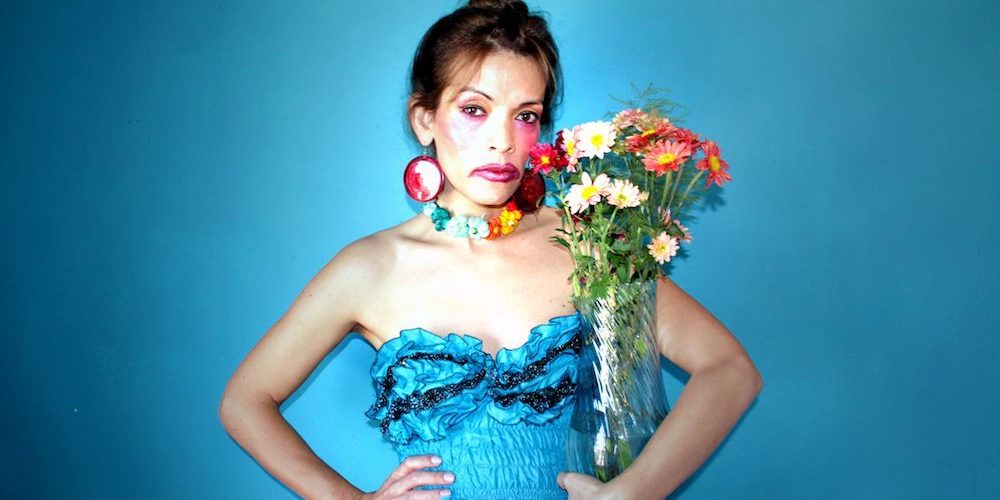
By Ivana Romero Photos: Guillermo Albrieu Llinás Camila Sosa Villada burned many of her teenage stories in a wood-burning stove. But she recently realized that one of those texts, written in red ink, had survived. In it, she wrote about her father, who, when he recovered from his drunken stupors, would teach her to trace numbers and letters. About her mother, so young and beautiful, living with Camila (who was a boy at the time) in a house in the middle of the woods, teaching her to read. She also told of the night her mother lit a candle to the Virgin of the Valley and went with her little boy to the bar, and when they returned, everything was ablaze. About how Camila took refuge at a neighbor's house with her little dog. About how she hugged the dog, who peed on the sheets, but it didn't matter, because he was her companion in the midst of the shipwreck. The editors of DocumentA—a performing arts space in Córdoba that also supports publishing projects—wanted to bring together three autobiographical books about writing: Juan Forn's * Cómo me hice viernes* (How I Became Friday) (The Phantom Departure ), and one by Sosa Villada. Those charred pages touched their hearts. And they told him to keep going, that he had the seed of a great story. From there emerged * El viaje inútil ), a confessional text, beautiful and harsh like a jewel blossoming in the mud.
[READ ALSO: Camila Sosa Villada: “Being trans is in itself a form of activism”]
“My first official act of cross-dressing wasn’t going out on the street dressed as a woman, legally speaking. My first act of cross-dressing was through writing,” the author writes. Up, down, and sideways, the text expands with the voraciousness of a cannibalistic plant, daring to speak, to think. Even to remain silent. “The publishers wanted a book about writing, and I didn’t know where to begin. But I returned to that story about my father and mother, about how they gave me words and how I was able to cling to writing,” says Camila, one Sunday at midday, while ordering another croissant. She lives in Córdoba, but after participating in the Carne Argentina reading series, she stayed a couple more days in Buenos Aires. “I’m staying at a French friend’s place who told me, ‘Camila, go to the bar where they do really French things. It’s lovely,’” the writer says in a bar in San Telmo, wrapped in a blue coat, her dark glasses on the table. Being a transvestite, a more political than narcissistic stance
“The first thing I ever wrote was my male name. I was sitting on my dad’s lap, with a box of colored pencils and a Gloria notebook. My dad took my fist and showed me how to use the pencil. He went even further and taught me how to write my name,” Camila recalls in her book. Reflecting on the matter now, she says, “I’m relaxed about the whole male name thing.” – To say it or not to say it… I don’t think it’s about that. Look, cross-dressing isn’t just about gender. It’s not just about feeling like a woman or dressing a certain way. Besides, I don’t know what a woman feels because I’m not one. At least, not in binary terms. Lohana had a saying: ‘If a trans woman comes to me and says she wants to be a police officer, she stops being a trans woman.’ So it has to do with that, with a more political than narcissistic stance,” she affirms.
 Being a transvestite, a more political than narcissistic stance
  Camila orders another tea and takes the time to elaborate further on the idea. “Cross-dressing isn’t something that only happens within yourself. You can be a cross-dresser without ever having worn a skirt in your life. I have cisgender women friends who seem more like cross-dressers to me than many transvestites. Cross-dressing can be of other kinds: a rejection of the patriarchy and an attack on the patriarchy. That’s what happened to me with writing before anything else,” she adds. Besides being a writer, Camila is an actress, playwright, poet, and psychology student, among other things. And in her first book of poems Sandro's girlfriend (published by Caballo Negro in 2015), there is a verse that says: “Draw up a plan of attack and resistance / rest, sleep for a year straight / wake up and find this list already resolved.” Between resistance, renunciation, and attack, an explosive tapestry is woven that has sustained Camila’s words and heart, both very resilient and combative.
"First writing, then sadness"
She was born in La Falda in 1982. She moved with her family to Córdoba. “My dad had won big at the casino and bought a house in Los Sauces, in the middle of the woods that had belonged to María Paula Albarracín’s family. He had a mistress, so he would take us to places farther and farther away and then leave us. Later, sometimes, he would come back to get us,” she says. The pointless journey It feeds on the sadness born of abandonment, which Camila understood as a family trait. “I say, first writing, then sadness. And it’s a victory over that destiny of my family, who never accepted their poverty: I learned to write first, and then I learned to be sad,” she writes. But sadness is just the tip of the iceberg in her writing. Despite the family's silence, her parents exchanged love letters. Once, her mother burned them, just as Camila later burned her stories, just as she shut down her blog, Sandro's Girlfriend, for fear that respectable writers would find out she had worked as a prostitute. Some devoted reader saved those posts and sent them to her. Her first novel, written in her youth, didn't fare so well. In it, she (still a boy) falls in love with the gym teacher. A friend showed the text to the school authorities, and her life fell apart. “In the long run, that girl did me a favor because from then on I didn't have to explain anything anymore,” Camila says now. But the betrayal hurt.[READ ALSO: Of love and desire: eight dissident books to warm up autumn]
The pointless journey She explores the solitude of the writer and, in that process, reinvents her identity. She also addresses the estrangement from her parents, who nevertheless gave her an essential gift: a love for books and writing. From there, Camila forges her own path through narrative, poetry (“a poem is a very difficult animal to hunt,” she asserts), and playwriting. “I had to invent my own roles because no one had thought of roles for transvestites like me,” she explains. In the book, she also refers to her holy trinity: Wislawa Szymborska and her tenderness amidst pain, Marguerite Duras and her obstinate excavation of the same memories, and Carson McCullers and her characters, as strange as they are delightful, whom she erases with a stroke of the pen whenever she wants. Sosa Villada even questions the idea that writing heals: “No, writing is not therapeutic. The wound is always there,” she warns. The desire to write, however, found her early on in a state of joyful fertility. “I am a viable female to incubate it; it lays its eggs and I carry them inside me like a mother,” she says in her book. Some aspects of that bond can be spoken, others cannot. In that tension, Camila navigates her own journey, a journey of essential futility for readers hungry for honest words, dazzling sparks that carve their way through the wild undergrowth.We are present
We are committed to journalism that delves into the territories and conducts thorough investigations, combined with new technologies and narrative formats. We want the protagonists, their stories, and their struggles to be present.
SUPPORT US

FOLLOW US
Related notes
We are present
This and other stories are not usually on the media agenda. Together we can bring them to light.