

#DianaSacayánTrial: INADI requested life imprisonment for transvesticide
The ninth hearing of the trial for the transvesticide of Diana Sacayán focused on the arguments of the legal representatives of the Institute against Discrimination, Xenophobia and Racism (INADI), the plaintiff in the case

Share

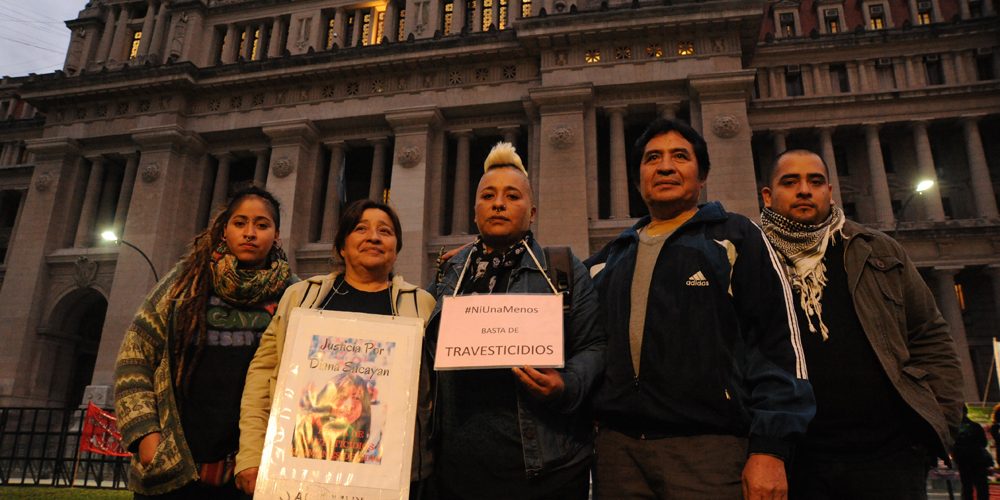
By Ana Fornaro and María Eugenia Ludueña Photos: Ariel Gutraich and CIJ The ninth hearing in the trial for the transphobic murder of Diana Sacayán focused on the arguments of the legal representatives of the National Institute Against Discrimination, Xenophobia, and Racism (INADI), the plaintiff in the case. The human rights defender and trans activist worked at INADI in the area of sexual diversity, and from there she spearheaded many of its struggles and achievements, such as the Gender Identity Law and the transgender employment quota in the Province of Buenos Aires. The hearing was scheduled to begin at 9:30 a.m., but, as last week, it started at least an hour late. As before, the lawyer for the accused Gabriel David Marino, Lucas Tassara, interrupted the proceedings to inform the judges of the Oral Court No. 4 – Adolfo Calvete, Ivana Bloch, and Julio Cesar Báez – that his client had not had breakfast at the Ezeiza prison and that this had already caused him dizziness. This generated general discomfort among the public – mostly family members and friends of Diana – and the judges decided that breakfast should be brought to the courtroom for him to eat there: “We believe it is important that the accused hear the arguments,” said Báez, the presiding judge.
[READ ALSO: #DianaSacayánTrial: a plea and a festival that made history]
The Inadi's closing argument lasted three hours, was divided into eight chapters, and was presented by lawyers Juan Kassargian and Micaela Saban Orsini. Kassargian opened the argument by summarizing the events of October 11, 2015, the night of the transvesticide, stating as proven that Marino and another man were in Diana Sacayán's house, according to statements from the security guard of the Flores building: -They attacked Diana with their bodies. They took advantage of the element of surprise. They attacked her from behind, something typical of cowards, in a clear context of hatred and gender violence. Ferocity
After reconstructing how Diana tried to defend herself, how they threw her to the floor and tied her hands, how they stabbed her repeatedly, and how she survived for ten minutes, Kassargian went on to present the assessment of the evidence based on the testimony of forensic doctor Roberto Cohen, who at the time spoke of the “ferocity” with which she was murdered: twenty-seven injuries and seven blunt force traumas to the head, among other acts of violence. As the lawyer listed these details and some family members listened again, tearfully, to the reconstruction of Diana's transphobic murder, an official entered the room with a cup of tea: it was for Marino, who was having breakfast while the gruesome details of the crime continued to be recounted.
 Ferocity
 [READ ALSO: #DianaSacayánTrial: the autopsy showed that she was murdered with ferocity ]
Kassargian also reviewed the testimony of Diana's brother, Sasha Sacayán, who highlighted her activism and how no one could replace her in her role as an activist for the rights of the trans community, as well as the difficulty of building trans leadership in a population with a life expectancy of 35 to 40 years in Argentina. The lawyer from INADI also emphasized the testimony of expert witness Amaranta Gómez Regalado, a Muxe activist, who gave a masterclass on trans identity in Latin America and the global scarcity of leadership in a previous hearing.Marino, with a history of violence
In reviewing the scientific evidence and key testimonies, Kassargian focused particularly on how the Homicide Division officers cross-referenced information to locate Marino, who used the name “Lautaro” on his Facebook profile. He also discussed the wiretaps from the former Cenareso facility—where Marino and Diana met—and where someone described him as “a very violent person.” “His irascible nature was highlighted, especially when he was withdrawn.” “Case reports emphasized that the defendant was lucid that night and that nothing can justify his behavior,” said the lawyer from Inadi (National Institute Against Discrimination, Xenophobia and Racism). For this reason, the lawyer emphasized Marino’s gender-based hate motive, citing Judith Butler’s definition of the “double negation” of trans identities by perpetrators of violence: the denial of their own desires and the denial of those identities, which dehumanizes them. We frame her murder as a hate crime, also called by academics "a crime motivated by discrimination or prejudice," because the perpetrator selected the victim for belonging to a minority group and also sent a threatening message to the group to which she belongs. It forces the community to be in a permanent state of alert. Marino attacked society that night. Marino committed a serious violation of human rights. He knew that by killing Diana he was killing a leader, a human rights defender.
Diana, the irreplaceable
After a ten-minute recess, lawyer Micaela Saban Orsini spoke at length about Diana's role as an employee of INADI (National Institute Against Discrimination, Xenophobia and Racism) and how her murder had left an unfillable void among her colleagues and within the institution. Saban Orsini recounted Diana's battles, such as the Gender Identity Law, the repeal of police edicts that criminalized trans identities, the Transgender Employment Quota Law in the Province of Buenos Aires, and the project for inclusive medical clinics in La Matanza.[READ ALSO: #DianaSacayán: “Diana gave everything for her family and her community”]
Diana received her new ID in 2012 at the Casa Rosada and said, “I’m no longer a person who doesn’t exist.” That same year, she was elected as the Ombudsman for La Matanza. Her colleagues at INADI remember when she came up with the idea of a trans quota. Diana had a deep social conscience. We miss her at the Institute. She was an example of struggle and commitment. Diana was robbed of the chance to see her own achievements. She was an idealist; she believed that things could be built with love, through networks.The need to talk about “transvesticide”
Kassargian resumed the final part of the argument, beginning by presenting figures that reflect the violation of the rights of the trans and travesti community. According to a 2012 report by INDEC and INADI, 84.1% of those surveyed reported having suffered violence: 63% in their neighborhood and 50% within their families. Furthermore, 80.4% lack access to healthcare, and 80% are involved in prostitution: Diana herself was involved for a very long time, until she began working at INADI. With this contextual data, Kassargian urged the Court to take into account the aggravating factors of hate, gender violence, and cruelty and treachery, and also requested life imprisonment for Marino. After tracing philosophical postulates from Primo Levi to Judith Butler, he said: “The message of hate is inscribed on the victim’s body. They projected that onto the body and the room, which was, as witness M said, 'a horror movie'.”[READ ALSO: Historic trial begins for the transvesticide of Diana Sacayán]
 The accused Marino along with his defense lawyers
In conclusion, He highlighted the amicus curiae briefs presented by the sexual diversity organizations, CHA, 100% Diversity and Rights and Abosex, which insist on the need for the sentence to use the term "transvesticide".
–At INADI we understand that language creates the world. It is impossible to exist without being inscribed within the structure of language. That is why we believe in the necessity of using the word transvesticide. Does it exist in the Penal Code? No, it doesn't. But neither does the word "parricide," and yet it is used. If a father is killed, it is called parricide; if a son or daughter is killed, it is called filicide; if a brother or sister is killed, fratricide. So, when a transvestite is killed because of her gender, it should be called transvesticide. And if the question is, should there be as many “cide” suffixes as there are genders? The answer is yes, because the reality, the circumstances and hardships of each group, the particular and structural discrimination they experience, is as unique as their own identities, Kassargian argued.
The accused Marino along with his defense lawyers
In conclusion, He highlighted the amicus curiae briefs presented by the sexual diversity organizations, CHA, 100% Diversity and Rights and Abosex, which insist on the need for the sentence to use the term "transvesticide".
–At INADI we understand that language creates the world. It is impossible to exist without being inscribed within the structure of language. That is why we believe in the necessity of using the word transvesticide. Does it exist in the Penal Code? No, it doesn't. But neither does the word "parricide," and yet it is used. If a father is killed, it is called parricide; if a son or daughter is killed, it is called filicide; if a brother or sister is killed, fratricide. So, when a transvestite is killed because of her gender, it should be called transvesticide. And if the question is, should there be as many “cide” suffixes as there are genders? The answer is yes, because the reality, the circumstances and hardships of each group, the particular and structural discrimination they experience, is as unique as their own identities, Kassargian argued.
We are present
We are committed to journalism that delves into the territories and conducts thorough investigations, combined with new technologies and narrative formats. We want the protagonists, their stories, and their struggles to be present.
SUPPORT US

FOLLOW US
Related notes


We are present
This and other stories are not usually on the media agenda. Together we can bring them to light.