

Interview with Joe Lemonge: “My will to resist saves me”
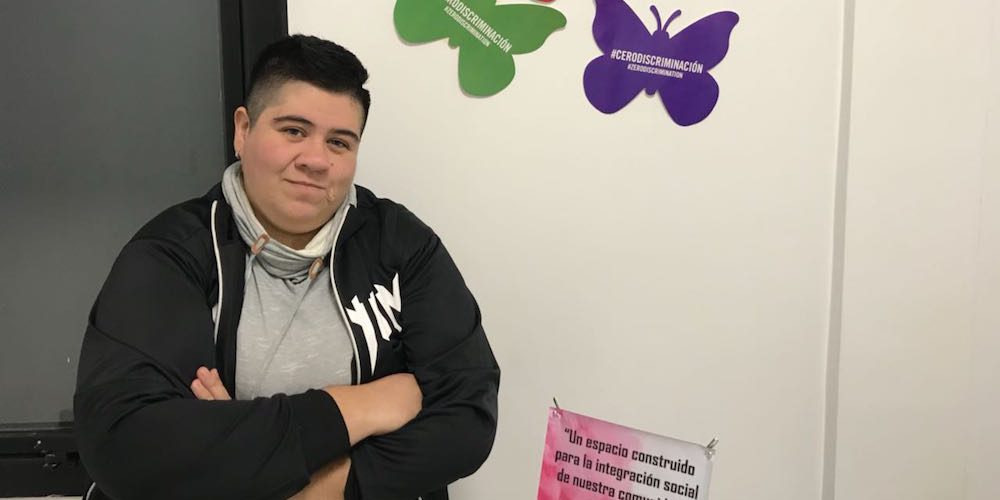
Two weeks after being sentenced to five and a half years in prison for “attempted homicide” for defending himself against his attackers, Joe Lemonge, a 25-year-old trans man from Entre Ríos, who had long been harassed by three neighbors, arrived in Buenos Aires. With the support of LGBTQ+ activists, he was able to leave Santa Elena, a town of 17,000 inhabitants where he had lived and suffered his entire life.

Share

Photos: Presentes Archive
Two weeks after being sentenced to five and a half years in prison for attempted homicide for defending himself against his attackers, Joe Lemonge, a 25-year-old trans man from Entre Ríos, who had long been harassed by three neighbors, arrived in Buenos Aires. With the support of LGBTQ+ activists, he was able to leave Santa Elena, the town of 17,000 inhabitants where he had lived and suffered his entire life. And where, until last Saturday, he continued to run into his three aggressors.
On October 13, 2016, as Joe recounted first at the police station and later in court, this group of men approached his house. One of them began banging on his door, insulting him, as he had done on other occasions.
[READ ALSO: Joe Lemonge: “The sentence hit me very hard but I cannot remain silent”]
It was the fourth time they'd come to the property where my little house and my mother's were. It was early morning; I'd just finished closing my kiosk when I heard whistling and banging. I knew he was going to come in. And he did. The others stayed outside, a few meters away. In the middle of the struggle, I grabbed a gun that belonged to my father, a rifle. I held the rifle by the barrel, as if to shoot him, and a shot went off, hitting him in the neck. He ran off, and my mother, who lived a few meters away, arrived. I kept saying, "What have I done? What have I done?" because I didn't understand what had happened. A little while later, we were all at the police station giving our statements. I brought the gun and told them everything. Giménez was taken to Paraná in a taxi a few days later; he'd already been discharged from the hospital. They raided my house because the other guys said I'd shot at them because I didn't want to sell them drugs. That was the lie they made up, and it stuck as the truth. Then they prosecuted me. They took me to a jail cell in La Paz and I was there for 7 days. They didn't find anything during the raid, no drugs, nothing.
Joe tells this story from one of the offices of the ATTTA (Association of Transvestites, Transsexuals, and Transgender People) Trans House in the San Cristóbal neighborhood of Buenos Aires, where they welcomed him for lunch. He speaks quickly and enthusiastically: he wants to tell everything, and the fact that he is not in pretrial detention and has been able to leave his town gives him hope.
The court convicted him, but for the first time, he feels he is not alone. He is receiving legal counsel from the organization Abosex and has changed defense attorneys. Now, a woman will be defending him (the third person to take on his case). This week, details of the proceedings will be released at a press conference with LGBTQ+ activists.

Joe, after the sentencing at the La Paz court (Entre Ríos). Photo: Pablo Merlo/Presentes
[READ ALSO: Convicted for defending himself: the story of Joe Lemonge in comic book form]
"I came here to protect myself. But also with the idea of being able to live and not just survive while all this lasts. Now I have to file the appeal. The process is going to be long, it could take a year. And I want to start over. Since October 2016, I've lost everything: my English classes, my father—who passed away—and my house, because it burned down."
In December 2016, after Joe arrived from Paraná, where he had spent 30 days in pretrial detention, this group of men set fire to his house. Neighbors witnessed it. He was staying at his mother's house, on the same property. He was there because his own home was still being ransacked from the raid.
They thought I was inside because they'd been told I'd come back. If I'd been sleeping there, I'd be dead. The firefighters took an hour to arrive. My mom's house was saved by sheer luck.
After that attack, his mother, a recently widowed language and literature teacher who had always been the family's breadwinner, gathered her savings and took her son to a small rented country house. Later, she had to go back to work; the bills kept piling up. Helping her son and paying for a private lawyer was expensive. Joe says that when they ran out of money, the lawyer left: there were only three months left until the trial. Joe and his mother were left on their own again. The state only guaranteed him a public defender 17 days before the oral hearing.
 The difficult years
 The difficult years
 Joe gestures and widens his eyes as he recounts his childhood and adolescence in a conservative town. At twelve, he realized he liked his classmate and identified as a lesbian. First, he felt ashamed, then guilty, then he accepted it and needed to tell his friends, who didn't understand. Neither did his basketball coaches or his club, where he had played since he was eight. At fifteen, he had to leave the team. One Sunday afternoon, he says, his own teammates pelted him with stones, yelling "fucking dyke."
-It also happened that a coach singled me out. She's a lesbian and it bothered her that I wasn't closeted, like her. In my town, all gay people are either closeted or, if they're not, they're "discreet."
The club's exclusion was followed by attacks at school, where he was eventually expelled for being a "tomboy," as the headmistress said when his parents complained about another attack, this time by an older classmate who rammed him with a motorcycle. Joe was slammed against a wall, and only a female friend came to his aid. After that incident, his mother transferred him to a different school, and he finished high school at night school.
– They gradually isolated me from everyone. What saved me a little was discovering photo blogs and becoming a flogger. There I found people more like me. Since they told me I looked like Cumbio, I named myself Cumbiana, and that was my nickname until two years ago . I could dress however I wanted and even go out to nightclubs, places I could never go because, look at me, so big, I didn't even know what to wear.
[READ ALSO: Activists called for Joe Lemonge's acquittal in front of the National Congress]
Joe was saved from adolescence by that new tribe, but also by his readings of the "Shiver" saga by the writer Robert Lawrence Stine, his English studies, listening to alternative rock and pop, and always following the Eurovision Festival.
-I also like Rubén Darío, and I somewhat identify with that cosmopolitanism. I've always looked at Europe and all its culture from a humble little house in a remote village in Argentina.
He was able to continue, but the scars remain. One of them is a cross tattoo he gave himself on his left hand. First it was a burn, then he added ink. It was a very difficult time, and the physical pain somewhat lessened the other kind of pain. On that same hand, he wears a ring with another cross.
-It's the one from San Benito. It's said to protect against bad vibes and envy.
The novel of the people
When Joe was arrested and prosecuted after the October 2016 attack, the local press reported the version of events given by his attackers. The headlines read, “Teacher shoots man over drug dealing.”
That was the version the tabloids spread, and it became the town's gossip. Everyone repeated it, and I was left with nothing. No job, and no reputation. Everything I'd built since I was 18 went down the drain. That's why my case hasn't been seen until now. Because everything was tainted. For the justice system, for the town, for everyone, I was what the press said: the lesbian who sold drugs. And since I transitioned last year and became Joe, it's only gotten worse.
After the sentencing, in an interview with the news site El Analista Digital, prosecutor Santiago Alfieri, who had requested a sentence of up to eight years, denied the accusations of transphobia. “ We at the prosecution are aware of the discrimination Joe suffered throughout his life; in fact, we considered it as a mitigating factor when determining the sentence. But at no point was it proven that Joe's shooting was justified by this type of discrimination. There was no prior, imminent, or prior action.”
"It was the fourth time these guys harassed me. They even went to intimidate my mom once, and everyone in the neighborhood knew it. They knew they were coming for me. They hang around the streets drunk and high, doing nothing. They told me, 'Now you're a tough guy, you're so brave, and we're going to get you.' But the justice system didn't care. Sometimes I wonder how I didn't go crazy with everything that happened to me. But I don't know, I have something inside me, like a hope, and what saves me is the will to resist . I see myself working and being an activist in the future, to do something with all this, something that can help other people in my community."
We are present
We are committed to journalism that delves into the territories and conducts thorough investigations, combined with new technologies and narrative formats. We want the protagonists, their stories, and their struggles to be present.
SUPPORT US

FOLLOW US
Related notes
We are present
This and other stories are not usually on the media agenda. Together we can bring them to light.