

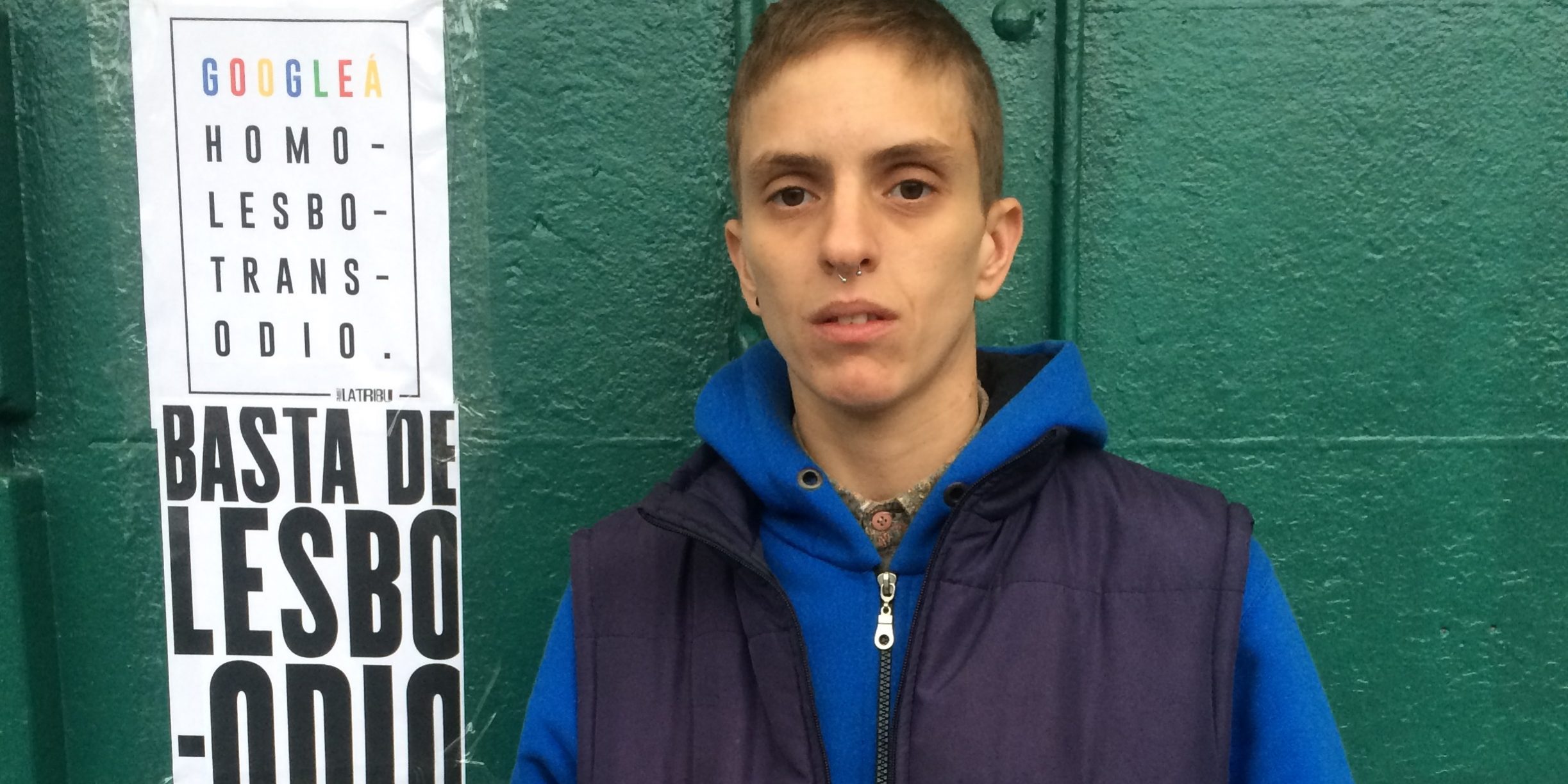
They are demanding that attacks on La Tribu employee be investigated as lesbo-hate.
Sofía del Valle is 30 years old and works at the bar of Radio La Tribu. On March 22nd at 6:30 p.m., a group of men attacked her at the corner of Corrientes and Estado de Israel streets. They were the same men who had already assaulted her twice. They threatened her: “We don’t want any weirdos in the neighborhood. We know you went with the cops, you fucking lesbian.”

Share

By Lucas Gutiérrez. This is the third time Sofía Del Valle has been attacked by the same group of men in a hate crime against lesbians. In the afternoon, on busy streets in the Almagro neighborhood, on her way to work, she was assaulted. “I’m not going to that neighborhood anymore; it’s one less neighborhood in my life,” she told Presentes. This Thursday, March 17, the International Day Against Homophobia, Transphobia, and Biphobia, Sofía, along with various organizations and activists, will hold a festival in the streets where she was attacked, raising awareness and demanding justice for this and other cases. Between September of last year and March of this year, Sofía was beaten three times by the same group of men. “We don’t want weirdos in the neighborhood. We know you went with the cops, you fucking lesbian,” they told her the last time. On March 22, around 6 p.m., as she exited the subway station on Corrientes Street, they grabbed her by the neck and dragged her a few meters away to beat her. The previous times they had attacked her from behind. Sofia is 30 years old and works at the bar of Radio La Tribu. “Before, I never did anything because this shit was already part of my life,” she explains, adding that she has experienced violence since she cut her hair at 20. “When I met Camila—her partner—I understood that things don’t have to be this way.”
They are asking for it to be investigated as a case of lesbophobia.
Alejandra Iriarte is part of the Feminist Lawyers Network and accompanies Sofía: “We hope that the case will be investigated as lesbophobia, violence, harassment, and discrimination based on gender identity. “This isn’t just any injury or threat; it’s directed at a visible lesbian, and this can’t be ignored in the legal investigation,” she tells Presentes. The FM La Tribu collective issued statements regarding the attacks. Paula Lorenzo, who hosts a program on this station, now sits with Sofía and Camila and speaks about the powerlessness they feel in the face of this: “We have to challenge the narrative legally, but also in the streets. We need to give a collective response.” And so, days ago, along with several other women, they walked through the area where Sofía was attacked and plastered it with posters. “Google lesbophobia,” some said, while others recounted what had happened. Neighbors, those who saw something and did nothing, those who didn’t even know it had happened—everyone was now reading what Sofía experienced (and is experiencing). Her attackers will read it too: “We are organized.” This Thursday from 6pm the streets that saw Sofia attacked will now witness a festival that will shout "Stop the hate".

 With her face still swollen from the attacks, Sofía went to Durand Hospital the next day to document her injuries. Afterward, she returned to the Specialized Prosecutor's Unit for Violence Against Women and LGBTI People (UFEM) to file a report, just as she had after the first attack. Sofía recounts that her first encounter with these men was in September 2017. While she was working at La Tribu bar, two of them were outside and began verbally harassing Camila through the window. When she went out to tell them to stop, they started with threats and threats, asking, "What are you, a woman?" The following week, around 6 p.m., while Sofía was walking along Aníbal Troilo Passage, one of them punched her in the back. "Stop, I'm a woman," she told them; "I know, you fucking lesbian," they replied, continuing to hit her. “After the first attack, I stopped going to work, then I started going with someone. The only day I went alone, they grabbed me again. They hit me from behind,” she says, adding that after the punches—this time from three assailants—they threw her to the ground and kicked her. Since they had also stolen her backpack, the incident was classified as robbery at the 11th police station in the Almagro neighborhood. It didn't matter that Sofía told them about the previous attack, explaining the lesbophobic nature of the act. Currently, the first and third attacks are classified as assault and threats, while this second one remains classified as theft. As the investigation continues, a request has been submitted to the City Government for security camera footage to identify the attackers.
 This attack on Sofía Del Valle is part of a growing wave of aggression against the LGBT+ community. In its latest report, the National Observatory of LGBT Hate Crimes reported that during 2017 there were at least 103 hate crimes based on sexual orientation, gender expression, and gender identity. The report indicates that physical violence increased by 500% compared to 2016 figures, and that most of these incidents occurred in public spaces.
We are present
We are committed to journalism that delves into the territories and conducts thorough investigations, combined with new technologies and narrative formats. We want the protagonists, their stories, and their struggles to be present.
SUPPORT US

FOLLOW US
Related notes


We are present
This and other stories are not usually on the media agenda. Together we can bring them to light.