

#DianaSacayánTrial: a plea and a festival that made history
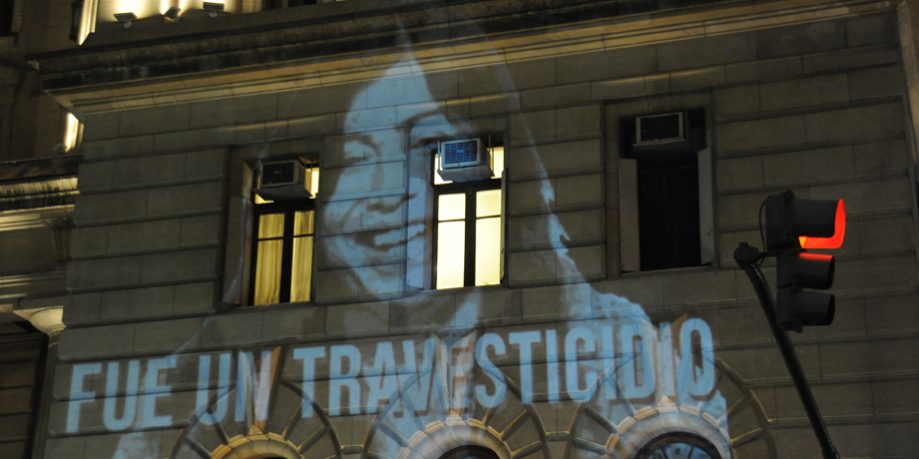
It was an important day in the trial for the transphobic murder of Diana Sacayán: activists made their presence felt both inside and outside the Buenos Aires courts, where the hearings are being held. The closing arguments began yesterday. The first argument presented before Criminal Court No. 4 was that of the family's legal team, represented by lawyer Luciana Sánchez.

Share

By María Eugenia Ludueña and Ana Fornaro. Photos: Ariel Gutraich and the Judicial Information Center (CIJ). It was an important day in the trial for the transphobic murder of Diana Sacayán: activism marked the occasion with a strong presence both inside and outside the Buenos Aires courts, where the hearings are being held. Yesterday, the closing arguments began. The first argument presented before the Oral Criminal Court No. 4 was that of the family's legal team, represented by lawyer Luciana Sánchez. A few meters from the courtroom, on the sixth floor, LGBTQ+ activists followed her words on a screen, breaking the reverential silence that pervades the building. Yesterday, the activists first gathered inside the courthouse and then outside, in Plaza Lavalle, where they continued until midnight with a festival honoring the human rights activist. It was a powerful demonstration of strength and struggle. A statement: we are here.

 The lawyer requested a life sentence for the sole defendant in this trial, David Gabriel Marino, arguing that the trial proved he was criminally responsible for the transphobic murder of Diana. The lawyer also asked the court for a series of reparations for the trans and travesti women's community.
 Part of Diana's family, a fundamental driving force in the cause.
A group of activists followed the proceedings in the hallways of the sixth floor of the courthouse, a few meters from the courtroom, where a screen displayed the broadcast from the Judicial Information Center. Afterward, the activities moved to the plaza across the street. There, the Festival for Justice for Diana Sacayán drew a large crowd that lasted well into the night.
Part of Diana's family, a fundamental driving force in the cause.
A group of activists followed the proceedings in the hallways of the sixth floor of the courthouse, a few meters from the courtroom, where a screen displayed the broadcast from the Judicial Information Center. Afterward, the activities moved to the plaza across the street. There, the Festival for Justice for Diana Sacayán drew a large crowd that lasted well into the night.
[NOW] From the Courthouse #JusticeForDianaSacayan The family's lawyer, Luciana Sánchez, continues her closing argument, now speaking about Diana's leadership in Latin America and her legacy. Outside the courtroom, family members and activists are showing their support. pic.twitter.com/JvFOcZ0TnA
— Presentes Agency (@PresentesLGBT) May 14, 2018
Words from Lohana
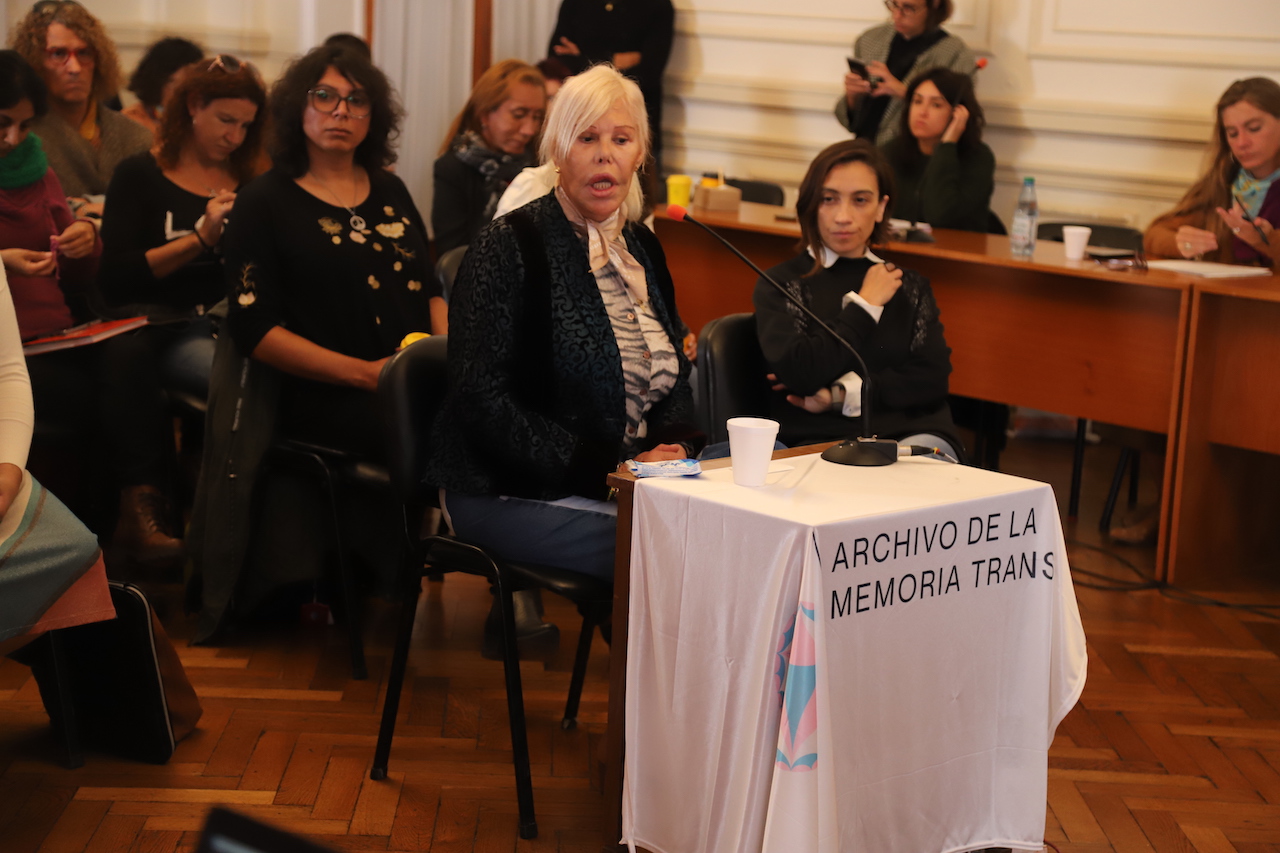
That Lohana's words opened the hearing, which began at eleven in the morning, was no coincidence. Last week, the prosecution had requested that the testimony given by the activist and friend of Diana to the court days after the transphobic murder be incorporated into the record. As a final witness, Lohana (who died in February 2016) spoke yesterday through the testimony read by a court official. “I met Diana at a police station when we were both imprisoned. We were just beginning the struggle.”

The plea
The family's legal team opened by stating that this is a "groundbreaking" process, as it is the first time the case has reached this stage, as attorney Luciana Sánchez explained at the beginning of her presentation. In the first part, she summarized the events based on the testimonies heard in the same courtroom since the proceedings began on March 12. Using the statements of various witnesses—activists, police officers, forensic experts, friends, and other witnesses—the family's legal team argued that the facts of the case had been proven. She then reviewed the sequence of events, outlining and citing the evidence presented by each witness.[NOW] #JusticeForDianaSacayan “We believe that Gabriel David Marino’s prior acquaintance with him led Diana to trust him, and we understand that the crime was motivated by hatred of gender identity along with desire,” said attorney Sánchez during her closing argument. pic.twitter.com/C7zC0B6Dq4
— Presentes Agency (@PresentesLGBT) May 14, 2018
The importance of the gender perspective
A significant portion of the argument analyzed the evidence. It highlighted the great value of the evidence produced (in both quantity and quality) and the implementation of the protocol for handling violence against women, implemented from the moment the Specialized Prosecutor's Unit for Violence against Women and LGBTIQ+ People (UFEM), headed by Mariela Labozzetta, who is also participating in the proceedings, arrived at the crime scene. “Having a gender perspective from the outset allowed us to obtain valuable information. It made it possible to collect evidence regarding the motives behind the murder. I emphasize these procedures because they are not routine; these protocols are not generally used.” She also highlighted the solid evidence. Unlike other cases, it is not common to have the quality and quantity of evidence we had in this trial to identify the elements of hate. In general, hate crime scenes are mishandled, not addressed with rigorous protocols, and go unpunished. The evidence implicating Marino, as established throughout the trial, is substantial. One of the most compelling pieces is the discovery of Marino's genetic profile in the DNA analysis of a sample taken from under one of Diana's fingernails. Another is the fingerprint found on the door of the room where she was murdered.

Diana, defenseless
The lawyer also highlighted the defenseless state in which the victim found herself at the time of her murder (as Cohen, the doctor who performed the autopsy, stated: “The autopsy shows that Diana was in a state of defenselessness due to alcohol intoxication, prior to being attacked. She had no opportunity to defend herself.” “Diana was a trans woman. We have to prove that her death was not accidental. And that she did not cause her own death (in relation to those who think that being a trans woman leads to death). Despite Diana being a human rights defender, she was murdered under the same circumstances as other trans women, killed before the age of 40.” Diana was exceptional, but she was not the exception.She was murdered in her home like any other transvestite. It was a political crime, but in an intimate setting. Marino forever immortalized her in that humiliating end. He wanted to continue exercising control over her body even after her death.
 The lawyer also listed the recurring characteristics of hate crimes based on gender identity. Among them, that Diana suffered a lethal attack in her own home, in her bedroom, on her bed. Gagged, bound, repeatedly beaten, stabbed, with a head wound, disfigured. Abandoned under a bloodied mattress. That her body also bore the multiple injuries typical of femicides. “Diana is a trans woman, South American, and Indigenous. Everything that happened is related to that. Everything that happens to trans women happens to them because they are trans women. And in general, they are very bad things, like transphobic murders,” said lawyer Sánchez.

The request of the lawsuit
The plaintiffs consider the facts of the case proven and that "there is sufficient evidence to say that Gabriel David Marino is the perpetrator. And that the primary motives for this crime were hatred of the victim because of her gender identity and her status as a human rights defender." The prosecution requested that Marino be convicted as the perpetrator of the crime of transvesticide. Specifically, the aggravated homicide motivated by hatred of the transvestite gender identity of Amancay Diana Sacayán (Article 80, Section 4 of the Penal Code), in conjunction with Article 80, Section 11, for having been committed by a man against a woman in the context of gender-based violence (femicide), in conjunction with having been committed with premeditation, and in conjunction with simple robbery, for having appropriated 20,000 pesos from Diana Sacayán. The prosecution requested a sentence of life imprisonment and argued that, given the concurrence of offenses, the robbery charge was already included. "We hope that justice will be served," the lawyer concluded. Outside the courtroom, there was applause.

Reparative measures
“For these crimes to stop being committed, the Judiciary can send a message, given that this is a landmark case in which they will issue a sentence. We know that Diana is also putting her body on the line now,” said Sánchez before listing a request for reparations. These measures are not under the court's jurisdiction, but the plaintiffs hope they will resonate so that other institutions will listen to the Justice system. Among other things, the lawyer listed:- To hold a public tribute to redress her image, given the media coverage of her murder. More has been said about her death than about her life and activism.
- The judiciary should apologize for failing to protect Diana. She had filed several reports of threats, all of which were dismissed.
- that the Judicial Branch recommend to the Legislative Branch to declare a social emergency for the transvestite and trans community.
- that the UFEM protocol be applied in all cases of transvesticide in the country and that more specialized gender prosecutors be created or that UFEM be given more structure.
- We demand that the Judiciary recommend to the Legislature the enactment of the Diana Sacayán Trans Employment Quota Law and that it be implemented in the Judiciary: we want trans lawyers and judges.

Justice for Diana Sacayán Festival
The day continued with a festival in Plaza Lavalle, attended by Say Sacayán, family, friends, political and social organizations, LGBTQ+ collectives, and other individuals. The festival drew a large number of activists and artists late into the night, demanding justice for Diana and the trans community. Susy Shock, Sudor Marika, and Kumbia Queers performed before an unusually large crowd for the time of day and location. Say Sacayán and Darío Arias, from the Justice for Diana committee, were joined by other LGBTQ+ activists in the same cry: “Justice for Diana, it was a transphobic murder.”
We are present
We are committed to journalism that delves into the territories and conducts thorough investigations, combined with new technologies and narrative formats. We want the protagonists, their stories, and their struggles to be present.
SUPPORT US

FOLLOW US
Related notes
We are present
This and other stories are not usually on the media agenda. Together we can bring them to light.