

#DianaSacayán For the first time in the trial, the accused of transvesticide spoke.
Yesterday was one of the most tense moments of the trial for the transvesticide of Diana Sacayán, the transvestite activist and human rights defender murdered in October 2015.

Share

By María Eugenia Ludueña and Ana Fornaro
Photos: Presentes/Ariel Gutraich (archive) Yesterday marked one of the tensest moments of the trial for the transphobic murder of Diana Sacayán, the trans activist and human rights defender killed in October 2015. The hearing was already complicated: it was scheduled to begin at 9 a.m. but started more than three hours late. As Luciana Sánchez, the lawyer representing the Sacayán family, would later say, it was a “willful” hearing. The usual courtroom was occupied; no other rooms were available. The Oral Criminal Court No. 4 tried to prevent its cancellation. Therefore, it ended up being held in a lavish, cinematic room on the ground floor of the Palace of Justice, but one that lacked a microphone and sound system.
 The four witnesses yesterday proved difficult—at times impossible—for the public to hear. There were no televisions available to share the videos and photos requested by both the plaintiffs and the prosecution, represented by Ariel Yapur. These files could only be accessed via computer screens or printed copies. After the court—comprised of Adolfo Calvete, Ivana Bloch, and Julio Cesar Báez—concluded the witness testimony, Judge Calvete asked public defender Lucas Tassara if the accused, Gabriel David Marino, wished to testify. He said yes.
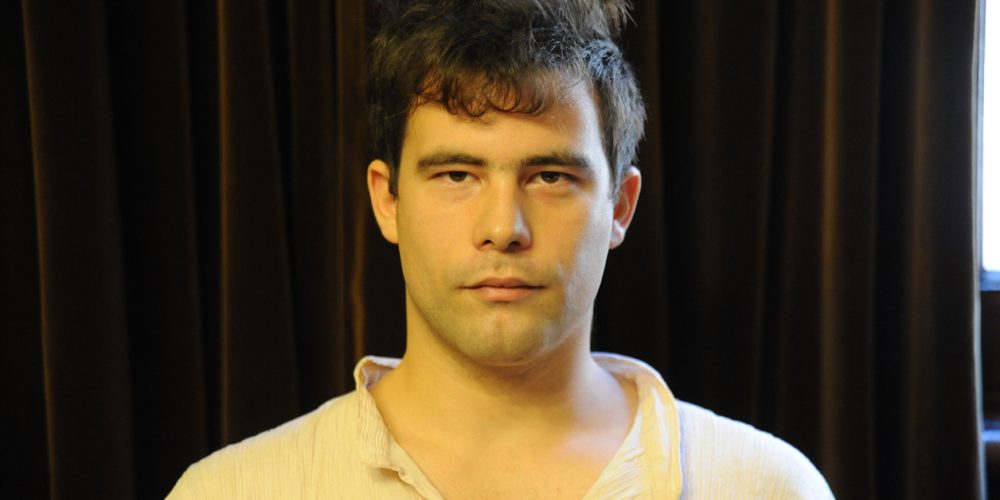
 Defense attorney Lucas Tassara (left) and Gabriel David Marino, accused of transphobic murder. After a brief recess, Marino sat in the chair facing the court, his back to the public, in that immense hall where life seems to have stood still for centuries (as in so many places in this neoclassical building constructed according to almost monarchical hierarchies). The statement was as brief as it was forceful. Marino was indeed heard. In a loud voice, he said: "I swear to God I am innocent. I was never at the scene of the crime." I didn't kill Diana. I demand justice for Diana Sacayán. I will not answer any questions. Hearing the accused plead for justice for the victim and echo the sentiments of those who have worked so hard to get this far was, to say the least, chilling. The public murmured, "Let him swear by the devil, not by God!" when Prosecutor Yapur took the floor. Vehemently, he requested that a statement from Marino, contained in the case file, be read aloud. "There is a significant difference between what the accused just said and what he said during questioning, when he was at the scene of the crime. That is why I request that this statement be read." The defense attorney objected. "Marino has already spoken. He is not more contradictory, just more concise and to the point," he attempted to justify. Adolfo Calvete, the presiding judge, considered that there was a contradiction, "which is why the statement should be read." "I object," the defense attorney insisted. Finally, only a few excerpts were read, in which Marino recounts being in Diana's apartment, "high on drugs," and—among other things—says he saw another person there with him stab her. There were several deliberations regarding a number of technical issues. These were largely triggered by the defense attorney's request—who took center stage yesterday like never before—that the court not consider Marino's previous statements. He even asked for the removal of the sketches made by the accused placing himself at the scene of the crime.
 Tassara, Marino's defense attorney, and the prosecution (represented in this trial by Yapur and Mariela Labozzetta of the Specialized Prosecutor's Unit for Violence against Women and LGBTI People) and the plaintiffs objected. “The defense wants to remove any trace of the accused from the case file. The defense attorney is making this unconstitutional interpretation of the right to defense, which affects our role as plaintiffs,” said Sánchez. Both the family's legal team and the INADI (National Institute Against Discrimination, Racism, and Xenophobia, where Diana worked) – represented by Juan Kassargian – expressed the same sentiment. The court agreed to respond next week. The plaintiffs also requested that the testimony of activist Lohana Berkins (who died in 2016) be incorporated by reading into the record. This testimony will be read next Monday during the eighth session of the trial, before the closing arguments begin. The final testimonies of the trial : In yesterday's hearing, the last four witnesses testified. The first was the police officer sent from the 38th precinct as soon as Diana Sacayán's murdered body was found in her apartment in the Flores neighborhood of Buenos Aires. The officer recalled that while waiting for the SAME ambulance to arrive, At the door, he spoke with a friend of the activist: that's when he learned that "Diana was the first trans woman in Argentina to whom President Cristina Kirchner gave an ID card" reflecting her self-identified gender. Later, a scientist testified who had analyzed the DNA samples in the laboratory and participated in preparing the reports. He emphasized "the exhaustive number of samples obtained in this case, compared to others." He also highlighted that the sample collection protocols were rigorously followed (the swabs, he said, were in optimal condition and were later compared with the victim's fingernails). And he explained technically why the DNA obtained from the samples undoubtedly matches that of the accused in this trial. While this witness was testifying, the echo of the open radio broadcast—held by activists and LGBTQ+ organizations in Plaza Lavalle, convened by the Justice for Diana Commission—permeated the courtroom in the voice of Lila Downs singing "Dignified": " From the mountain, the voice of lightning is heard, it is The clear flash of truth . In this holy life where no one forgives anything, but if a woman fights for her dignity. “Oh, my dark-haired one, my little dark-haired girl, I will never forget you .”
 The third witness was a forensic doctor, one of the first to arrive at the crime scene. She recalled that there was blood on the walls and mattress of the room. She interpreted the disarray of the room as evidence of a struggle and an attempt by the victim to defend herself. And that after the murder, Diana's body had not been moved. Finally, a homicide detective testified, who had participated in two raids to obtain clothing with traces of Marino's DNA and arrest him. After him, it was Marino's turn. The courtroom where this hearing—the seventh of the trial that began on March 12—took place is on the ground floor of the courthouse. A large crucifix hangs in the room; it is much larger than usual, but it has the same wood-paneled walls, soaring ceilings, and a giant chandelier with more than twenty shades. The judge's bench is raised above floor level. The chairs look like they belong on a film set. Vintage Hollywood chairs: disproportionately large, made of wood, with the symbol of justice carved into the back. They are of varying heights, theoretically corresponding to the tallest chairs for those in higher positions. Yesterday, that order was distorted under the stern gaze of eleven male jurists, portrayed in oil and displayed on the walls of the courtroom. And as if that male presence weren't enough, they are accompanied by a dozen photographic portraits of other doctors.
Presentations by CHA and 100% Diversity and Rights
The organizations Argentine Homosexual Community (CHA) and 100% Diversity and Rights presented themselves as amicus curiae (Friend of the Court) to bring closer arguments to the Court that allow the murder of the transvestite activist Diana Sacayán to be framed as a transvesticide and hate crime. The presentations "are based on the symbolic impact of hate violence, which sends a message of widespread terror to the LGBT community," Pedro Paradiso Sottile (CHA) and Greta Penna, from 100% Diversity and Rights, told Presentes. The document from 100% Diversity and Rights develops the historical, social, and legal context in which violence against LGBT people, and especially against transvestite and trans people in Argentina, is situated. “It is from this perspective that a viewpoint that individualizes hate crimes as justifiable aggravating factors, as a greater legal condemnation, makes sense, since the motivation is based on prejudices—prejudices that correspond to the stereotype of the hated group—and not so much on a selection for individual reasons,” they point out. And they add: “When states fail to conduct thorough and impartial investigations into cases of violence against LGBTI people, impunity for these crimes sends the social message that violence is condoned and tolerated, which, in turn, further fuels violence and produces distrust of the justice system by victims.” At another point, they maintain that "There will be no access to the right to gender identity if the murder of a transvestite person is not prosecuted and those responsible for that crime are not punished, taking into consideration that the murder occurred while that person was exercising their freedom to live and develop according to their identity." In these legal proceedings, such as the one being processed in this case, the acts in dispute will be subject to proof, but not the right to gender identity and to live, and not die, by virtue of its free development.” For its part, the CHA (Argentine Homosexual Community) emphasizes Diana Sacayán's role as a human rights defender. They consider that “it is important that, although other hypotheses may arise during the investigation, the one related to the possibility that the crime was a consequence of her human rights work must be pursued exhaustively.” They also point out that a possible classification solely under the category of aggravated homicide (Article 80 of the Penal Code) due to hatred of gender identity (paragraph 4), or solely under the category of femicide (paragraph 11), would be insufficient and legally inadequate. They state that the concurrence of both paragraphs under the characterization of transvesticide “constitutes the correct legal classification that accounts for all the subjective and objective elements present in the case before the court.” Finally, the document recommends that “when there are indications that suggest a relationship existed between the victim and the perpetrator, measures must be taken to ensure that the investigation is not conducted in a biased manner. It must be made clear that the existence of prior knowledge is neither a reason nor grounds for dismissing a motivation based on prejudice—in this case, a transphobic motive—that culminated in the transphobic murder of Diana Sacayan.” “The decision adopted in this case will have a decisive impact on the identity of the trans community in general. It will mark a turning point in history regarding how the constitutional system treats transvestite and trans people in our country, to what extent their citizenship and access to fundamental rights are (or are not) equally guaranteed by our rule of law; to what extent justice determines the resolution of these disputes, reaffirming the recognition of identity, autonomy, and equality of individuals and respect for the pluralism and diversity of those who live together in the republic, or as a victory for impunity, hostility, and persecution of trans people.” "The different ones, the 'silenced' ones, the 'historically excluded and stigmatized' ones," Pedro Paradiso Sottile of the CHA told Presentes.Festival on Monday 14/5 at the Courts
 After leaving the courtroom, the public—family, friends, and members of various organizations—walked 50 meters to Plaza Lavalle, where they met with activists at the open-air radio broadcast and took a group photo. There was a brief closing session, during which Luciana Sánchez shared what had transpired during the hearing.
 In the plaza, protesters also called for the acquittal of Joe Lemonge, a young trans man from Entre Ríos convicted last week for defending himself against an attack by a group of men. Darío Arias (Conurbanos por la Diversidad) expressed his gratitude for the support and, like Sánchez, highlighted Say Sacayán's role in leading the family's legal action.
 And she announced that next Monday the Justice for Diana Sacayán Commission is holding a live music festival. It will begin at 6 p.m. in front of the courthouse, to add strength and visibility to this landmark case in which the Judiciary is using the term "transvesticide" for the first time and must rule on a hate crime based on gender identity, a case that has witnessed so many others.
Given the repeated use of materials produced by Agencia Presentes that have been appropriated by other media outlets and individuals, we reiterate that they may only be used with proper attribution to the agency and its authors. Journalism is a job, like any other.
]]>We are present
We are committed to journalism that delves into the territories and conducts thorough investigations, combined with new technologies and narrative formats. We want the protagonists, their stories, and their struggles to be present.
SUPPORT US

FOLLOW US
Related notes


We are present
This and other stories are not usually on the media agenda. Together we can bring them to light.