

Uruguay has the first state census of trans people
In Uruguay, the trans population experiences multiple situations of vulnerability while the comprehensive law for trans people remains in the drawers of Parliament.

Share

By Denisse Legrand*
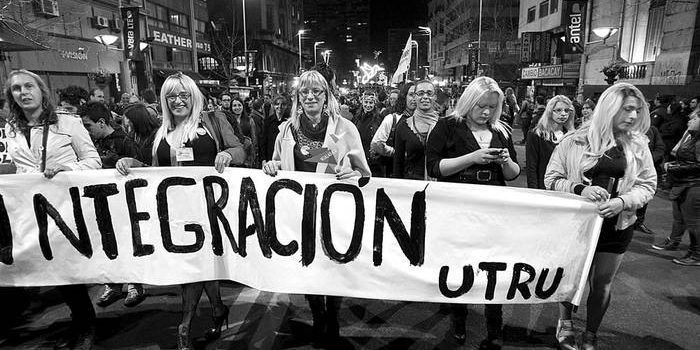
Photo: Diversity March. Photo: Iván Franco (archive, September 2014)
In Uruguay, the trans population faces multiple forms of vulnerability. Expulsion, in its broadest sense, shapes their lives. A comprehensive law for trans people languishes in Parliament. In recent weeks, a conservative push has once again brought their bodies—and their lives—into the public debate, generating a series of controversies that demonstrate the organized offensive against their rights. The awakening of parliamentarians to approve the comprehensive law for trans people and guarantee a minimum framework of rights is a necessity that cannot wait.
Quantifying a reality
According to the National Census of Transgender People, conducted by the Ministry of Social Development and the University of the Republic, there are approximately 853 transgender people in Uruguay. Ninety percent are transgender women and ten percent are transgender men.
This census is unique in the world. Uruguay is the first country to make the political decision to gather comprehensive information about this population in order to recognize and address their reality. According to Federico Graña, National Director of Sociocultural Promotion at the Ministry of Social Development and one of those responsible for this research, this work is important because “the Uruguayan State recognizes the particular situation of a population, definitively making visible the hard data of their reality and the various barriers that have prevented, and still prevent, the full development of transgender people in the country.”
While the census is a highly valued tool, some experts have raised certain concerns. It is believed that the numbers are slightly underestimated. The reasons are varied, according to Delfina Martínez, a trans activist: “Many are afraid of being registered, perhaps because it’s the first time. This is especially true for older people who have endured immense suffering and were persecuted by the state. The registration process, which until recently labeled them as 'passive pedophiles,' involved police harassment, days of confinement, and physical, psychological, and emotional abuse. There are also many who live in remote rural areas and have to dress as men to access legal employment, so they choose to live their true identity only intermittently. Like these, there are many reasons why trans people distrust and fear being included in a state registry.”
Expulsion as the norm
What Delfina recounts didn't happen so long ago; abusive practices against trans people were commonplace, for example, in the raids of the second half of the 1980s. For this reason, and so many others, the State is failing this population. The quality of life of trans people is directly linked to the lack of specific policies and the context of discrimination in which they live. Expulsion is the norm—from schools, from homes, from every social sphere. This is one of the factors that determines their average life expectancy of 35 years. Despite this unbearable disconnect from formal systems, only 1% of trans people are incarcerated.
The trans population lives mostly (61.8%) in coastal and border areas. Canelones, Maldonado, Cerro Largo, Salto, Paysandú, and Artigas are the departments with the largest trans populations. The remaining 38.2% reside in Montevideo.

The vast majority of transgender people are adults: 34.7% are between 18 and 29 years old, 26.6% are between 30 and 40, 19.9% are between 40 and 50, and only 17.6% live past 50. Only 10% are under 18.
In a country where the average age of leaving the parental home is 28, the average age of leaving home for transgender people is 18. Of course, the average person's transition to independence is not marked by the violence that transgender people experience when they leave home. The main reason they leave home is related to family problems arising from the development of their gender identities. Six out of ten transgender people report having been discriminated against by a family member. They recognize several family members who have projected discrimination onto their bodies and their processes: their mothers (41%), their fathers (50%), their siblings (56%) and other relatives (27%).
Only 19% made the registration change
Although Uruguayan legislation has progressed and transgender people can legally change their name and gender marker after a court process, at the time of the census only 19% (158 cases) had legally changed their name and gender marker. There were also 149 cases (18%) that were in the process of doing so. But the vast majority, 513 cases (60%), had not taken any steps to legally change their name or gender marker. The reasons for this are unknown. Perhaps the prospect of facing a legal process or the costs and time involved are some of the causes.
Education, far from being an inclusive environment, is an instrument of exclusion and discrimination. 88% report having been discriminated against. Bullying from classmates and the whims of teachers who insist on calling them by a name that does not represent them, arguing that "it's the one on the list" or simply for the pleasure of causing discomfort, appear constantly in their accounts. At school, 75.3% of discrimination comes from classmates and 18.7% from teachers; at high school, the figures are similar (classmates, 70.2%; teachers, 20.6%).
Only 12.1% of transgender people were able to complete secondary school, either at a high school or a technical school. The highest level of education attained ranges from incomplete primary school (11%), complete primary school (25.8%), and incomplete lower secondary school (23.6%). Only 1% of transgender people were able to access university and complete a degree.
Sex work is a very common employment option. 67% of transgender people have been involved in sex work. Of every three transgender people, one currently works in sex work, another did so in the past, and only one has never done so. It is believed that this figure is underestimated for various reasons, including the stigma that still acknowledging oneself as a sex worker, or the fact that some resort to this work "to save themselves," without considering it a real job.
Prostitution, the only destination
The vast majority became involved in the sex trade before the age of 18. In these cases, we cannot speak of sex work, but rather of sexual exploitation. According to testimonies, 14 years old is often a pivotal age for trans people. It is worth asking, in these times when there has been so much debate about the situation of minors, whether the sexual exploitation of children and adolescents, a product of abandonment by the State and their families, will receive as much attention as the attempt to prevent these same adolescents from making decisions about their health and about the transformations of their bodies to better reflect their gender identity. Will those who want to block access to the healthcare system and guarantees for these adolescents then campaign to prevent their exploitation?
To have a responsible debate about health, we must also understand what we are talking about. It is a misconception that all trans people are dissatisfied with their bodies. On the contrary, many are content with their bodies and their genitalia and do not want to alter them in any way. They don't want hormones, implants, or genital surgeries. "There are people who transition without adhering to hormone replacement therapy, because it's not mandatory; it's basically a matter of bodily autonomy," Martínez explained.
Myths about operations
According to the census, the majority of transgender people live their gender identity without undergoing physical changes. 78% do not take hormones, while only 22% do. Regarding implants, 75% do not have them, and 17.9% have had liquid silicone implants. The remainder opted for industrial oils, which are highly risky. Migration of industrial silicone is a recurring issue that can cause serious injuries (disabling and fatal).
Gender reassignment surgery is an option for very few people. 60.7% of transgender people have not had it and have no intention of doing so. There are 322 cases (37.7%) of transgender people who have not had the surgery but might be interested in doing so. At the time of the census, only eight people had undergone the surgery; four had it in Uruguay and the other four abroad.
An opportunity
The Comprehensive Transgender Rights Bill will soon be debated in Parliament. It is a historic opportunity to understand the reality of transgender people and address it comprehensively through specific public policies. The aim is to promote gender equality and reduce the multiple forms of discrimination.
Actions are proposed to promote inclusion in the workforce, education, culture, and healthcare. It states that health must be a right “without any type of discrimination and/or pathologization based on gender identity.” It also establishes procedures for changing one's name and registered sex, and provides reparations for those harmed by the State during the darkest periods in the country's history.
Ultimately, this law allows us to recognize that transgender people are people. It is an opportunity to repair the enormous damage we have caused. It also enables us to build a slightly less harmful world for future generations. Today, approximately 1,000 people were born and raised in a context of structural violence. We cannot allow stigma and discrimination to continue destroying lives. We cannot continue to perpetrate violence against transgender people.
]]>
We are present
We are committed to journalism that delves into the territories and conducts thorough investigations, combined with new technologies and narrative formats. We want the protagonists, their stories, and their struggles to be present.
SUPPORT US

FOLLOW US
Related notes
We are present
This and other stories are not usually on the media agenda. Together we can bring them to light.