

Trans voices from Entre Ríos demand a job quota
Putting an end to the violence against our identities and what constitutes them is the challenge we want to establish within the feminist movement, but no longer as a form of accompaniment but by adopting our struggle as our own, pronouncing the issue on the social agenda.

Share

By Keili González* We need to design counter-hegemonic strategies so we no longer occupy the lowest rung in the cruel political system of Entre Ríos, which audaciously demands that we "improve ourselves." As if each trans woman were their own problem to be solved. Putting an end to the violence against our identities and our very essence is the challenge we want to establish within the feminist movement, not merely as a form of accompaniment, but by adopting our struggle as our own, by placing the issue on the social agenda. Our province is one of the few that doesn't even have a trans employment quota bill. We trans women have met with public officials in Entre Ríos demanding policies that include sexual and gender diversity. Our first meeting was with Matías Germano, head of the Undersecretariat of Human Rights, which oversees the Sexual Diversity Area. This area was sanctioned by the Legislative branch and enacted by Governor Gustavo Bordet seven months ago, but it remains merely symbolic. One of the biggest problems our community faces is the lack of access to the job market. If there's one thing the provincial government hasn't allowed us to do, it's participate in creating public employment policies , much less enter the workforce to pave the way for us to enjoy our genuine right to work. “I'm still preparing myself. I finished high school, took a computer course, and now I'm in college. I really intend to move forward, to train myself so that one day—I haven't lost hope—I can get a decent job. Today, we know there are no public policies to help us, to support us, or to back us up in finding employment,” said Agustina Busten , a trans activist and advocate from Paraná.
 Karen Bruselario , a trans activist from the city of Victoria, acknowledged the difficulties the trans community faces in finding work, saying, “After so many years of having no job opportunities, of knocking on doors and no one seeing me as capable, I received an offer to work in a union that teaches classes for adults. Today, at 33, I have my first job where I don't risk my body , but rather have the chance to show that that former prostitute wanted to grow.” The activist also clarified that a friend gave her the opportunity after years of waiting for the government to respond.
 “Very few trans women are employed in Concepción del Uruguay; only a few who have managed to get a degree are working. I can't get a job; I have no chance, even though I want to. Those of us who are forced into prostitution have had even that dream stolen from us, and we continue to struggle with the various problems we face,” commented Laura Girard , a trans activist from that city.
 “Trans women face the difficulty of not entering the formal labor system, and one of the reasons for this is entering the prostitution system, which is a consequence of prior expulsion. There are some of our colleagues who are not in the situation of having to prostitute themselves to survive, which allows them access to other places because they don't carry the stigma of having been seen on the street offering their bodies,” said Iara Aranzazú Quiroga , a trans activist and militant from Paraná.
Why is equality not possible without us included?
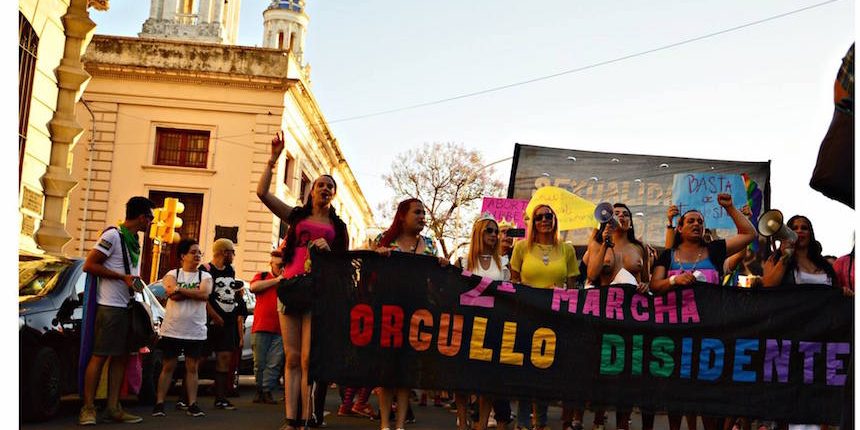
Addressing trans and gender-diverse identities within employment policies is crucial for advancing the effective inclusion and integration of all people without discrimination and on equal terms in society. To achieve this, it is essential that the promotion of decent work recognize the specific needs of our community, which is one of the most vulnerable. On May 2nd, trans women demonstrated in front of the Undersecretariat of Human Rights, with the objective that the provincial State implement effective public employment policies in areas that were designed and implemented with a gender and sexual diversity approach, making decisions to be able to respond to the conditions of a specific population excluded for having a non-hegemonic gender expression. Keili González
In this context of extreme violence, we, the trans women of Entre Ríos, as political entities, have organized ourselves to say enough is enough. Our bodies can't take any more. Everything we have endured throughout our lives, our experiences and circumstances, our context, is inscribed on our bodies. We are bearers of a history, and one of the cruelest, that of living in the shadows, and that has a symbolic value that we cannot detach ourselves from.
For this reason, within feminism we promote political strategies of solidarity, and this can only be achieved by treating the other as an equal, including them not only in discourse but also in concrete actions, working on urgent needs in the face of the enormous absence of the State, with the sole objective of not making otherness disappear.
* Trans communicator and activist. Lives in Nogoyá, Entre Ríos. ]]>
Keili González
In this context of extreme violence, we, the trans women of Entre Ríos, as political entities, have organized ourselves to say enough is enough. Our bodies can't take any more. Everything we have endured throughout our lives, our experiences and circumstances, our context, is inscribed on our bodies. We are bearers of a history, and one of the cruelest, that of living in the shadows, and that has a symbolic value that we cannot detach ourselves from.
For this reason, within feminism we promote political strategies of solidarity, and this can only be achieved by treating the other as an equal, including them not only in discourse but also in concrete actions, working on urgent needs in the face of the enormous absence of the State, with the sole objective of not making otherness disappear.
* Trans communicator and activist. Lives in Nogoyá, Entre Ríos. ]]>
We are present
We are committed to journalism that delves into the territories and conducts thorough investigations, combined with new technologies and narrative formats. We want the protagonists, their stories, and their struggles to be present.
SUPPORT US

FOLLOW US
Related notes
We are present
This and other stories are not usually on the media agenda. Together we can bring them to light.