

Diana Sacayán's transgender employment quota law is being demanded nationwide.
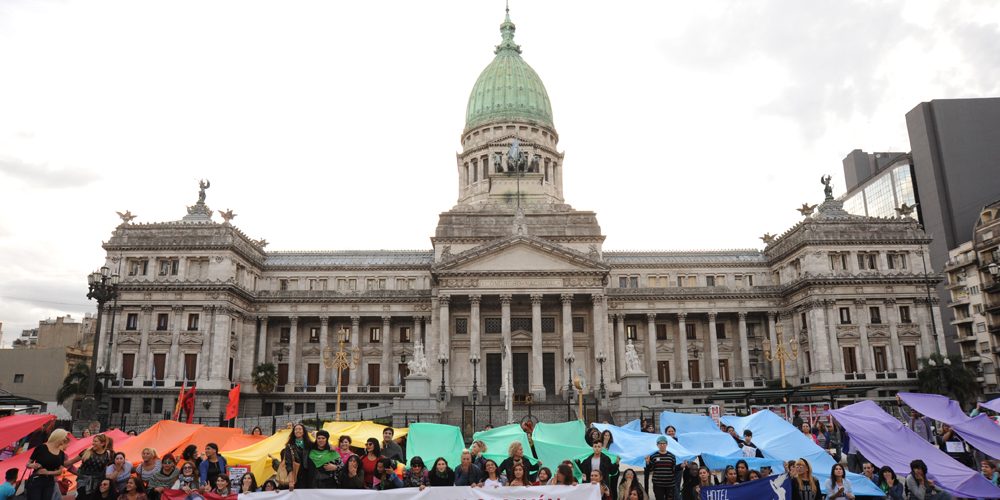
Photos: Ariel Gutraich. On International Workers' Day, in front of Congress in Buenos Aires, a group of more than ten social organizations and LGBTQ+ activists presented a coalition to promote a national trans employment quota law. According to official figures available at the national level (dating from…

Share

Photos: Ariel Gutra . On International Workers' Day, in front of Congress in Buenos Aires, a group of more than ten social organizations and LGBTQ+ activists presented a coalition to promote a national trans employment quota law. According to official national figures (dating from 2014), at least 80% of trans people have never had formal employment, and only 32% have completed high school. The precarious conditions and violations of their basic rights mean that most do not survive past the age of 35. For this reason, activists believe that a quota law guaranteeing 1% of state positions is crucial, thereby restoring basic rights. The bill promoted by the coalition was presented to Congress in 2016, based on a model that already exists (though not yet implemented) in the province of Buenos Aires: hence, it also bears the name "Diana Sacayán," after the driving force behind that provincial law. The transvestite human rights activist was murdered a month after the project she had fought so hard for was approved.


[READ ALSO: The debt of the province of Buenos Aires with the #TransWorkQuota law]
 After 4 p.m., activists had already organized to take a photo in front of the Congress building, holding the rainbow flag and the banner of the law. As Say Sacayán, Diana's brother and a leader of the Anti-Discrimination Liberation Movement (MAL), said, "The date and location are symbolic. There is no law, and there is no May Day for trans people. That's why we're calling on everyone who wants to work collectively."
 The master of ceremonies was trans activist Alba Rueda (from Mujeres Trans Argentina), who introduced various leaders from across the country. One of the first to speak was Gabriela Mansilla, Luana's mother. Luana received her new ID card in 2013 at the age of five, becoming an emblem of the fight for trans rights. Today, Gabriela is part of the civil association Infancias Libres de Violencia y Discriminación (Childhoods Free from Violence and Discrimination). "We, the parents and grandparents of trans children, are here because we don't want our children's destiny to be prostitution. We also want to support our fellow activists who fought for the Gender Identity Law, which benefits our children with an ID card that opens doors for them to go to school. There needs to be a historic milestone to restore the rights that have been taken from us." "Perhaps we can ensure that no girl over the age of 12 is standing on a street corner, but rather in school, with a family, with equal opportunities and a future. We need a national trans employment quota law, Diana Sacayán, for the people who need to work now and for the future of children," Mansilla said.


 From Mar del Plata, where a municipal ordinance was approved quota and also The National University became the first in Latin America To discuss the creation of a trans job quota, several activists and recently hired workers traveled to the university. Agustina Ponce, from the Equal World Association (AMI), recounted how, through the Lohana Berkins Open Chair, they were able to secure the approval of the job quota at the University. Agustina is also the first trans teaching assistant at the Law School of Mar del Plata. "One of the colleagues who joined was in prostitution and completely changed her life. I'm talking about equality for freedom. I'm not talking about independent sex work versus prostitution: I'm talking about us having the possibility to choose what the hell we want to do with our lives. There are ongoing processes of stigmatization that inevitably throw us onto the street. We're dying at 35, and the State has to take responsibility. The Gender Identity Law alone won't be enough to compensate for this lack of rights. We have the law approved in the province of Buenos Aires, and it seems like we're asking for crumbs when we ask for its implementation." "Every day a trans woman under 35 dies. We need to be able to reach a point of empathy in society. But real empathy. That the pain is shared by everyone when a sister is killed," said Agustina.

[READ ALSO: University of Mar del Plata already has its first employees through the #TransWorkQuota]

[READ ALSO: MAP: This is the trans job quota in Argentina]

 In addition to the activists, Mónica Macha (National Deputy for Unidad Ciudadana) and Karina Nazabal (former Provincial Deputy for Frente para la Victoria) were also present and spoke. Both, who worked with Diana Sacayán at the provincial level when the quota law was enacted, pledged to support the national bill in Congress and to provide political support to LGBTQ+ activists. "This community has been fighting for its rights historically, and we need a society that can build with less cruelty and with the ability to address the problems and needs of each community. We must demand its implementation at the provincial level and fight for its national implementation. Having a law doesn't solve everything, but today María Eugenia Vidal is violating the right to a trans job quota," said Macha. "This is also a class struggle. That a minority group decides who can work and who can't in this country. For me, it has always been an honor to be a tool for Diana. In this position, I don't have to convince anyone about the importance of the trans job quota, but I do want to congratulate them and wish them well." "At that time there were very few of us, today there are more of us and we owe this law to Diana Sacayán because it is hers," Nazabal said.


[READ ALSO: Trans voices from Entre Ríos demand job quotas]

 Gabriel Escobar, a trans man and member of Conurbanos por la Diversidad (Suburbs for Diversity), spoke about his story and why he has nothing to celebrate on May 1st. “I’m 45 years old. Tomorrow I have nothing to celebrate, and I think all my fellow trans people understand me. It’s difficult to reach this age and to reach it this way. Not being able to enjoy your transition, your identity. What we want is to work. We support the Diana Sacayán job quota; we are eternally grateful to her wherever she is. But the governor (María Eugenia Vidal) doesn’t respect it, and at the national level they used us to say they’ve incorporated us into society. We are people; we have the right to live with dignity like any other citizen. I hope next year I can be celebrating Labor Day.”


[READ ALSO: Trans voices from Entre Ríos demand job quotas]


[READ ALSO: “I was fired after 16 years: I was the only trans person in that Ministry”]
 These are some of the organizations that make up the Front: Anti-Discrimination Liberation Movement (MAL); Argentine Trans Women (MTA); Student Center of the Mocha Celis Trans Popular High School; Conurbanxs for Diversity; 100% Diversity and Rights; Feminist Trava Fury; Argentine Homosexual Community (CHA); Lohana Berkins National Current; Equal World Association (AMI); Childhoods Free of Violence and Discrimination; Orange Rose.
 ]]>
]]>
We are present
We are committed to journalism that delves into the territories and conducts thorough investigations, combined with new technologies and narrative formats. We want the protagonists, their stories, and their struggles to be present.
SUPPORT US

FOLLOW US
Related notes


We are present
This and other stories are not usually on the media agenda. Together we can bring them to light.