

The first university cafeteria run by trans students
This initiative, a collaboration between the LGBTIQ+ collective Devenir Diverse and the student group Estudiantes al Frente, has created eleven jobs for transgender university students at the Faculty of Philosophy and Humanities of the National University of Córdoba. The cafeteria has historically been excluded from higher education.

Share

By Alexis Oliva, from Córdoba.
Photos: Nayla Azzinnari —There are breaded beef, chicken, soy, and chickpea sandwiches. But I recommend the lentil burger. It's the new thing, you're going to love it. Come on, they sell out fast… Peter accompanies the recommendation with a good salesman's smile, from behind the counter of the trans cafeteria in the “Green Pavilion” of the Faculty of Philosophy and Humanities (FFH), National University of Córdoba (UNC). —Now, as promised: eggplant mayonnaise! —announces Fe, one of the people in charge of the kitchen, and the news is celebrated with applause. Everything looks new in the recently opened space . New people working, new products, and new customers; new words, gestures, and smiles. And Peter isn't exaggerating when he says that demand exceeds supply, because the student and faculty community is supporting the trans cafeteria at this island faculty, in a university environment not immune to the setbacks in rights and awareness that are currently affecting Argentine society. "How could we not buy here, if it's the first trans cafeteria in an Argentine university ? That's really cool!" emphasizes Irene, who in her late fifties is about to finish her Anthropology degree. "There's definitely support..." confirms Lautaro, a twenty-something History student. "We're very happy. The students are really supportive. We've had a great response, even though we're still missing some things, but we'll keep bringing in more," promises Peter, originally from Bariloche and a Nursing student at the UNC.

No conquest is small.
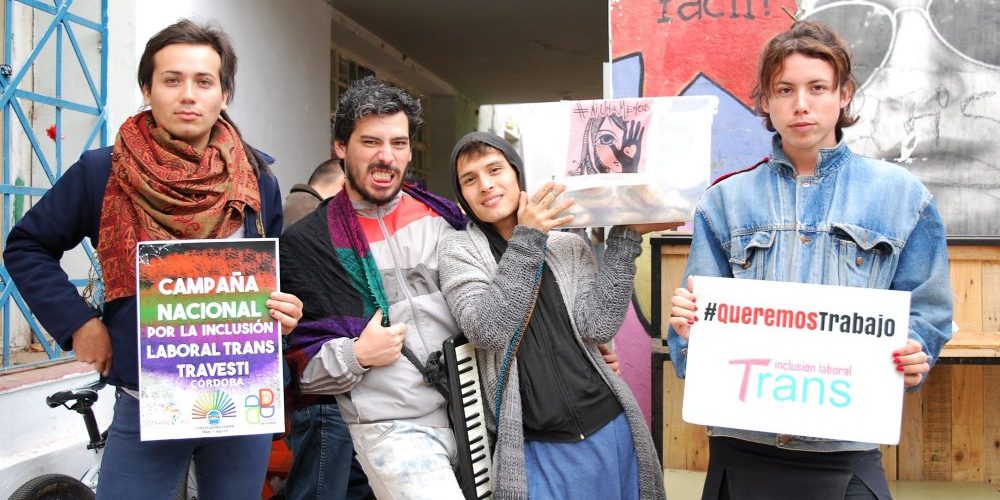
In the canteen and its surrounding visual environment, the poster for the Campaign for Trans and Travesti Labor Inclusion is displayed alongside the faces of teacher Carlos Fuentealba, Santiago Maldonado, Rafael Nahuel, and Facundo Rivera Alegre, the young man from Córdoba who disappeared in February 2012, in the renamed “Mariano Ferreyra Pavilion.” Contrary to the prevailing indifference, in this politicized space, no hope is excessive. And no victory is insignificant. And no wonder, because from the start The project generated eleven direct jobs for trans peoplePeter, Santiago, Ximena, and Leah cover successive three-hour shifts serving the public, between 9 a.m. and 9 p.m.; Anna, Fe, Fabiana, Morti, Alan, Florencia, Bárbara, and Bruno are in charge of food production. They are students of Language, Philosophy, History, Nursing, and Arts. They applied and were selected after a series of interviews, with the sole condition that they were students at the National University of Córdoba (UNC) and with one fundamental criterion: need. For almost all of them, it is their first job ever.
 The initiative was born from a joint experience of the group Students at the Forefront, in charge of the student center of FyH, and the LGBTIQ+ rights movement Devenir Diverse, within the framework of the National Campaign for Trans and Travesti Labor Inclusion: from the management of scholarships for the very scarce trans university population, to the project of the first canteen managed only by trans people in a national university.
"The State never took responsibility"
“The material reality of the trans community is extremely poor,” he says. Present Gabriela Galván, president of the student center of FyH–. The State never took responsibility, the family expels them, and society is mostly transphobic. That greatly limits their career prospects. In interviews with social workers, it emerged that many trans students at the university had to resort to prostitution to buy notes or pay for bus fare. This project arose in response to that reality.”. For Gabriela, this is “a huge victory, one that begins to pave the way for a historical redress of realities that were never addressed.” She adds: “At one point, we were excited about the Gender Identity and Equal Marriage laws, and the voices, demands, and claims of the LGBT community began to carry weight. With this government, the few rights they had achieved are now being violated. For us, as a student center, the important thing is that there begins to be real visibility that Trans people also study, work, and live with us, and we must contain them.”.
 There's still a long way to go. Gabriela denounces the trans employment quota project at UNC, started with some training courses, It was interrupted and “it’s been shelved”“in the Rectorate. Even the Superior Council ordinance 9/2011, which before the enactment of the Gender Identity Law ordered “recognition of the adopted and self-perceived identity of any person” in all academic and administrative departments of the UNC, “is not respected in several faculties.”
 “We don’t want subsidies or plans”
President of Devenir Diverse and vice-president of the Federal Trans and Travesti Call of Argentina, Ivanna Aguilera is currently dedicated to coordinating the work in the trans canteen.
“We don’t want subsidies or plans”
President of Devenir Diverse and vice-president of the Federal Trans and Travesti Call of Argentina, Ivanna Aguilera is currently dedicated to coordinating the work in the trans canteen.
 Ivana Aguilera, president of Devenir Diverse
With the pride of a dream realized, she emphasizes: “We don’t want subsidies, employment programs, or food baskets. These are just band-aids the State puts on to claim they’re fulfilling their obligations to the trans population, and that’s a lie. They last for a month or two, and then they take them away.” Here are colleagues who, for the first time, will have access to a fixed monthly income. And beyond earning money, there's a visibility aspect: what isn't named and shown doesn't exist. We exist, we show ourselves, and we demonstrate that we can lead a business, do dignified work, and build a work culture to sustain it.”.
Ivana Aguilera, president of Devenir Diverse
With the pride of a dream realized, she emphasizes: “We don’t want subsidies, employment programs, or food baskets. These are just band-aids the State puts on to claim they’re fulfilling their obligations to the trans population, and that’s a lie. They last for a month or two, and then they take them away.” Here are colleagues who, for the first time, will have access to a fixed monthly income. And beyond earning money, there's a visibility aspect: what isn't named and shown doesn't exist. We exist, we show ourselves, and we demonstrate that we can lead a business, do dignified work, and build a work culture to sustain it.”.
 Ivanna says that Of the total university population, trans students represent 0.05 percent. “Why are there so few trans and transvestite people in the educational sphere?” Many of my classmates start primary and secondary school, but they drop out because they have to go out and work on street corners. The next day they struggle to get up and are malnourished. Those few who are in university face immense difficulties. Even though education is free, for a trans person it's extremely expensive, and there's no access to scholarships. That's why we want initiatives like this one to spread to other faculties.”
-The positive stereotype of the university student describes them as young, thoughtful, open-minded, and without prejudices. Is that accurate?
Not necessarily. It's something that needs continuous work, because there's no interaction with trans people. Trans issues affect all citizens, especially young people. People from outside need to come and open minds. The University City is the place where not only will the educators of other young people emerge, but also the parents of the young people who will inhabit this country. That's why We want them to have an open mind to educate those kids, and that's why we need to focus on young people.
Ivanna says that Of the total university population, trans students represent 0.05 percent. “Why are there so few trans and transvestite people in the educational sphere?” Many of my classmates start primary and secondary school, but they drop out because they have to go out and work on street corners. The next day they struggle to get up and are malnourished. Those few who are in university face immense difficulties. Even though education is free, for a trans person it's extremely expensive, and there's no access to scholarships. That's why we want initiatives like this one to spread to other faculties.”
-The positive stereotype of the university student describes them as young, thoughtful, open-minded, and without prejudices. Is that accurate?
Not necessarily. It's something that needs continuous work, because there's no interaction with trans people. Trans issues affect all citizens, especially young people. People from outside need to come and open minds. The University City is the place where not only will the educators of other young people emerge, but also the parents of the young people who will inhabit this country. That's why We want them to have an open mind to educate those kids, and that's why we need to focus on young people.
 The glow of a new life
It's almost 11 a.m. and the kitchen staff arrive with lunch. Once again, the sparkle of something new shines through. They're very young and radiate barely contained energy, despite having spent the night preparing the ingredients for the sandwiches they carry in plastic containers adorned with the #NiUnaMenos poster. Anna explains that three of them are from Chaco and came with the hope of "surviving with a decent job." Now, their dream is to pursue a university degree.
 The glow of a new life
 Anna, one of the students who works in the dining hall.
Student activists come out to greet them, offer them mate, and take selfies with the trans labor campaign flag. They discuss menu innovations: empanadas, dressings, desserts. Inclusive gastronomy is a political act of resistance at the Faculty of Philosophy and Letters (Filo).
Anna, one of the students who works in the dining hall.
Student activists come out to greet them, offer them mate, and take selfies with the trans labor campaign flag. They discuss menu innovations: empanadas, dressings, desserts. Inclusive gastronomy is a political act of resistance at the Faculty of Philosophy and Letters (Filo).
 Santiago travels every day from La Falda to attend his second year of a History degree. Before, he survived on a Progresar scholarship of 1,500 pesos. Until he got this job, his parents helped him. He's supposed to replace Peter at noon, but he's been helping out in the cafeteria for a while now. "Sometimes everyone comes in at once. We manage, though. You have to do things right. The boss is cool, but she keeps us on our toes..." he says, giving Ivanna a knowing wink. She takes the bait: "Here, you have to work hard and be proactive. This job is a responsibility."
 ]]>
]]>
We are present
We are committed to journalism that delves into the territories and conducts thorough investigations, combined with new technologies and narrative formats. We want the protagonists, their stories, and their struggles to be present.
SUPPORT US

FOLLOW US
Related notes

We are present
This and other stories are not usually on the media agenda. Together we can bring them to light.